The year is ticking down

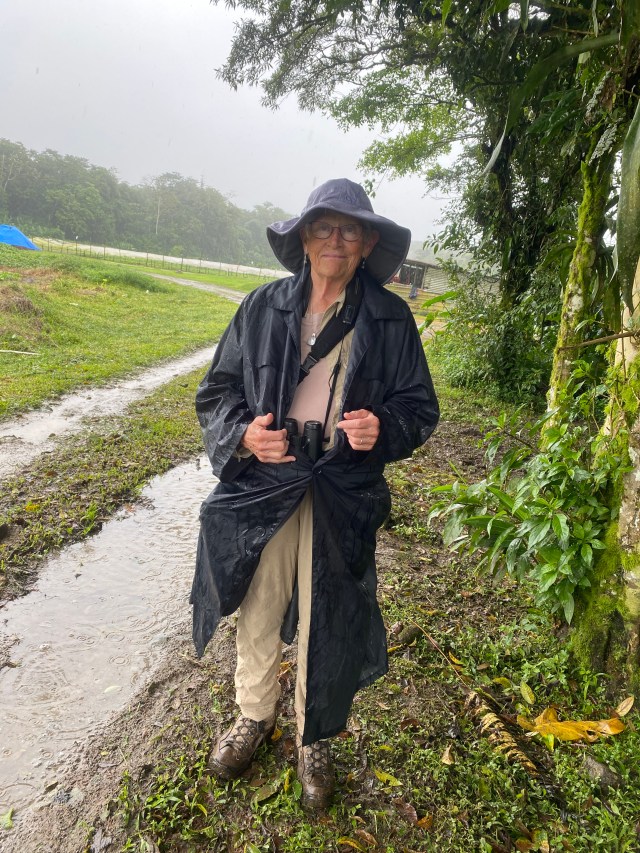
Soaked. January 1, 2025, El Valle de Antón, Panama.

The two things I will most remember about 2025 are the rains and the butterflies. 

I began the year in Panama on a birding trip, where it rained and rained. Typically, it should have been the dry season, but it was abnormally wet. The precipitation was welcomed by Panamanians – recent droughts had taxed the water sources, primarily the Chagres River, which provide water to shuttle container ships through the Canal. It rained, misted, or was overcast virtually the entire time; I estimated we had a sum total of about three hours of sun over the course of the trip. It would have been nice to have more sun, which is required for seeing dragonflies and damselflies. But I soaked up the rain, happily. I’ll always remember the first day of 2025, in the rain, watching a Black-crowned Antpitta, completely oblivious of us or the precipitation, as it hopped in the leaf litter feeding at an army ant swarm. All of us were drenched; none of us complained. 

This was the first of many memorable rains and full-throttle thunderstorms in 2025: Costa Rica in June (an especially theatrical downpour on evening of June 9) and during travels in Mexico – in July in Chihuahua at Basaseachi (thanks to the monsoon rains, Mexico’s second-highest water fall was roaring); in August in Oaxaca in San José del Pacífico (rain and bone-chilling neblina – fog – requiring a fire one night in our cabin) and Pluma Hidalgo (rain and more neblina, particularly enveloping on the evening of August 12, creating what I described as a “hushed silverscape”). And then here at home, in and around Alamos in southern Sonora, we had the best monsoon in recent memory. 

When the year started in Panama, I began to realize how deeply I missed rain. The Southwest United States and adjacent Northwest Mexico are in the 25th year of a megadrought – the driest period in the last 1,225 years. Typically, the monsoon rains fall from late June into September when they can be augmented by autumnal rains produced by Pacific hurricanes moving inland across Sonora. The average annual monsoon rain is 19 to 35 inches. However, those amounts have shrunk dramatically, especially in 2020 and 2021. In 2024 there was virtually no monsoon, and the winter rains, which can boost the annual monsoon rains by a few inches, were nil. We essentially went a year without rain.

The city wells were almost depleted. A years’-long project to pump water from wells in the Mayo River watershed went online just in the nick of time. All around the municipio, wells were running dry and people were frantically drilling more wells. The first significant rain I noted in my calendar was June 25th. There was rain again on June 26th. And on the rains continued and continued. We were almost afraid to celebrate for fear we might jinx it. The biggest rain, approximately 8 inches, fell over about 24 hours on September 4th and 5th, the result of Pacific Hurricane Lorena. The last rain, October 11th to 13th, caused by Pacific tropical storm Raymond, was 3.2 inches. Alamos had the best monsoon in perhaps two decades: 39 inches. 

(The 2025 monsoon pacified the human population of Alamos, but it has produced a false sense of security. One good monsoon does not make up for a quarter-century of drought. The rains provided some superficial relief but have not sufficiently recharged groundwater.) 

The rains did kick plant production into high gear. In turn, the surge of greenery and flowers – diminished for years – provided food, nectar, and cover for butterflies and their caterpillars.  And the butterflies came, by the tens of thousands. There were butterflies everywhere.

Their buoyancy reflected mine. The monsoon, if not the end of our water problems, was such a relief. 

The Yellows started appearing in June, thousands upon thousands, floating in clusters along the highway from Alamos to Navojoa, flickering around bushes and vines. When I was swimming, as I turned my head to take a breath, I saw them silhouetted against the sky. Yellows are intensely yellow, quite a few flash brilliant orange when flying, and many species have elegant tracery of black on the edges of their wings. They are in the family Pieridae, which encompasses about 1,100 mostly tropical species. The Whites are the other large group in the family, so named because they are intensely white. The Yellows and the Whites seem to glow. 

I could not ignore them. I overcame a self-limiting problem I have of thinking I cannot possibly stuff more information in my brain. I mobilized. I started photographing and identifying them. This has been exhilarating. 
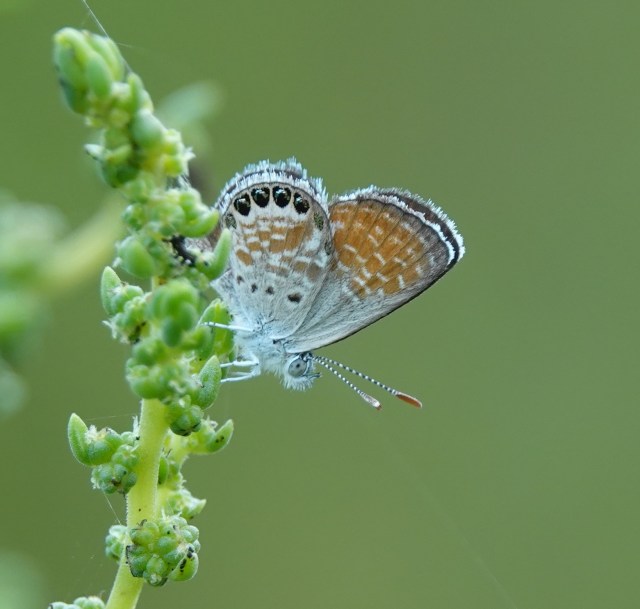
Western Pygmy-Blue, near Etchojoa, Sonora, Mexico. The smallest butterfly in North America,
with a wingspan of 1/2 to 3/4 of an inch.

Besides my spouse, David, who always encourages my attempts to stuff more stuff in my head, I must thank two people: Jeffrey Glassberg, distinguished molecular biologist – he was a pioneer of DNA-fingerprinting – and author of the fabulous field guide Butterflies of Mexico and Central America, and Ricardo Cota, our gardener who planted and nurtured a bed of zinnias, favorite nectar flowers of butterflies. 

I will end the year having photographed 71 species of butterflies. It is a start. 
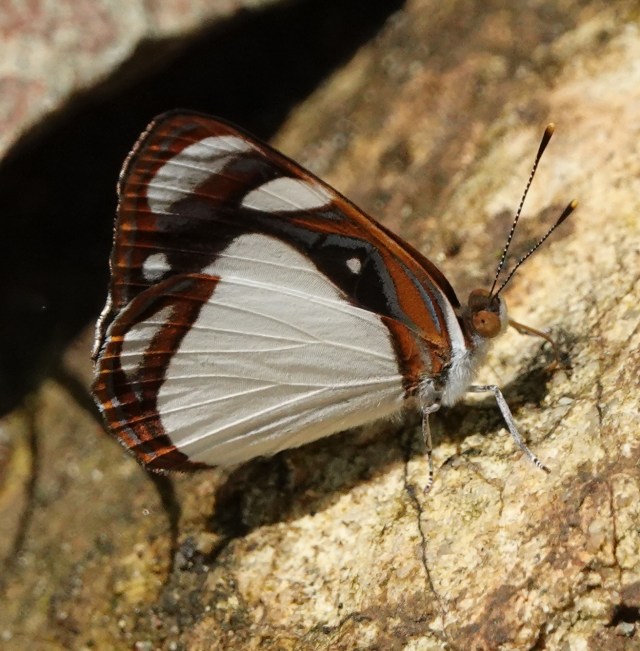
White Sailor, Cascada Arco Iris, Pluma Hidalgo, Oaxaca, Mexico.

During the monsoon and as of the last week of December, Dorantes Longtail, Urbanus dorantes, was, by far, the most common and abundant butterfly in our yard, around town, and in the wilder areas we frequent around Alamos. They were everywhere. I wish I could extrapolate how many. It is a skipper, in the family Hesperiidae. Like the 3,500 or so other species of skippers, Dorantes Longtail is a modest brown, some might say dull, butterfly. One thing that makes the Hesperiidae fun (or frustrating) is the challenge of identifying most of them. It is like solving a puzzle. Some cannot be identified in the field even by experts. But Dorantes Longtail is easy to identify with its long tail and tiny translucent “window panes” in the forewings that glitter when it flies. 
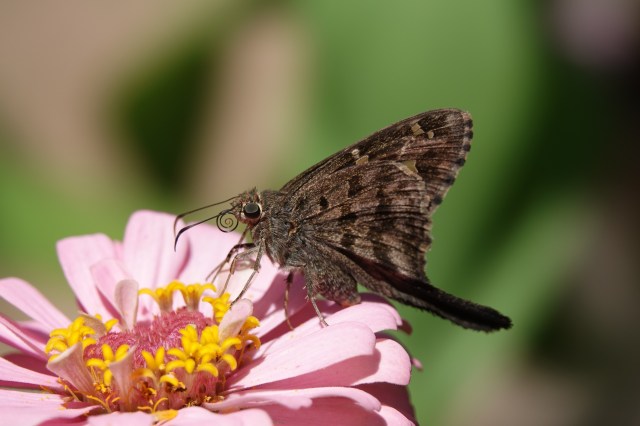
Dorantes Longtail, in our garden, Alamos, Sonora, Mexico.

It is thought that this little skipper is named for the 16th-century Spanish explorer Andrés Dorantes de Carranza, one of four survivors of the Narváez expedition, who after heaving up in 1528 on the shores of current-day Galveston Island, wandered around the desert Southwest for eight years before drifting southward into Mexico across present-day Chihuahua and Sonora, and finally in 1536 to Villa de San Miguel, now Culiacán in Sinaloa. It is not too far-fetched to imagine Dorantes et al. wandering over terrain that in the 1680s became the booming mining town of Alamos, Sonora. 

Dorantes, the explorer, and Dorantes, the butterfly, have caused me to wander, aimlessly it seems, into thoughts of deep time and the evolution of migration in the animal kingdom. Aerial flight began to evolve in insects about 400 million years ago. Butterflies, as a group, began to evolve from nocturnal moth ancestors about 100 million years ago, originating in what we call the Americas and radiating to all corners of the planet except Antarctica.Butterflies own the air. 

Terrestrial bipedal humans began to evolve in Africa a mere 4 million years ago. About 20,000 to 30,000 years ago, just yesterday, relatively speaking, humans began migrating to the Americas – in the opposite direction of butterflies* – mainly by way of the Beringia land bridge. Granted, flight is complicated but looks so graceful and effortless. Excluding examples of a few gifted athletes, there is nothing elegant about bipedalism. Plus, as every aging human knows, one’s feet start to hurt. 

Humans plodded over the earth for millennia. Then, rather rapidly, they invented ways to propel themselves through water and in the air, and to move faster and faster on land. Humans are a restless lot. 

For millions of years, migration in the animal kingdom has been, and still is, obligate – that is, necessary for survival. Animals roam around looking for food (and sex). Food fuels their movement. Facultative migration – optional and flexible – is a recent human behavior (I cannot think of a non-human example). For instance, the European conquest of peoples in the Americas, which kick-started about 500 years ago, was about economic, cultural, racial, and religious hegemony. Various polities are still engaged in these endeavors.  

Facultative migration in humans has evolved to require massive inputs of energy, not to fuel our bodies but our conveyances – beasts of burden, ships, trains, planes, automobiles. Facultative migration entails the use of a lot of carbon-based fuel. Only very recently, and among a very small cohort of humans, has migration become purely facultative, frivolous really, for fun and adventure, certainly not for survival and with no belligerent thought of conquest. David and I fit into this subset of facultative migrants to Mexico. We started coming to Sonora 25 years ago, about the time the drought started. 

Although we will be dead, it is possible that if the drought continues and temperatures continue to rise in this corner of the Americas, humans will be obligated to withdraw. In the meantime, I will sit down, put my feet up, and enjoy the last hours of 2025 remembering the rain and the butterflies. 

*This interesting article references the opposite dispersal patterns of butterflies – migrating from the Americas – versus mammals (including humans) migrating to the Americas. Kawahara, A.Y., Storer, C., Carvalho, A.P.S. et al. A global phylogeny of butterflies reveals their evolutionary history, ancestral hosts and biogeographic origins. Nat Ecol Evol 7, 903–913 (2023). https://doi.org/10.1038/s41559-023-02041-9

Posted in Insecta | Comments Off on The year is ticking down

América and Adal 

Mexican Navy ARM Cuauhtémoc after colliding with the Brooklyn Bridge. Photo from US National Transportation Safety Board Incident Investigation.

On May 17, 2025, the Mexican Navy ship Cuauhtémoc – an elegant tall ship glimmering with lights in the evening twilight – was leaving the South Street Seaport in New York City when a freak accident occurred. For reasons under investigation, perhaps related to mechanical failure, tidal currents in the East River, prevailing winds, and/or human error, the sailing ship thrust quickly in reverse – in the wrong direction – toward the Brooklyn Bridge. Its three masts collided with the span, causing them to snap and topple. 

In keeping with maritime tradition when a sailing vessel is entering or leaving a port, crew members of the Cuauhtémochad climbed the masts and riggings – a ritual called “manning the yards” – to bid New York adios. The ship was on its way to Iceland as part of an eight-month tour of duty for the sailors with plans to visit 22 ports in 15 countries. 

Two of the cadets manning the yards were killed when the ship’s masts hit the bridge.

The Cuauhtémoc is a training vessel for cadets from the Mexican Heroic Naval Military Academy. It is one of four sister ships built for Latin American navies in the shipyards in Balboa, Spain in the early 1980s. Cuauhtémoc’s sisters, also used as training ships, are Colombia’s Gloria, Ecuador’s Guayas, and Venezuela’s Simón Bolívar

The tall ships are the ceremonial pride of their respective navies. The vessels participate in tall ship races and regattas and play an ambassadorial role, sharing their culture and history at ports around the world. This was the 43rd training voyage of Cuauhtémoc. There were 277 people on board, 179 were cadets (although the exact number varies in different accounts). In 2011, the Mexican Navy opened its training tours to women. 

The ship remained docked in New York City for repairs until October 4th when it embarked for its home port in Cozumel. In early November, it continued its training voyage – but with a much-abbreviated itinerary. It will visit only three ports of call in Mexico. 

Cuauhtémoc’s training voyage was intended to commemorate the 200th anniversary of a naval blockade in 1825 led by Pedro Sainz Baranda, one of the founders of the Mexican Navy. It led to the final expulsion of Spanish troops from their last stronghold on Mexican soil at San Juan de Ulúa, a fortress overlooking Veracruz on the Gulf of Mexico. The victory marked the culmination of the Mexico’s long-fought independence from Spain. To underscore the country’s tortuous history with Spain, this year also marks the 500th anniversary of the execution in 1525 of Cuauhtémoc, the last Aztec emperor, by Spanish conquistador Hernán Cortés. 

The cadets who died were América Yamileth Sánchez from Xalapa, Veracruz and Adal Jair Maldonado from San Mateo del Mar, Oaxaca. She was 20. He was 23. 

Flor de la vida – the prime of life – two young cadets on a voyage around the world, standing as it were on top of the world, watching the glittering skyline of New York City, waving at people gathered on the pier. Then in a few freak seconds the theater of their lives went dark. América and Adal, gone. Just like that. Bereft, baffled, heart-broken families, friends, fellow cadets left to question what went wrong. The brief onslaught in their home towns of camera-wielding voyeurs masquerading as the news media. Privacy is hard won in these times. At least in the fishing village of San Mateo del Mar, which is located in the Isthmus of Tehuantepec of Oaxaca where people are known for their standoffishness, the family of Adal seems to have successfully alluded the vultures of media. All the video footage I could find showed the alcade – the mayor – standing on a virtually empty street (a few passersby with their backs turned) speaking on behalf of the family. 

The U.S. National Transportation Safety Board is charged with determining the cause of the accident, who was at fault. https://www.ntsb.gov/investigations/Pages/DCA25MM039.aspx As of this posting, the investigation is “ongoing” – such a vague, stalling, and patronizing word. Of course, the search for cause, should one be found, is all about liability and lawsuits. Finding cause does not rewind the clock, and there’s never solace in an explanation. América and Adal are dead. 

The churning river of time moves swiftly on. And the voracious media rushes off to a never-ending banquet of deaths, maiming, fires, floods, disasters. On November 1, as people all over Mexico were in the midst of celebrating Día de los Muertos – Day of the Dead – an explosion and fire, apparently from a faulty transformer, killed 24 people, including 6 children, in Waldo’s, a grocery store in Hermosillo, Sonora. 

Every so often I pick up Robert Frost. A few months ago I stumbled on his poem “Out, Out—”  about a boy in the flower of life who died in a freak accident. 

… “No one believed. They listened at his heart.
Little – less – nothing! – and that ended it. 
No more to build on there. And they, since they
Were not the dead one, turned to their affairs.” 

Posted in Mexico | 2 Comments

Huicochic, Ode Adventures in the Sierra Madre

This is the view to the south-southeast from the mesa above Huicochic. The farthest range on the horizon comprises the Sierra de Alamos, the Sierra de Aduana, and on the far right the massive rock outcropping Catcharamba. The town of Alamos, where we live, lies at the base of the Sierra de Alamos.

“ode” is an abbreviated term for Odonata, the insect order of dragonflies and damselflies.

We went to Huicochic for the first time on September 1, 2025. On that trip we met Arcelia, who owns a cabaña she rents to tourists, mostly people on the weekends who cruise the backroads in the Sierra in their UTVs, a growing trend in Mexico. Frequently these people are in organized caravans, their vehicles blasting music and decked with flashing LED light-whips. We have a UTV too minus those accoutrements. We told Arcelia we planned to reserve a couple of nights in the near future during the week. 

We returned on September 17 for a two-night stay. Rafa Wong accompanied us on both trips, a wonderful friend and asset in the back country: he is bilingual, he shares our interest in the natural world, and he is at home with rural people (this cannot be said of all urbanized people). The dogs Nina and Dolly came on the second trip. The road from Alamos to Huicochic is unpaved except for a very few places on inclines or across vados (stream crossings, usually dry but variously flowing during monsoon season). These engineering efforts are frequently undermined or destroyed by rain events. The route to Huicochic heads north from Alamos, passing through the rural Sonoran villages of La Higuera, Los Tanques, and Los Camotes, where it turns east, passing through the towering pyramidal tailings of a gypsum mine and by the crumbling, vacant village of Taymuco and its well-kept cemetery, an indication that former citizens or their relatives return every year for Día de los Muertos to paint and tidy up the headstones and adorn them with plastic and living flowers and velas (candles). The road then gently descends to the vado across the Río Taymuco where José Carrasco, a cordial man in his forever-smudge eyeglasses, runs a little store that sells sodas, beer, and lechuguilla, the local hooch made from the native agave. From this point, the road begins to wind and climb, seriously. It loops into the state of Chihuahua, passing through Las Chinacas (population estimate 300), tucked in the cleavage of an arroyo, and takes a turn north. About twenty minutes up the road is the ghost village of La Lobera, its several burned-out, bullet-riddled houses consistent with the report that the occupants were forced out or killed in a narco skirmish about ten years ago. The road comes to a Y, the right fork continuing on to Chinipas, Chihuahua; the left fork turning back into Sonora and terminating in Huicochic.

The community is situated in a broad, flat basin, suitable for settlement and agriculture. The houses are scattered about rather than organized in a grid or along a main thoroughfare. Several streams crisscross this open area, rising and falling with the monsoon rains and creating significant muddy expanses. Mud is a big nuisance in the pueblos throughout Mexico during the monsoon. Municipios (the equivalent of counties in the U.S.), depending on their leaders and budgets, make an effort to pave at least the main streets in rural communities. It hasn’t happened yet in Huicochic. Much of Sonora has been in a prolonged drought with pathetic-to-nonexistent monsoons for a couple of decades, but this year, 2025, parts of Sonora have received rains reminiscent of the old days – i.e., before the upheavals of climate change. People are discernibly happy notwithstanding the mud. 

Distance from Alamos: approximately 45 miles 
Travel time: three and a half hours
Population of Huicochic: estimated 80
Elevational ascent: 384 to 1558 meters  
Biome change: tropical deciduous forest and semiarid thornscrub to oak and pine

We have been wanting to come to Huicochic for several years. There are different species of odes at these higher elevations. We had heard people talk about a nearby waterfall – El Salto – that was supposed to be quite beautiful – but what waterfall isn’t? And of course, we knew it would be cooler in summer up here in the pines. This year David was incentivized by reports from a fellow ode-head (a dragonfly and damselfly enthusiast) of several interesting odes at the waterfall and in an arroyo on the way to Chinipas. 

We went to El Salto on our first visit and headed there immediately on our return visit, even before dropping stuff at our cabaña. The sky was threatening to cloud over – bad for ode-heads (with few exceptions odes fly only in full sun). The road from town quickly ascends a rocky mesa, a jolting experience, then levels out but is no less jolting. From up on the mesa, the vistas to the west and south are stunning. The Sierra de Alamos and the rock monolith Cacharamba are outlined in deep purple on the distance horizon. I am reminded of “Sittin’ on Top of the World,” the wonderful feigning-good-riddance love song. Certainly the best remedy for lost love is a long view from a high place. 

The approach to the waterfall is not the typical one. The road stops at the verge of the falls where the water pours through a slot into the arroyo below. A rickety barb-wired fence along a portion of the rim provides neither protection nor solace. (On this second visit, I made it clear the dogs would stay in the UTV.)  

On our first visit a man cordial enough appeared out of nowhere on a mule with two dogs and took David and Rafa down the steep, slippery trail to the bottom of the falls. He took $150 pesos, the $50-per-person fee posted on a sign at the entrance. On our second visit David and Rafa engaged a man, his wife, and grown son who were working on a nearby cabaña. I had lingered across the stream. They seemed quite friendly. When I joined them, I handed the father $150 pesos. Rafa said this family claimed the fellow we met on our first visit was an opportunist. There appears to be competing rivalries between two adjoining ejidos about who manages the attraction and benefits from it. 

It started to sprinkle, then rain in earnest as we were returning to Huicochic. We got back about 3 p.m., or thereabouts. Here near the Sonora-Chihuahua state line, time equivocates. Our digital devices mostly were picking up Chihuahua time, which is an hour ahead of Sonora time. My analog wristwatch was on Sonora time. As we were starting to unpack the vehicle in the rain, Arcelia arrived under her umbrella to welcome us and open up the cabaña. She is charming, and the cabin simple and inviting. (We paid $4,000 pesos for two nights.) Before she left, Rafa had arranged for her to make tortillas for us. The cabin is perched on a hill overlooking the town with a porch for sitting and watching the creeks rise and fall and townspeople and dogs come and go. 

A stairway of massive rocks, perhaps hauled from a local quarry, leads up to the cabin. Each riser is a significantly different height, posing a danger to first-time climbers carrying baggage who grew up in a culture where equal riser height is a birthright. Granted, rough-hewn rock steps are unlikely to have precisely equal dimensions, but the unequal riser is a near-universal aspect of life in Mexico. While there are countless bogus stereotypes about Mexicans (don’t get me started on that topic), a quantifiable fact is a general indifference to steps and stairs with equal risers. I don’t know what this signifies, if anything, and this particular cultural character of uneven stair climbing is likely to fade away as Mexico grows ever more like the United States. In any case, it has taken me years to approach a stairway in Mexico with skepticism – and sometimes I still forget. 

A steady rain, not fierce, sometimes intermittent, continued. David and I took naps. Rafa went to pick up our tortillas and visit with Arcelia. Later, David and Rafa drove across the stream, while it was still crossable, to the only store in town and for miles around. Rafa had visited a few years previous and been touched by the elderly woman who owned it, a revered presence in Huicochic. Unfortunately, she died a few months ago. Her daughter Elsa has taken charge of the store. They returned with cookies and lechuguilla ($100 pesos for 600 milliliters in a plastic Topo Chico bottle). 

The view of Huicochic from our porch.

We entered a state of late-afternoon lethargy. We sat on the porch looking out on the town in the light rain, me drinking beer, the menfolk sipping lechuguilla. People and their dogs came and went, picking their way across the series of streams, on foot, on horse or mule, a few in pickup trucks. At once an ordinary and splendid parade. The sun set. We went inside. Rafa had brought along a tasty dish of calabacitas, corn, and queso. We sat around the kitchen table eating dinner in the dim light sitting on wood and metal chairs of such mass I can barely lift them. (Hefty chairs are another oddity of Mexico, especially in rural areas.) We retired to our bedrooms. Nina slept with Rafa. 

On Thursday we headed out around 7 a.m. on the road to Chinipas to find the ode arroyo the location of which David had mapped out. I can’t in truth say I enjoyed every aspect of this excursion. There are times, and this was one, when the silence and vastness and chasms of the Sierra Madre unnerve me. I want to see these places while I can. I don’t have to pretend I love the experience in the moment. For the vistas I have no words. Don Angel Esquer, our now retired 93-year-old gardener, used to travel this country. When we visited him after our trip, he told us of riding mules to Chinipas on a narrow trail through the pines that skirted around boulders and perched on the edges of shear drops, and when oncoming travelers encountered each other in a tight spot, one party had to back up their mules to let the other group pass. Today, the road – by comparison to several decades ago and considering the enduring remoteness of this part of the world – is excellent. It still perches on abysses. There are no other engineering options. At one particularly spectacular vista point, we could see through gaps in a layer of clouds, the town of Chinipas and the brown, meandering Río Chinipas far below and off in the distance. As we descended into the valley, the day became warmer, the sun more intense. We arrived at the “turn off” a little before 10 a.m., which was nothing more than a gap in the scraggly bushes. This is the old, abandoned road to Chinipas. 

When David is on an ode quest, he transforms into a person who early on I scarcely recognized – seemingly oblivious to everything around him but his objective. Now, I know this is David, the Ode-Head. Off he went vanishing down the road, Rafa and the dogs following. I quickly realized the combination of steep drop offs, blasting sun, and a rapidly descending trail comprised of scree was not for me – or my dogs. I grabbed Dolly – Nina was sticking with David – and we clambered up and back to the vehicle where we crowded into patches of what shade there was and waited in the breezeless heat for David, Rafa, and Nina to return. Dolly would have preferred to be with her pack, romping on the precipices with Nina, but I was having none of that. Around noon, my threesome returned, exhausted but triumphant. They had seen and photographed, among other odes, a Sierra Madre Sylph (Macrothemis ultima) and a mystery Sanddragon, in the genus Progomphus. David photographed this same Sanddragon at the Taymuco vado a few years ago; he is consulting with odonatologists about its status as a new species.

Dolly and I waiting in a sliver of shade for David and Rafa and Nina to return.

We retraced our route to Huicochic, no less impressed with the vistas, and stopping at a beautiful seep where we saw multiple Black-and-white Damsels (Apanisagrion lais), delicate damselflies hovering and perching in the dappled light. Back in Huicochic, we went to the one and only store to visit with the one and only Elsa. The store is a timepiece that has stopped ticking, fixed in the early 1900s, and Elsa has replaced her mother as a force. She is petite, with a beautiful smile, of indefinite age (gray hair with a purple tint), and agile (she was weeding her garden while talking with us). She was out front chatting with a customer, a lean and leathery fellow. He was about to head out to Las Chinacas on his mule laden with bags of commodities he had purchased. Before departing, he proffered nips from his plastic bottle of lechuguilla, a timeless courtesy in the backcountry of the Sierra Madre. Rafa needed a power cable with a special connector to charge a camera battery. Elsa had a surprising array of options in her inventory, and Rafa found one that worked. The 21st-century necessity and craving for connectivity has infiltrated every nook and cranny of the world. 

On our last evening in Huicochic, we repeated our porch sit, had chicken jambalaya for dinner, went to bed. Thunder and lightning and rain pounding on the metal roof jarred us awake around 10 p.m. Nina ran and leapt into bed with Rafa. Dolly burrowed between us. The storm lasted about 30 minutes. I felt like we were inside the kettledrum during Beethoven’s Fifth Symphony. It was the crescendo of our trip to Huicochic. 

Posted in Mexico | Comments Off on Huicochic, Ode Adventures in the Sierra Madre

Eggs

Cuko’s eggs are the only product I buy of which I know the source and the supply chain. When I need them, and sometimes when I don’t (I have trouble turning down his eggs), he delivers them to my door in a plastic pail, driving to my house in his old robin’s-egg-blue pickup. Cuko lives half a mile away.   

I concede there is one unknown in the supply chain. I have not yet asked Cuko where and how he acquires chicken feed for his hens.   

I pay him $150 pesos – roughly $8 US dollars – for 30 eggs. That’s about $50 pesos more than the price of store-bought eggs here in Alamos, Sonora – significantly more than a conscientious Mexican shopper is able or willing to pay. The only way Cuko’s business model works is to have a few clients with a desire for his product and the capacity to pay his price. That would be me, a retired pensioner from the United States who used to raise her own chickens and places a high value on yard eggs. 

Of course, Cuko doesn’t have a business model. He just has more eggs than he and his family can eat. 

He is a carpenter, semi-retired. He may have done other things in the past. It is customary for Mexican men to have multiple careers over a lifetime, often simultaneously. We met him in 2021 after seeing a sign on his fence se vende catres – cots for sale – and, when we decided we were in the market for a couple, we knocked on his door. A well-made cot is like a cradle; it promotes  sleep. In rural and small-town Mexico, during sweltering summers, people spend the night on their portals on cots to escape the heat indoors. Cuko’s are well made. 

When we were transacting the order for the cots, he showed me his woodshop in the back of his house and facing the backyard. That’s when I discovered he had chickens. He has built a large airy coop for them, and he clips their wings so they can range free in his yard. High walls prevent the entry of neighbor dogs, the most common predators of chickens. Cuko told me he raises chickens because (stating the obvious) their eggs are vastly superior to factory eggs. I told him if he ever had any extra, I would buy them. 

I consider this conversation the beginning of our producer-client relationship, but there was considerable market friction before I ever purchased an egg – a four-year delay to be precise. In the meantime, we kept up with Cuko, waving and exchanging pleasantries when we would pass each other on the street (Alamos is a small and friendly town). And we did some business with him. In 2023, as part of moving full-time to Alamos, we hired him to do some finish carpentry in our dining room. I daydream about his building a coop for me, so I can have my own chickens. That’s never going to happen. 

Time passed. I still had a demand; he just didn’t have a supply. Until he did. Cuko has a rooster (or two), which means over time his hens were not only producing eggs but also chicks, a percentage of which grew up to be hens that after six months or so would start laying their own eggs. 

On February 10, 2025, Cuko texted me to ask if I wanted to buy some eggs. He had an oversupply. I was thrilled. So for five months, I have been buying his eggs.

It’s not a perfectly efficient market arrangement for either of us. I run out of eggs before I remember to tell him I need more. We text back and forth about a delivery time, creating more friction in our supply-demand equation. Or I buy more than I need (as I mentioned, I can’t resist). (I share them with friends.) Or he’s stuck with eggs, when we are traveling, which is fairly frequent. I have tried, not very successfully, to hook him up with other buyers. 

Then, to borrow a major economic theme from economist John Maynard Keynes, there is uncertainty. Because no one, including Cuko and I, can predict what will happen in the future, our cozy egg arrangement could change, abruptly or slowly, or vanish in a twinkling. Seasonally, hens lay fewer eggs. Or they reach an age where they stop producing (at which point they typically go in the stew pot). Or a dog or other predator figures out how get into Cuko’s compound. Or an asteroid hits the planet. 

There was some perplexing uncertainty recently. For about ten days, Cuko did not respond to my text messages. I was puzzled but distracted by other stuff. Then I started to ruminate. Is Cuko OK, I wondered. I stopped by his house, shouted first at the fence, then I walked up on the porch to knock on the door, then I started to wonder if that was a wise move, since I knew Cuko had a dog whose comportment I was not familiar with, so I retreated to the other side of the fence just as the dog came tearing around the corner and flung himself snarling at the gate I had just closed. While I was trying to cajole the dog, Cuko walked out on his porch. I explained I was worried that I hadn’t heard from him, and he said, “Se me perdió mi celular” – my cellphone got lost – a wonderful reflexive verbal formation that places the blame on the phone, not on the person who lost it. 

I asked him if he had some eggs. Yes, he did, but I had no money. I went home, and he delivered them to my house twenty minutes later. 

My egg business with Cuko bears no resemblance to how markets function in much of the world. I am not romancing my egg story as a general economic model or alternative to global production and distribution. There are never going to be cottage industries making smart phones or cars. I have grown weary of the literary genre extolling bygone sociocultural models – the loss of pastoralism is an especially popular theme among writers with a seductive knack for lyricism. The most recent book I put down unfinished is Anima: a Wild Pastoral, by Kapka Kassabova.

In my role as egg buyer, I simply enjoy being embedded in the life of a small Mexican town, a tiny cog in its economic engine. I am not particularly interested in market convenience or efficiency. The clunkiness of buying eggs from Cuko is fine with me. Well, I could do without a growling dog in the supply chain. 

Posted in Mexico | Comments Off on Eggs

Tachinidae

If I believed in transmigration, I would like to come back as a dipteran, specifically a tachinid fly. I have spent most of this life trying to be nice. For a change, I’d enjoy being armored and prickly. 

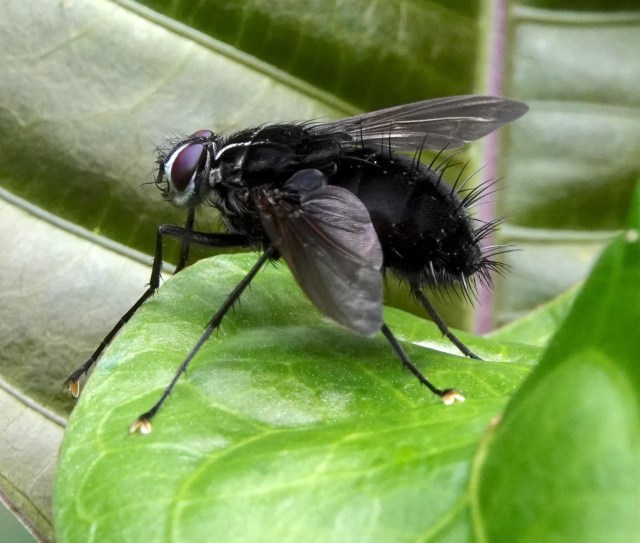
This is a photo of a prickly fly I took on September 5, 2024, in Tatamá National Natural Park in Colombia. I am fairly confident is a tachinid. One clue to its identity are the spiky bristles on its rear end. The definitive characteristic of all tachinids, not visible in this photo, is the presence of a subscutellum, a flaplike convex bulge below the scutellum, which is the shieldlike plate behind the head. (Until recently, I did not know what a scutellum was, much less a subscutellum.) 

There are currently something like 10,000 named species in the family Tachinidae. Who knows how many remain undiscovered and undescribed. Not many people in the world have the knowledge and patience to i.d. tachinids. Assuming my fly is a tachinid, the odds of my knowing which one are slim. 

Tachinids inhabit all zoogeographical regions, with the highest diversity – around 3,000 species – occurring in the Neotropics. They come in a variety of sizes, shapes, colors, and markings (rings, spots, zigzags), and they have evolved an array of strategies for survival and reproduction. Virtually all known species share one distinct behavior: they are parasitoids. Unlike true parasites, such as the mites living in our eyelashes, that feed or reproduce on a host without causing significant problems, parasitoids ultimately kill their hosts, usually slowly. 

Humans (of which I am one) cannot resist anthropomorphizing other living creatures. The entertainment and movie-making industries have made a killing, so to speak, monetizing this habit of ours, turning insects especially, but also reptiles and mammals, into humanoid monsters or heroes. 

The Alien movie franchise has made billions of dollars anthropomorphizing the reproductive strategy of parasitoidism, starting with the 1979 Alien in which a human crew of a spaceship serve as the hosts of a Xenomorph, a gruesome extraterrestrial insect-like parasitoid creature. While the creators of the Xenomorph understood the basic biological details of parasitoidism, I suspect most of the millions of Alien viewers have no idea of, or curiosity about, parasitoidism in the real world. 

Like the traits and behaviors of all living things, parasitoidism would not have evolved if it weren’t efficacious. It is not just a successful reproductive strategy of tachinid flies – about 10 percent of all insect species are parasitoids. Parasitoidism, along with all eat-and-be-eaten strategies, also serves the vital function of maintaining ecosystem equilibrium. Imagine, for example, all the mountains of putrefying carrion and garbage that would accumulate on Earth without the recycling services of certain species of fly larvae (known to most people as “maggots”). As for tachinids, their larvae help keep in check the populations of their hosts, many of them plant-eating caterpillars that are agricultural pests. 

Someone should make a sci-fi movie about a world without flies.

Parasitoidism is not a simple one-scheme-fits-all process. In his book Flies: The Natural History and Diversity of Diptera, entomologist Stephen A. Marshall summarizes some of the strategies female tachinid flies use for getting their progeny inside their host: “Most tachinids incubate their eggs so that they are ready to hatch immediately upon oviposition, spending little or no time exposed as a vulnerable unhatched egg. Some female tachinids use a piercing ovipositor to inject their eggs, releasing them safely inside the host. Others lay eggs that hatch immediately into active larvae, while females in one group lay thousands of minute eggs that hatch only when ingested by a host.” 

The entrenched larvae proceed to feed on the living host, emerging when it is dying or dead. They have evolved numerous ways to survive inside another living creature. One obvious challenge is breathing. As Marshall recounts, some larvae develop a funnel-like apparatus to draw air from outside the host. Others tap into the host’s internal breathing apparatus. This strategy, he writes, is “analogous to a parasitoid sticking a breathing tube into your lung while feeding on your other internal organs.” 

For the curious, there are numerous YouTube videos on parasitoidism in vivo. 

In their delightful article One Hundred Years of Parasitoids, Apostolos Kapranas and Ian C.W. Hardy note that the strategy of parasitism was first described about a thousand years ago by Chinese entomologist Lu Dian (1042-1102) based on observations of the life cycle of tachinid flies. But it wasn’t until fairly recently that Swedo-Finnish entomologist Odo Reuter, in his 1913 book on insect habits and life histories, devised the term “parasitoid” to explicitly distinguish species of insects in which the larvae ultimately kill their hosts, as opposed to true parasitic insects in which both larval and adult stages utilize a host without killing it. Parasitoids have long been used as biological agents to control agricultural pests, even, as the authors point out, before they were so named by Reuter. 

Reuter, who died in 1913 at the age of 63, was a poet as well as an indefatigable entomologist. His obituary pointed to “his keen eye for minute, but constant, up to that time overlooked characters” in his studies of insect morphology. It went on to note, “Reuter was possessed of an extraordinary working power. For the last five years he was almost unable to walk and totally blind, but this influenced his energy in no way. . . . His blindness and other sufferings he bore with great patience, and in one of his last poems he wrote, 

‘The Power wise that took the light from me 
Well knew that I had seen enough indeed.’”

In a fitting coda, Kapranas and Hardy wrote, “In defining the characteristics of parasitoids that mark them as distinct from predators and from parasites, Reuter, though blind, was far-sighted.”  

Reference
Kapranas, A. & Hardy, I.C. (2014) One hundred years of parasitoids Biocontrol New and Information 35(1), Article 1N-4N. 

Posted in West Saari Road | Tagged | Comments Off on Tachinidae