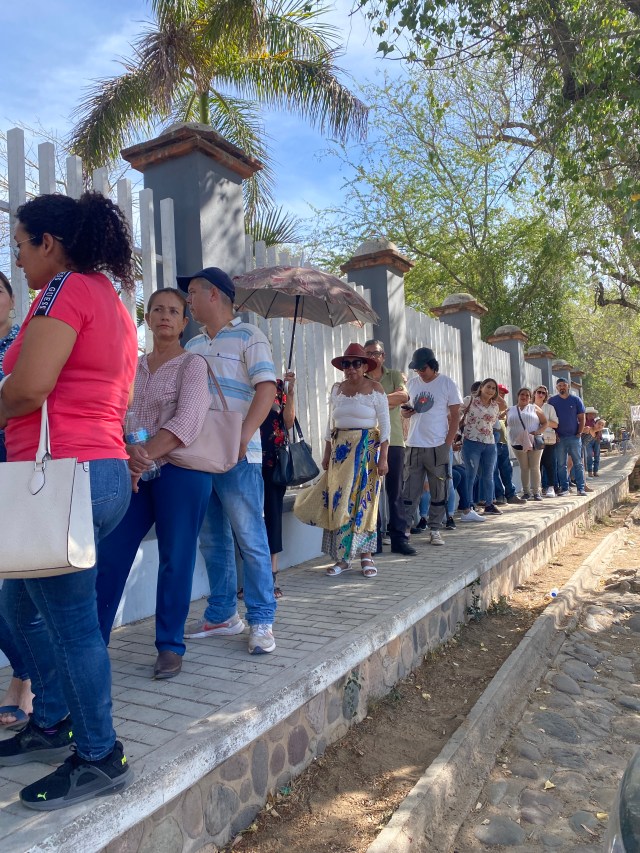
June 2, a Sunday, was election day in Mexico. It was also the quietest day I can recall in Alamos, Sonora, where we live. Ordinarily, Sunday is hopping with tourists (our town is a popular weekend destination) and with locals out and about shopping and relaxing (Sunday is the only free day most Mexicans have off work). The classic tip-off that it’s Sunday in Álamos are the scattered congregations of men in white cowboy hats, jeans, and boots standing around the tailgates of pickups drinking beer. On my comings and goings on June 2, I did not see any of these congregants taking their communion. It seemed to me that people had one destination in mind – their specified casillas, polling places.
A significant contributor to the peace and quiet is the authority vested in the 32 states of Mexico to ban or restrict the sale and consumption of alcohol the day before and the day of elections. Most states do so. It’s called la ley seca – the dry law – and it just makes life and election day simpler and saner. In addition, political parties cannot campaign for several days before elections, and they absolutely cannot gather with their paraphernalia outside the casillas on election day.
An American has to wonder. Why are US federal elections not held on Saturday or Sunday when most voters are off work? Why don’t we restrict campaigning in the days leading up to elections? Why don’t we ban the gathering of increasingly rowdy political party operatives at polling places?
For a number of reasons, the June 2 election was the largest in the history of Mexico. In addition to the presidential election (which occurs every six years), there was an unprecedented number of races around the country – all 128 senators, all 500 members of the chamber of deputies, nine gubernatorial candidates, and more than 19,000 local elections. Also more and more Mexicans living abroad have been voting since 2006, when the National Electoral Institute (INE) granted these citizens the right to vote in presidential elections. They have the option to vote online or to mail in their ballots, and this year, for the first time, Mexicans aboard could vote in person at Mexican consulates around the world. In major US cities the lines were long, very long.
And then there was the fact – and motivation for many voters – that Mexicans would elect the first woman president in their history. Two women and one man were on the ballot (he and his party never got traction). As the polls predicted, Claudia Sheinbaum, of the Morena party and the protégé of the current controversial president AMLO – Andrés Manuel López Obrador – won by a landslide.
An American has to wonder. When will the US elect a woman president?
I am not going to pretend I do not know this: the electoral process in Mexico is not safe for candidates running for local offices in areas of cartel lawlessness who challenge these barbarians or cannot be bought off or otherwise intimidated by them. Millions of Mexicans, and thousands of local candidates, are not under this menace – something the US media fails to explain to American readers – but still that does not mitigate the fact that 37 local candidates across Mexico were assassinated while campaigning this year. In 2021, for the midterm elections, 36 candidates were assassinated. So this bloody cartel mayhem is not an anomaly but a norm. It is far and away the biggest trauma and problem facing Sheinbaum and the Mexican people. Just as domestic gun violence and mass shootings are America’s biggest nightmare.
It is hard to put this havoc aside. But I will for a day. I will never forget June 2. It was serene in my village, and I got to observe the greatest privilege of my species – the right to stand peacefully in line and vote.
Two main sources:
 saaribampo
You must be logged in to post a comment.