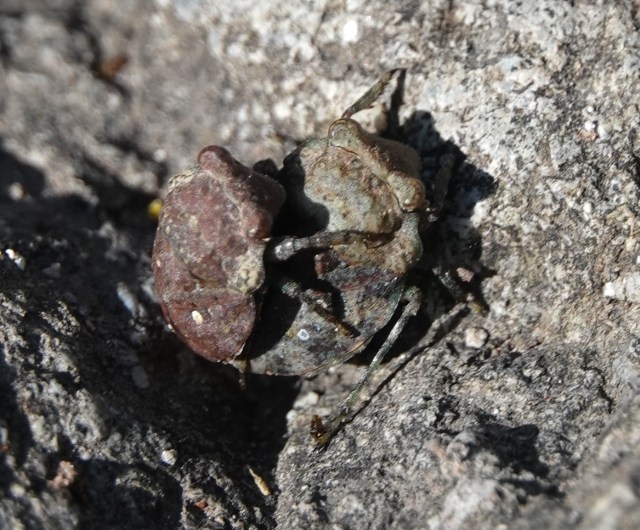
On August 28, 2024, while looking for odonates at stream crossings in El Arroyo Taymuco, I happened to be staring down at a boulder I was about to crawl over when I saw something tiny teetering in a crack in the surface of the rock. “What the heck?” I thought. It looked like a chip off the old boulder – the same speckled coloration – except it was alive and moving, sort of. I nudged it. It lurched. I figured it must be some sort of insect, even though I couldn’t make out any distinct features. I photographed it. Back home, at my computer, when I zoomed in on the image, “it” was not one, but two bugs piggy-back presumably copulating. They looked like tiny frogs, smaller than a dime.
These warty creatures are distinctive enough that even a novice can identify them to family with a fair degree of certainly – not often the case with many thousands of insects. With the help of Stephen A. Marshall (Insects: Their Natural History and Diversity), Stephen Cresswell (Insects of Latin America: A Photographic Guide), and my husband, David Smith (who has encountered these bugs before), I was able to put a name to them: toad bugs in the family Gelastocoridae (order Hemiptera). I will even be so bold to say they are probably in the genus Gelastocoris.
It is a small family, as insects go, with about 100 species worldwide, divided into two genera, Gelastocoris and Nerthra. Not much is known about the life histories and behavior of individual species, especially in the wild. In the early 1990s, Lara N. Brown and J. E. McPherson, entomologists in Illinois, collected individuals of the widespread toad bug, Gelastocoris oculatus oculatus, and reared them in a laboratory. Their findings published in 1994 (see citation below) make for interesting reading. I noted with glee that they frequently observed their specimens “riding and copulating” just like my wild ones.
Toad bugs are not easy to study in their habitats. They are mostly secretive, cryptic, and most species dwell in the tropics, which are still in many places remote and difficult to access with hot climates. Nerthra species seem to be mostly nocturnal, making them especially challenging to find. It was thought that toad bugs were strictly riparian, living and breeding in the sandy, muddy, rocky edges along streams and ponds, but toad bugs in the tropics have been observed far from water in litter of vegetation – rotting logs, under banana leaves, etc.
Toad bugs do hop, a mode of moving that is also useful when feeding. They are mighty little predators, with specially adapted raptorial front legs for pouncing on and grasping prey (other insects). Like all species in the order Hemiptera, toad bugs have piercing-sucking mouth parts for consuming their prey.
In 1955, Edward L. Todd (citation below) published a taxonomic revision of the toad bug family that apparently has not been superseded by more recent molecular-based taxonomic assessments. I say “apparently” because in the small Mexican town where we live I am limited by what I can dig up on internet searches. What delighted me about Todd’s publication was coming across, among the listings of all the museum specimens he examined, a number of specimens of four species of toad bugs collected by Howard Scott Gentry on the Río Mayo and around Alamos, Sonora, where we live and wander.
Gentry (1903-2005) is a legend among the clan of naturalists who have an interest in the Tropical Deciduous Forest of Sonora and the surrounding Sonoran Desert. Starting in 1933, he spent twenty years roaming Northwestern Mexico – when it was really wild – searching for and collecting plants. As well as a botanist and ethnobotanist, he had wide-ranging interests and collected, shared, and sold specimens of other organisms besides plants. Like toad bugs. Gentry’s Rio Mayo Plants (University of Arizona Press, 1998) is a posthumously updated version of his classic work on Sonoran-Chihuahuan botany.
I have no doubt that I’ve overlooked toad bugs when walking along or wading in streams here in Mexico. Now that I have a search image, I do hope to stumble on more.
Lara N. Brown and J. E. McPherson “Life History and Laboratory Rearing of Gelastocoris oculatus oculaturs (Hemiptera: Gelastocoridae) with Descriptions of Immature Stages” (Proceedings of the Entomological Society of Washington 96(3) 1994, 516-526).
Edward L. Todd, “A Taxonomic Revision of the Family Gelastocoridae (Hemiptera)” (University of Kansas Science Bulletin, October 15, 1955 vol 37, no. 11, 277-475).
 saaribampo
You must be logged in to post a comment.