
This cloud was hovering over the Sierra de Alamos in the dawn light when I walked onto our portal at 5:30 a.m. on September 16, 2024. It was a peach and silver flying saucer. It seemed to glow. It was calming. I climbed the stairs up to our roof and took some photos.
The name for this cloud is lenticularis. It is a type of cloud that forms most often on the lee (downwind) side of hills and mountains in persistent standing waves of invisible air. It is a cloud that because of its ethereal permanence calls attention to itself.
I climbed down from the roof, retrieved my cup of coffee I had left on the portal, and went about my day.
People around here know I watch clouds. Over the morning two friends, Elly and Rafa, sent me photos of the same cloud. It had changed from shadowy pastel to brilliant white. Clouds are mirrors of the light that shines on them. Its shape had change, too – my birdwatching friend Rafa called it a wing cloud – but it was in the same place, silently hovering over the flank of the mountain and over our town of Alamos. Its presence indicated that the invisible waves of air were still steadily coursing over the crest of the sierra.

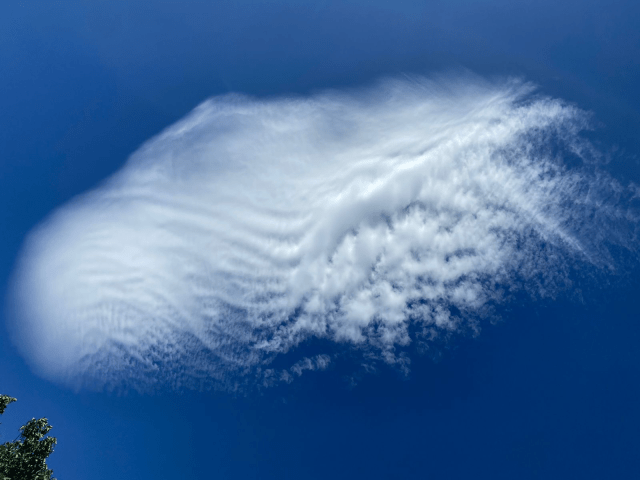
Around 11:30 I went outside to hang up some clothes. The cloud had diminished in size but was still there, hovering, silent.
By now the cloud had hovered in place for at least six hours. I went inside to our kitchen and a few minutes later looked out the window. The lenticularis had extinguished, or rather evolved, into a lacy patch of cloud called lacunosus. This formation appears when pockets of cold air sink through a cloud layer, creating a spiderweb-like cloud that, unlike lenticularis, is fleeting. It lasts for a few minutes to seconds. I ran to get my cellphone but the lacunosus had vanished. (I am still kicking myself for missing this one.)
Later, I started to wonder if other folks in town, besides my friends Elly and Rafa, had noticed the hovering lenticularis. It is such a gorgeous and eye-catching cloud – plus I knew there would be a lot of people outside. September 16th is Mexican Independence Day – a very big day all across the country. Alamos, along with every city and town in Mexico, has a big parade. Some of the parade goers must have looked up and noticed.
So I uploaded my early-morning image and Elly’s later photo on Mitotech Alamos Informa, the community Facebook page, and asked if anyone had seen the cloud or a variation of it. To my surprise, more than 200 people responded, and quite a few posted photos and videos. What can I say? I was thrilled that so many of my fellow citizens in Alamos, Sonora had looked up and marveled at the lenticularis we all shared on Día de Independencia.

It was one of many photos taken by people in Alamos and posted on the community Facebook page.
 saaribampo
So my dear Suzanne, are those Poplar trees
Hi Brent. You mean….palm trees? Hope all is well.
As I remember, alamo means poplar trees so I figure that the town name came from those trees at the time of settlement, hence my question about the trees in the background.
Ah, now I get it. Yes Alamo/Alamos is Spanish name for cottonwood tree(s), a kind of poplar. Cottonwoods grow along streams, rivers. There used to be more cottonwoods in Alamos — many cut down or have died — but there are still some along the major arroyos (dry) in town. None of the trees in the cloud photos are cottonwoods.