If I believed in transmigration, I would like to come back as a dipteran, specifically a tachinid fly. I have spent most of this life trying to be nice. For a change, I’d enjoy being armored and prickly.
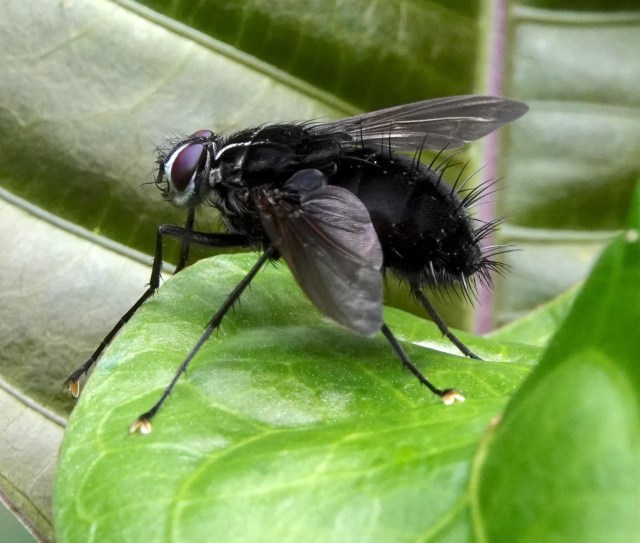
This is a photo of a prickly fly I took on September 5, 2024, in Tatamá National Natural Park in Colombia. I am fairly confident is a tachinid. One clue to its identity are the spiky bristles on its rear end. The definitive characteristic of all tachinids, not visible in this photo, is the presence of a subscutellum, a flaplike convex bulge below the scutellum, which is the shieldlike plate behind the head. (Until recently, I did not know what a scutellum was, much less a subscutellum.)
There are currently something like 10,000 named species in the family Tachinidae. Who knows how many remain undiscovered and undescribed. Not many people in the world have the knowledge and patience to i.d. tachinids. Assuming my fly is a tachinid, the odds of my knowing which one are slim.
Tachinids inhabit all zoogeographical regions, with the highest diversity – around 3,000 species – occurring in the Neotropics. They come in a variety of sizes, shapes, colors, and markings (rings, spots, zigzags), and they have evolved an array of strategies for survival and reproduction. Virtually all known species share one distinct behavior: they are parasitoids. Unlike true parasites, such as the mites living in our eyelashes, that feed or reproduce on a host without causing significant problems, parasitoids ultimately kill their hosts, usually slowly.
Humans (of which I am one) cannot resist anthropomorphizing other living creatures. The entertainment and movie-making industries have made a killing, so to speak, monetizing this habit of ours, turning insects especially, but also reptiles and mammals, into humanoid monsters or heroes.
The Alien movie franchise has made billions of dollars anthropomorphizing the reproductive strategy of parasitoidism, starting with the 1979 Alien in which a human crew of a spaceship serve as the hosts of a Xenomorph, a gruesome extraterrestrial insect-like parasitoid creature. While the creators of the Xenomorph understood the basic biological details of parasitoidism, I suspect most of the millions of Alien viewers have no idea of, or curiosity about, parasitoidism in the real world.
Like the traits and behaviors of all living things, parasitoidism would not have evolved if it weren’t efficacious. It is not just a successful reproductive strategy of tachinid flies – about 10 percent of all insect species are parasitoids. Parasitoidism, along with all eat-and-be-eaten strategies, also serves the vital function of maintaining ecosystem equilibrium. Imagine, for example, all the mountains of putrefying carrion and garbage that would accumulate on Earth without the recycling services of certain species of fly larvae (known to most people as “maggots”). As for tachinids, their larvae help keep in check the populations of their hosts, many of them plant-eating caterpillars that are agricultural pests.
Someone should make a sci-fi movie about a world without flies.
Parasitoidism is not a simple one-scheme-fits-all process. In his book Flies: The Natural History and Diversity of Diptera, entomologist Stephen A. Marshall summarizes some of the strategies female tachinid flies use for getting their progeny inside their host: “Most tachinids incubate their eggs so that they are ready to hatch immediately upon oviposition, spending little or no time exposed as a vulnerable unhatched egg. Some female tachinids use a piercing ovipositor to inject their eggs, releasing them safely inside the host. Others lay eggs that hatch immediately into active larvae, while females in one group lay thousands of minute eggs that hatch only when ingested by a host.”
The entrenched larvae proceed to feed on the living host, emerging when it is dying or dead. They have evolved numerous ways to survive inside another living creature. One obvious challenge is breathing. As Marshall recounts, some larvae develop a funnel-like apparatus to draw air from outside the host. Others tap into the host’s internal breathing apparatus. This strategy, he writes, is “analogous to a parasitoid sticking a breathing tube into your lung while feeding on your other internal organs.”
For the curious, there are numerous YouTube videos on parasitoidism in vivo.
In their delightful article One Hundred Years of Parasitoids, Apostolos Kapranas and Ian C.W. Hardy note that the strategy of parasitism was first described about a thousand years ago by Chinese entomologist Lu Dian (1042-1102) based on observations of the life cycle of tachinid flies. But it wasn’t until fairly recently that Swedo-Finnish entomologist Odo Reuter, in his 1913 book on insect habits and life histories, devised the term “parasitoid” to explicitly distinguish species of insects in which the larvae ultimately kill their hosts, as opposed to true parasitic insects in which both larval and adult stages utilize a host without killing it. Parasitoids have long been used as biological agents to control agricultural pests, even, as the authors point out, before they were so named by Reuter.
Reuter, who died in 1913 at the age of 63, was a poet as well as an indefatigable entomologist. His obituary pointed to “his keen eye for minute, but constant, up to that time overlooked characters” in his studies of insect morphology. It went on to note, “Reuter was possessed of an extraordinary working power. For the last five years he was almost unable to walk and totally blind, but this influenced his energy in no way. . . . His blindness and other sufferings he bore with great patience, and in one of his last poems he wrote,
‘The Power wise that took the light from me
Well knew that I had seen enough indeed.’”
In a fitting coda, Kapranas and Hardy wrote, “In defining the characteristics of parasitoids that mark them as distinct from predators and from parasites, Reuter, though blind, was far-sighted.”
Reference
Kapranas, A. & Hardy, I.C. (2014) One hundred years of parasitoids Biocontrol New and Information 35(1), Article 1N-4N.
 saaribampo
You must be logged in to post a comment.