
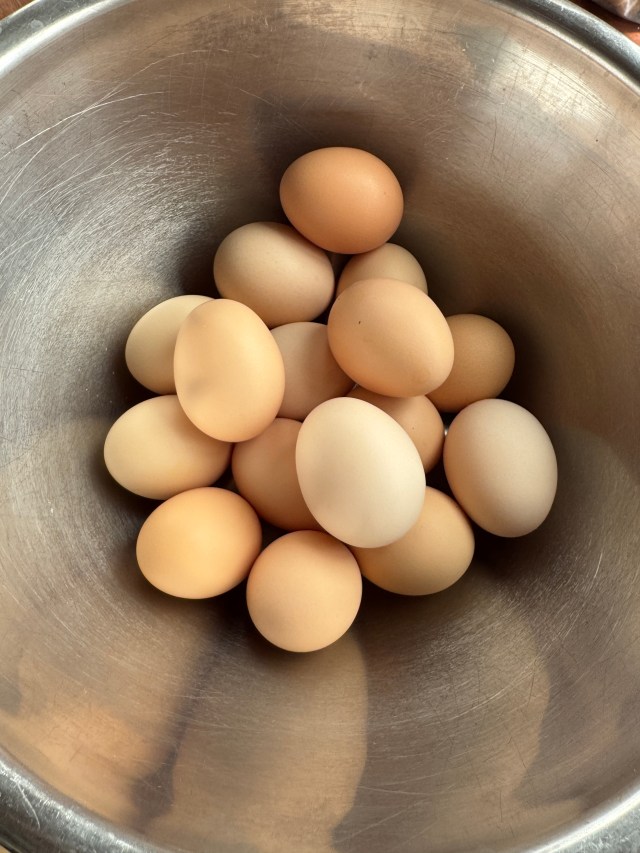
Cuko’s eggs are the only product I buy of which I know the source and the supply chain. When I need them, and sometimes when I don’t (I have trouble turning down his eggs), he delivers them to my door in a plastic pail, driving to my house in his old robin’s-egg-blue pickup. Cuko lives half a mile away.
I concede there is one unknown in the supply chain. I have not yet asked Cuko where and how he acquires chicken feed for his hens.
I pay him $150 pesos – roughly $8 US dollars – for 30 eggs. That’s about $50 pesos more than the price of store-bought eggs here in Alamos, Sonora – significantly more than a conscientious Mexican shopper is able or willing to pay. The only way Cuko’s business model works is to have a few clients with a desire for his product and the capacity to pay his price. That would be me, a retired pensioner from the United States who used to raise her own chickens and places a high value on yard eggs.
Of course, Cuko doesn’t have a business model. He just has more eggs than he and his family can eat.
He is a carpenter, semi-retired. He may have done other things in the past. It is customary for Mexican men to have multiple careers over a lifetime, often simultaneously. We met him in 2021 after seeing a sign on his fence se vende catres – cots for sale – and, when we decided we were in the market for a couple, we knocked on his door. A well-made cot is like a cradle; it promotes sleep. In rural and small-town Mexico, during sweltering summers, people spend the night on their portals on cots to escape the heat indoors. Cuko’s are well made.
When we were transacting the order for the cots, he showed me his woodshop in the back of his house and facing the backyard. That’s when I discovered he had chickens. He has built a large airy coop for them, and he clips their wings so they can range free in his yard. High walls prevent the entry of neighbor dogs, the most common predators of chickens. Cuko told me he raises chickens because (stating the obvious) their eggs are vastly superior to factory eggs. I told him if he ever had any extra, I would buy them.
I consider this conversation the beginning of our producer-client relationship, but there was considerable market friction before I ever purchased an egg – a four-year delay to be precise. In the meantime, we kept up with Cuko, waving and exchanging pleasantries when we would pass each other on the street (Alamos is a small and friendly town). And we did some business with him. In 2023, as part of moving full-time to Alamos, we hired him to do some finish carpentry in our dining room. I daydream about his building a coop for me, so I can have my own chickens. That’s never going to happen.
Time passed. I still had a demand; he just didn’t have a supply. Until he did. Cuko has a rooster (or two), which means over time his hens were not only producing eggs but also chicks, a percentage of which grew up to be hens that after six months or so would start laying their own eggs.
On February 10, 2025, Cuko texted me to ask if I wanted to buy some eggs. He had an oversupply. I was thrilled. So for five months, I have been buying his eggs.
It’s not a perfectly efficient market arrangement for either of us. I run out of eggs before I remember to tell him I need more. We text back and forth about a delivery time, creating more friction in our supply-demand equation. Or I buy more than I need (as I mentioned, I can’t resist). (I share them with friends.) Or he’s stuck with eggs, when we are traveling, which is fairly frequent. I have tried, not very successfully, to hook him up with other buyers.
Then, to borrow a major economic theme from economist John Maynard Keynes, there is uncertainty. Because no one, including Cuko and I, can predict what will happen in the future, our cozy egg arrangement could change, abruptly or slowly, or vanish in a twinkling. Seasonally, hens lay fewer eggs. Or they reach an age where they stop producing (at which point they typically go in the stew pot). Or a dog or other predator figures out how get into Cuko’s compound. Or an asteroid hits the planet.
There was some perplexing uncertainty recently. For about ten days, Cuko did not respond to my text messages. I was puzzled but distracted by other stuff. Then I started to ruminate. Is Cuko OK, I wondered. I stopped by his house, shouted first at the fence, then I walked up on the porch to knock on the door, then I started to wonder if that was a wise move, since I knew Cuko had a dog whose comportment I was not familiar with, so I retreated to the other side of the fence just as the dog came tearing around the corner and flung himself snarling at the gate I had just closed. While I was trying to cajole the dog, Cuko walked out on his porch. I explained I was worried that I hadn’t heard from him, and he said, “Se me perdió mi celular” – my cellphone got lost – a wonderful reflexive verbal formation that places the blame on the phone, not on the person who lost it.
I asked him if he had some eggs. Yes, he did, but I had no money. I went home, and he delivered them to my house twenty minutes later.
My egg business with Cuko bears no resemblance to how markets function in much of the world. I am not romancing my egg story as a general economic model or alternative to global production and distribution. There are never going to be cottage industries making smart phones or cars. I have grown weary of the literary genre extolling bygone sociocultural models – the loss of pastoralism is an especially popular theme among writers with a seductive knack for lyricism. The most recent book I put down unfinished is Anima: a Wild Pastoral, by Kapka Kassabova.
In my role as egg buyer, I simply enjoy being embedded in the life of a small Mexican town, a tiny cog in its economic engine. I am not particularly interested in market convenience or efficiency. The clunkiness of buying eggs from Cuko is fine with me. Well, I could do without a growling dog in the supply chain.
 saaribampo
You must be logged in to post a comment.