The two things I will most remember about 2025 are the rains and the butterflies.
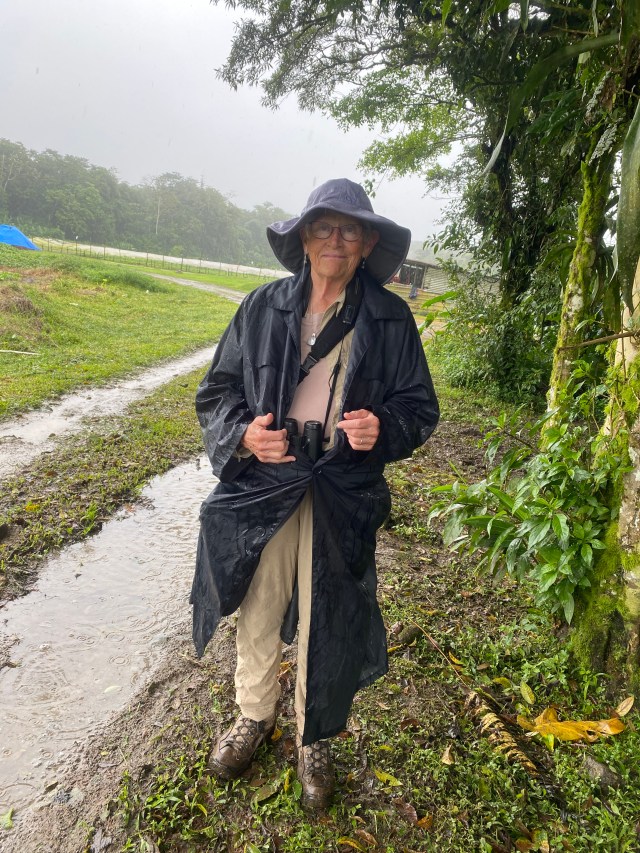
I began the year in Panama on a birding trip, where it rained and rained. Typically, it should have been the dry season, but it was abnormally wet. The precipitation was welcomed by Panamanians – recent droughts had taxed the water sources, primarily the Chagres River, which provide water to shuttle container ships through the Canal. It rained, misted, or was overcast virtually the entire time; I estimated we had a sum total of about three hours of sun over the course of the trip. It would have been nice to have more sun, which is required for seeing dragonflies and damselflies. But I soaked up the rain, happily. I’ll always remember the first day of 2025, in the rain, watching a Black-crowned Antpitta, completely oblivious of us or the precipitation, as it hopped in the leaf litter feeding at an army ant swarm. All of us were drenched; none of us complained.
This was the first of many memorable rains and full-throttle thunderstorms in 2025: Costa Rica in June (an especially theatrical downpour on evening of June 9) and during travels in Mexico – in July in Chihuahua at Basaseachi (thanks to the monsoon rains, Mexico’s second-highest water fall was roaring); in August in Oaxaca in San José del Pacífico (rain and bone-chilling neblina – fog – requiring a fire one night in our cabin) and Pluma Hidalgo (rain and more neblina, particularly enveloping on the evening of August 12, creating what I described as a “hushed silverscape”). And then here at home, in and around Alamos in southern Sonora, we had the best monsoon in recent memory.
When the year started in Panama, I began to realize how deeply I missed rain. The Southwest United States and adjacent Northwest Mexico are in the 25th year of a megadrought – the driest period in the last 1,225 years. Typically, the monsoon rains fall from late June into September when they can be augmented by autumnal rains produced by Pacific hurricanes moving inland across Sonora. The average annual monsoon rain is 19 to 35 inches. However, those amounts have shrunk dramatically, especially in 2020 and 2021. In 2024 there was virtually no monsoon, and the winter rains, which can boost the annual monsoon rains by a few inches, were nil. We essentially went a year without rain.
The city wells were almost depleted. A years’-long project to pump water from wells in the Mayo River watershed went online just in the nick of time. All around the municipio, wells were running dry and people were frantically drilling more wells. The first significant rain I noted in my calendar was June 25th. There was rain again on June 26th. And on the rains continued and continued. We were almost afraid to celebrate for fear we might jinx it. The biggest rain, approximately 8 inches, fell over about 24 hours on September 4th and 5th, the result of Pacific Hurricane Lorena. The last rain, October 11th to 13th, caused by Pacific tropical storm Raymond, was 3.2 inches. Alamos had the best monsoon in perhaps two decades: 39 inches.
(The 2025 monsoon pacified the human population of Alamos, but it has produced a false sense of security. One good monsoon does not make up for a quarter-century of drought. The rains provided some superficial relief but have not sufficiently recharged groundwater.)
The rains did kick plant production into high gear. In turn, the surge of greenery and flowers – diminished for years – provided food, nectar, and cover for butterflies and their caterpillars. And the butterflies came, by the tens of thousands. There were butterflies everywhere.
Their buoyancy reflected mine. The monsoon, if not the end of our water problems, was such a relief.
The Yellows started appearing in June, thousands upon thousands, floating in clusters along the highway from Alamos to Navojoa, flickering around bushes and vines. When I was swimming, as I turned my head to take a breath, I saw them silhouetted against the sky. Yellows are intensely yellow, quite a few flash brilliant orange when flying, and many species have elegant tracery of black on the edges of their wings. They are in the family Pieridae, which encompasses about 1,100 mostly tropical species. The Whites are the other large group in the family, so named because they are intensely white. The Yellows and the Whites seem to glow.
I could not ignore them. I overcame a self-limiting problem I have of thinking I cannot possibly stuff more information in my brain. I mobilized. I started photographing and identifying them. This has been exhilarating.
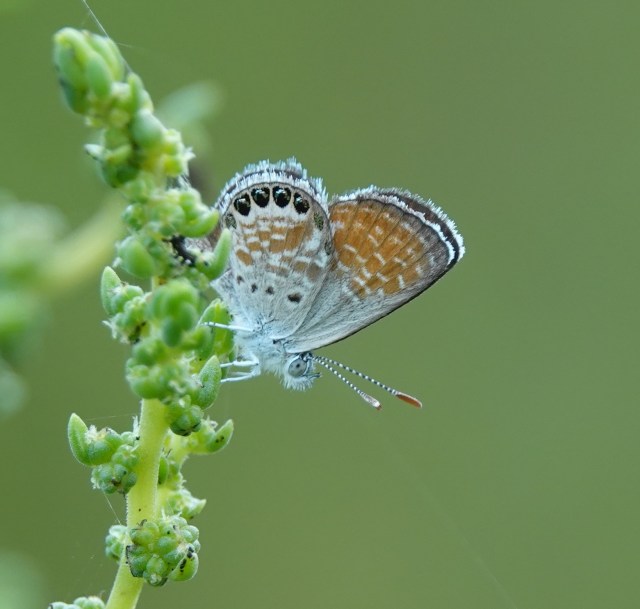
with a wingspan of 1/2 to 3/4 of an inch.
Besides my spouse, David, who always encourages my attempts to stuff more stuff in my head, I must thank two people: Jeffrey Glassberg, distinguished molecular biologist – he was a pioneer of DNA-fingerprinting – and author of the fabulous field guide Butterflies of Mexico and Central America, and Ricardo Cota, our gardener who planted and nurtured a bed of zinnias, favorite nectar flowers of butterflies.
I will end the year having photographed 71 species of butterflies. It is a start.
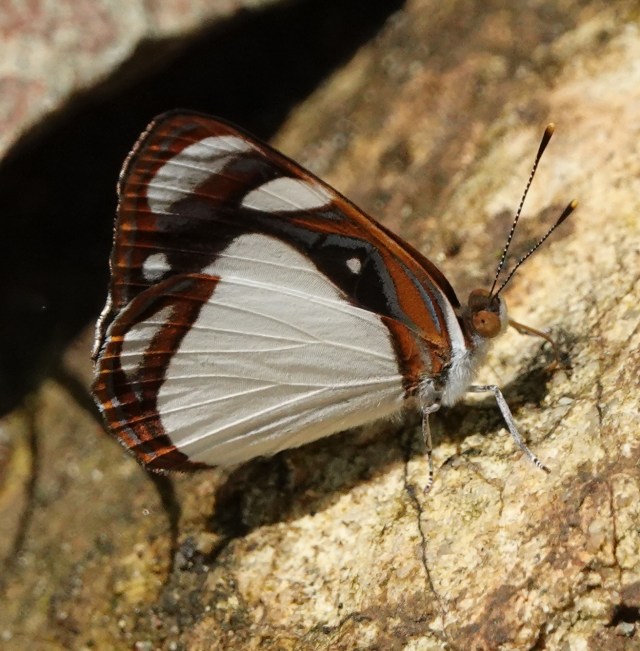
During the monsoon and as of the last week of December, Dorantes Longtail, Urbanus dorantes, was, by far, the most common and abundant butterfly in our yard, around town, and in the wilder areas we frequent around Alamos. They were everywhere. I wish I could extrapolate how many. It is a skipper, in the family Hesperiidae. Like the 3,500 or so other species of skippers, Dorantes Longtail is a modest brown, some might say dull, butterfly. One thing that makes the Hesperiidae fun (or frustrating) is the challenge of identifying most of them. It is like solving a puzzle. Some cannot be identified in the field even by experts. But Dorantes Longtail is easy to identify with its long tail and tiny translucent “window panes” in the forewings that glitter when it flies.
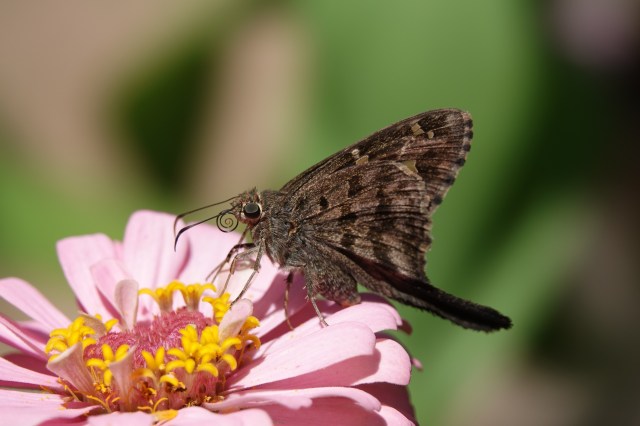
It is thought that this little skipper is named for the 16th-century Spanish explorer Andrés Dorantes de Carranza, one of four survivors of the Narváez expedition, who after heaving up in 1528 on the shores of current-day Galveston Island, wandered around the desert Southwest for eight years before drifting southward into Mexico across present-day Chihuahua and Sonora, and finally in 1536 to Villa de San Miguel, now Culiacán in Sinaloa. It is not too far-fetched to imagine Dorantes et al. wandering over terrain that in the 1680s became the booming mining town of Alamos, Sonora.
Dorantes, the explorer, and Dorantes, the butterfly, have caused me to wander, aimlessly it seems, into thoughts of deep time and the evolution of migration in the animal kingdom. Aerial flight began to evolve in insects about 400 million years ago. Butterflies, as a group, began to evolve from nocturnal moth ancestors about 100 million years ago, originating in what we call the Americas and radiating to all corners of the planet except Antarctica.* Butterflies own the air.
Terrestrial bipedal humans began to evolve in Africa a mere 4 million years ago. About 20,000 to 30,000 years ago, just yesterday, relatively speaking, humans began migrating to the Americas – in the opposite direction of butterflies* – mainly by way of the Beringia land bridge. Granted, flight is complicated but looks so graceful and effortless. Excluding examples of a few gifted athletes, there is nothing elegant about bipedalism. Plus, as every aging human knows, one’s feet start to hurt.
Humans plodded over the earth for millennia. Then, rather rapidly, they invented ways to propel themselves through water and in the air, and to move faster and faster on land. Humans are a restless lot.
For millions of years, migration in the animal kingdom has been, and still is, obligate – that is, necessary for survival. Animals roam around looking for food (and sex). Food fuels their movement. Facultative migration – optional and flexible – is a recent human behavior (I cannot think of a non-human example). For instance, the European conquest of peoples in the Americas, which kick-started about 500 years ago, was about economic, cultural, racial, and religious hegemony. Various polities are still engaged in these endeavors.
Facultative migration in humans has evolved to require massive inputs of energy, not to fuel our bodies but our conveyances – beasts of burden, ships, trains, planes, automobiles. Facultative migration entails the use of a lot of carbon-based fuel. Only very recently, and among a very small cohort of humans, has migration become purely facultative, frivolous really, for fun and adventure, certainly not for survival and with no belligerent thought of conquest. David and I fit into this subset of facultative migrants to Mexico. We started coming to Sonora 25 years ago, about the time the drought started.
Although we will be dead, it is possible that if the drought continues and temperatures continue to rise in this corner of the Americas, humans will be obligated to withdraw. In the meantime, I will sit down, put my feet up, and enjoy the last hours of 2025 remembering the rain and the butterflies.
*This interesting article references the opposite dispersal patterns of butterflies – migrating from the Americas – versus mammals (including humans) migrating to the Americas. Kawahara, A.Y., Storer, C., Carvalho, A.P.S. et al. A global phylogeny of butterflies reveals their evolutionary history, ancestral hosts and biogeographic origins. Nat Ecol Evol 7, 903–913 (2023). https://doi.org/10.1038/s41559-023-02041-9
 saaribampo
You must be logged in to post a comment.