Cranberries

Ruby jewel.

Bog Ruby

Every wild berry has its own charm, but the one I most like to pick is the cranberry. It ripens in autumn when the air is crisp, the tamaracks are turning sun-gold, and all gardeners and gatherers have that quickening feeling—summer has fled and winter is coming.

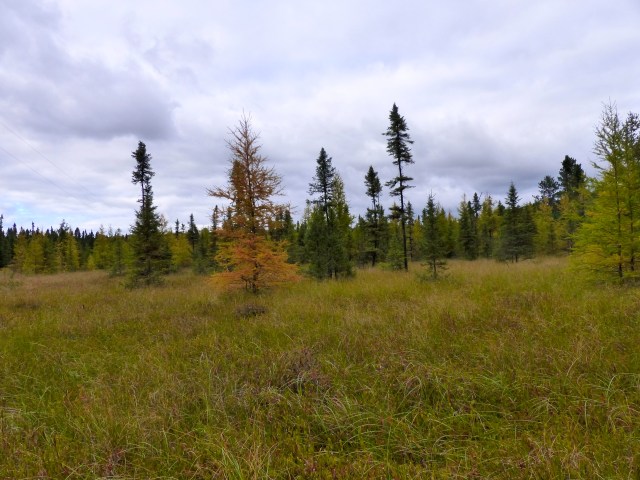
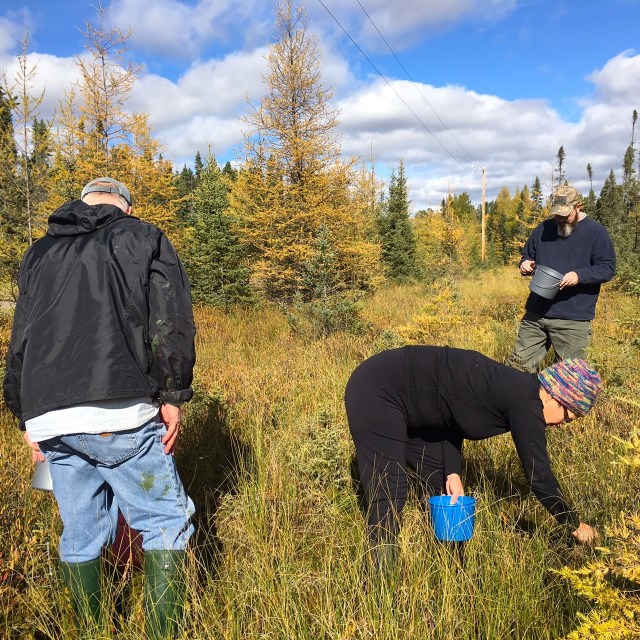
The black spruce and tamarack bog in Pike Township, MN, where we most often pick cranberries.

The black spruce and tamarack bog in Pike Township, MN, where we most often pick cranberries.

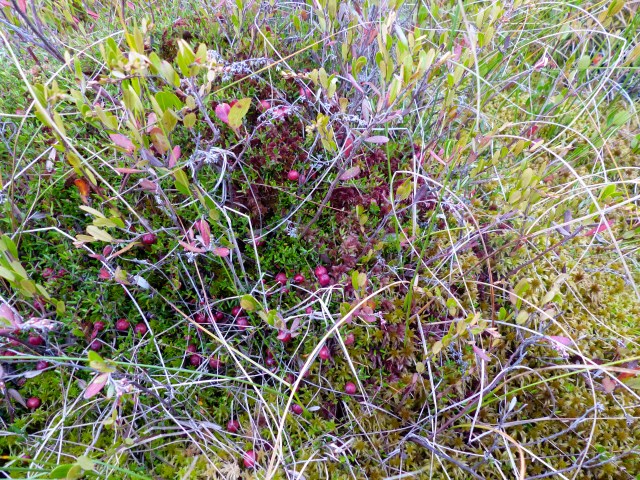
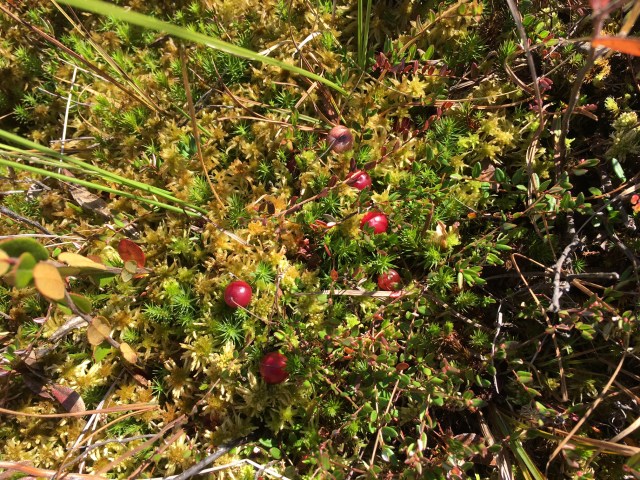
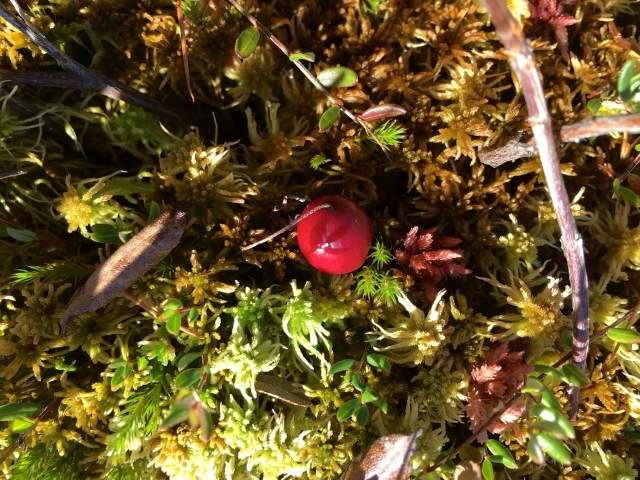
Cranberries are the ruby jewels of the boreal bog. They perch atop or hide within the spongy hummocks of sphagnum moss. Picking is a process of plucking the perched ones then waving a hand through the feathery tendrils of the sphagnum to find the hiders. In the quest for cranberries, the picker’s field of view is narrowed to one hummock, then the next, and at this eye level the bog world becomes a miniature forest of grasses, sedges, and fungi.

Cran

Bountiful

Picking cranberries puts a person in touch with her body. I call it bog yoga. There is lots of bending, stretching, squatting, teetering and balancing in the squishy muck. (My biggest concern is that I will fall over and spill the contents of my bucket at the end of picking when I’m slogging out of the bog.) The next day the bones and muscles have plenty of twinges of happy remembrance of the day before.

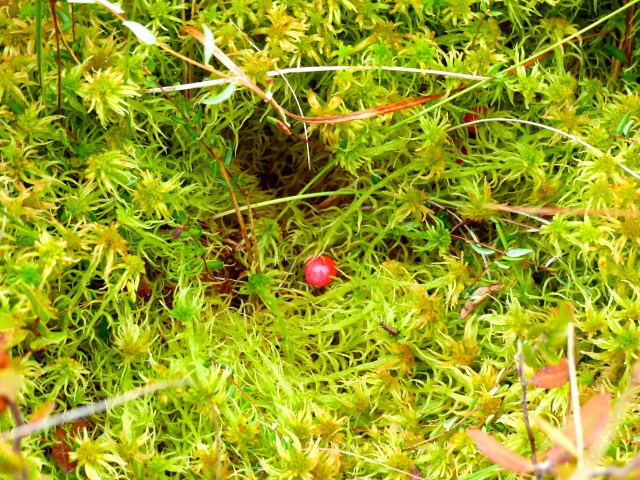
Cranberry on Sphagnum Hummock

Cranberry on Sphagnum Hummock

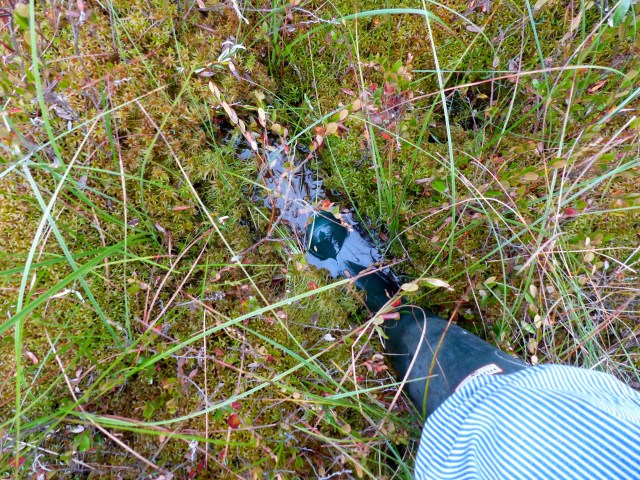
Picking is more relaxing in years of average or below average rainfall, which 2016 was not, because in parts of the bog it is dry enough to lie down or kneel on a cushiony hummock while picking. This year was all bending and stooping and a little harder on the lumbar spine. But the reward for an aching back was traipsing in the waterlogged bog. With every step, the calf-deep water sluiced and gurgled and the moss hummocks quaked. The bog was more like a creature than a landscape.

Bog World

Bog World

Bog Squishing

Bog Squishing

Bog Bending

Bog Bending

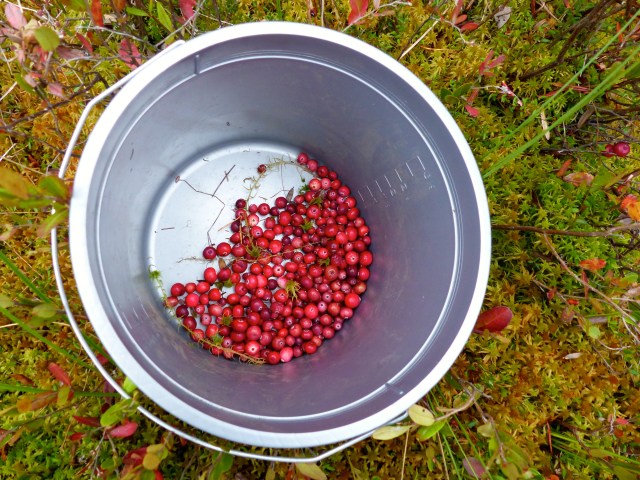
My Bucket

My Bucket

Perhaps because of the ample summer moisture, the 2016 cranberry season was exceptional in the bogs around Embarrass, Minnesota. Not all years are so bountiful, and some years there are none. Pickers were talking of gathering bucketsful in a few hours, and the season seemed to stretch out for weeks, perhaps because the fall was mild. Unlike most of my friends, who are berry-picking machines, I never come home with bucketsful, but I cherish every ruby jewel. I freeze about half of my harvest. The rest are folded into scones and coffeecakes.

Posted in West Saari Road | Comments Off on Cranberries

Goya, My Man

Come back.
I am sorry.
I was running late.

Two hundred years?

My darling, that’s an eye blink,
barely a deposition of decay
to become the oil
that fuels our cars.

Cars?
Well, I’ll explain later.

Meet me a las siete
en el Hotel Mora
que está entre El Prado y
El Reina Sofía en Paseo del Prado.

You will love the Prado these days.
It is full of Goyas.

Never mind the Vespas.
They are just a means of traveling faster,
unfortunately forward, not backward,
which would have gotten us together quicker.

(We could have met in the middle,
somewhere in 1902.)

And never mind those people
with one hand cupped to an ear.
They are merely talking
to someone they love.

October 2002 


Posted in The Occasional Poem | Comments Off on Goya, My Man

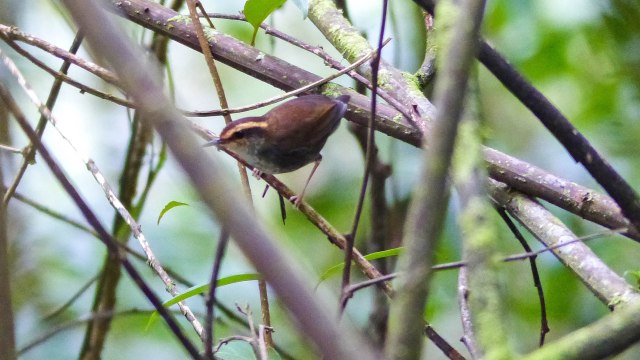
The Bornean Stubtail

Bornean Stubtail (Urosphena whiteheadi) Photo by David Smith

Bornean Stubtail (Urosphena whiteheadi)
Photo by David Smith

The Bornean Stubtail is a plain brown bird about the size of a goose egg. What passes for its song consists of rapid outbursts of high-pitched static. As its name implies, it is found only on the island of Borneo and it doesn’t have much in the way of a tail. There are far more stunning and easier-to-see birds in Borneo, but the Stubtail is the sly hermit messenger who renders best what twenty days’ birding in the tropical forests of Sabah1 meant to me.

 I estimate I saw the Bornean Stubtail for no more than three seconds. As much as I might pretend otherwise, I am not likely to ever see one again. It was darting from twig to twig in the tangled understory of the fog-shrouded forest, responding to playback of its song. A tiny nutmeg-brown bird, cream-colored eyebrow, dark sparkly eyes, flesh-pink toothpick legs, no tail to speak of. There it was, then there it wasn’t.

My few seconds of Bornean Stubtail contained compressed memories of other reclusive brown birds—Swainson’s Warbler in Texas, Winter Wren, Veery, and Hermit Thrush in the woodlands and bogs on our farm in Minnesota, Brown-backed Solitaire in Mexico. These are birds that, with the possible exception of the warbler, I will see on many more occasions unless I fall over dead tomorrow. Henceforth when I see them, they will remind me of my one and only Stubtail.

We saw the Bornean Stubtail at Mt. Kinabalu National Park2, on our fifth and final morning in the park and our last day of birding in Sabah before heading back to Kota Kinabalu3 where we would scatter the next day to our various homes and routines in temperate North America. We were a party of eleven—eight participants and three guides, who on our final morning were bearing the professional onus of having to produce for the group four Bornean endemics, one of them the Stubtail, all uncommon and difficult to coax into view. 4

Birding in Borneo is richly rewarding, hard work, and for a first (perhaps only) timer on the island sensorially overwhelming. There are roughly 650 species of birds of which 420 are resident and of that number 50 or so are endemic to the island; the other 130 species are migrants or winterers from nearby continents. Many of these birds are taxonomically grouped in Asian, Australian, and African families unfamiliar to birders who have not ventured out of the Western Hemisphere. Bulbuls, babblers, barbets, broadbills, bee-eaters, pittas, hornbills, sunbirds, spiderhunters, flowerpeckers. It is head spinning.

Competing with the birds for attention is everything else, which in Borneo is a great deal (and I focus narrowly on non-human diversity while omitting the rich histories, religions, cuisines, and cultures of Malaysia and its surrounding Southeast Asian neighbors): 14 primates, including Orang Utan; more than 280 mammals, including flying squirrels ranging in size from 5 inches to 3 feet, the Bearded Pig, the Bornean Pygmy Elephant, 27 species of whales and porpoises, and 94 species of bats; who knows how many invertebrates, including the world’s second-largest insect (Phoebiticus chani, a giant stick insect measuring 56.7 cm 5); and an equatorial explosion of floral diversity—an estimated 10,000-15,000 flowering plants—including the world’s largest flower (Rafflesia, which can measure 1 meter across), perhaps as many as 3,000 species of orchids, 500 ferns, and 3,000 species of trees, which include some of the tallest trees on the planet. It is hard to describe Borneo. The inventories of species blur, the superlatives begin to sound trite, the describer starts to run out of oxygen.
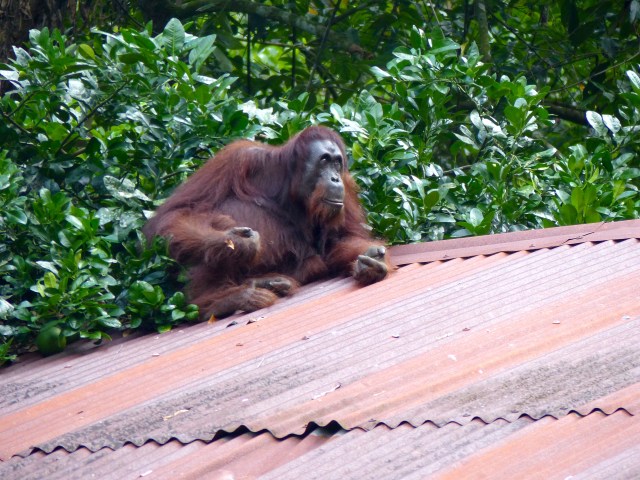
Old female Orang Utan (Pongo pygmaeus) on roof of a building at Gomantong Caves. Photo by Suzanne Winckler

Old female Orang Utan (Pongo pygmaeus) on roof of a building at Gomantong Caves.
Photo by Suzanne Winckler
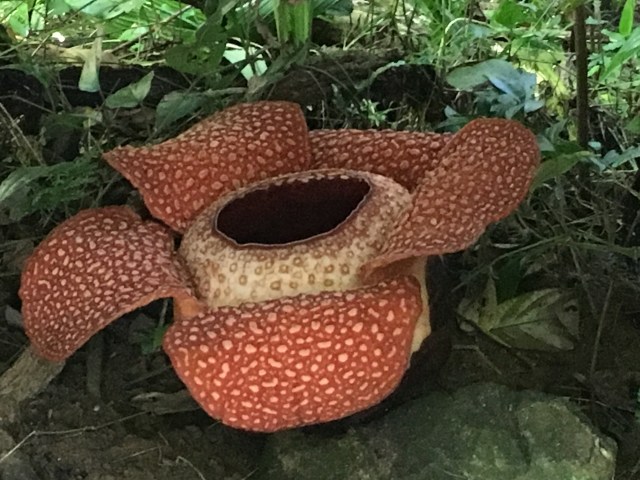
 

Rafflesia keithi at the Viviane Rafflesia Garden near Poring Hot Springs Photo by Suzanne Winckler

Rafflesia keithi at the Viviane Rafflesia Garden near Poring Hot Springs.
Photo by Suzanne Winckler

At the four forest preserves we visited in Sabah we had the realistic potential of seeing about half of the island’s 650 birds. I tell myself that if I lived in Borneo—even for just six months—I could with patience and repeated effort have found a fair number of these birds by myself. We had twenty days. We were in the hands of professionals whose business and passion (I do not use the word lightly) is to find birds and show them to other people.

It is hard to explain to non-birders the level of expertise, physical dexterity and endurance, sensory acuity, and depth of knowledge required to be a professional bird guide. To non-birders, all birders look alike—people in drab clothing rambling in the forest craning their necks. Bird guides are professional athletes who look superficially like ordinary people and, as long as their stamina, vision, and hearing hold up, they do not peak in their 30s or 40s like many professional athletes. One of our Borneo guides, Rose Ann Rowlett, who happens to be one of my oldest and dearest friends, is 70. She is a lithe and beautiful specimen of a professional bird guide.

A synopsis of our bird guides at work: Using playback requires amassing recordings, which the guide has made him or herself or acquired from another professional guide or a source like xeno-canto 6, and then cuing up a specific song in a matter of seconds. It is essential to already know the songs and calls because it helps a guide pinpoint the general location of a bird and then do playback to draw it in. Bird guides, depending on how widely they lead tours, typically have knowledge of several hundred to several thousand birdsongs. In Borneo, extremely reclusive birds, of which there are many, respond very slowly to playback, especially during the non-breeding season when there is less incentive to protect territory. Often, we sat quietly for 30 minutes to an hour on a trail while Rose Ann did playback. If the bird came into view (sometimes it did not), our guides then began the art of showing the bird to us. Rose Ann, Richard Webster, and our in-country guides Hazwan bin Suban and Napoleon Dumas used green lasers to point out a bird’s perch, which requires great skill to aim the light below or to the side of the bird so as not to disturb it. Richard, Hazwan, and Napoleon typically were in charge of getting telescopes on birds within seconds for closer views. All of this action took place as quietly as possible (a lot of whispering and gesturing) on narrow and often steep and slippery trails.
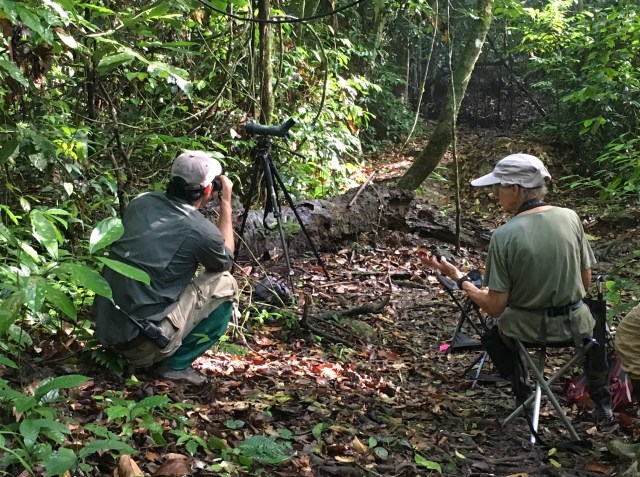
Napoleon Dumas and Rose Ann Rowlett on the Hornbill Trail at Borneo Rainforest Lodge, working on three shy birds, Blue-headed Pitta, Bornean Banded Pitta, and Bornean Ground-Cuckoo Photo by Suzanne Winckler

Napoleon Dumas and Rose Ann Rowlett on the Hornbill Trail at Borneo Rainforest Lodge, working on three shy birds, Blue-headed Pitta, Bornean Banded Pitta, and Bornean Ground-Cuckoo.
Photo by Suzanne Winckler

So back to our last morning birding in Borneo. We started out in our big tour bus at 5:30 a.m. before sunrise. At the time, in the under-caffeinated mental haze of predawn, I did not fully appreciate how intent Rose Ann, Richard, and Hazwan were on finding those four endemics. The first objective was Everett’s Thrush. Like the Stubtail, it is a diminutive brown bird but ever so slightly less reclusive. It regularly comes out in the open if only briefly and in the dark to forage before dawn in the leaf litter along the shoulders of the main road through the park. At approximately 6 a.m., we saw—i.e., we were shown—two individuals tossing leaves on the side of the road in the glow of the bus’s headlights. Under the circumstances, as I crouched in the aisle of the bus and peered through my binoculars through the windshield to the circle of light in the pitch dark, the birds seemed to me more like a dream than a reality. The Everett’s Thrush was a lifer7 for all the participants and for Hazwan, who has been leading tours in Borneo for a dozen years—an indication of what a rare and challenging bird it is to see.
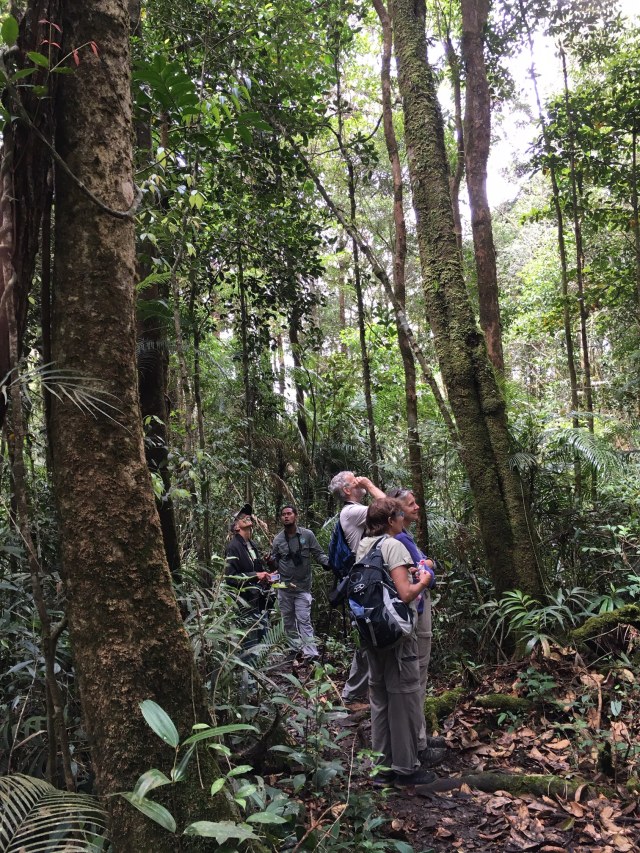
Our last morning on the Mempening Trail at Mt. Kinabalu Park. Photo by Suzanne Winckler

Our last morning on the Mempening Trail at Mt. Kinabalu Park.
Photo by Suzanne Winckler

About 20 minutes later—at 6:20 a.m. according to my notes—we were out of the bus and walking as quietly as eleven people can through the forest on the narrow Mempening Trail as Rose Ann worked to coax Crimson-headed Partridge into view by playing its loud, repetitive, almost frantic-sounding call over and over. It is one of the most common and distinctive sounds of Mt. Kinabalu. We heard them every day of our stay in the park but had yet to see one. (I will say parenthetically but emphatically that the sounds of birds in Borneo are as wonderful as the visions of them.) Two were responding—these partridges engage in dueting—to Rose Ann, seeming to be moving closer and closer. At 6:35 a.m. a pair sidled across the narrow trail just slowly enough for us to see their endearing partridge plumpness and stunningly red head and breast. Birds seen in the early morning light filtering through the forest almost seem to glow.

Two for four. We broke for breakfast.

At 8:45 a.m. with about two hours to bird before heading to Kota Kinabalu, we drove back up the park road in a last-ditch effort for the two other endemics: Fruithunter and Bornean Stubtail. The day before, birding along the road, Rose Ann, Richard, and Hazwan had heard the thin, quavering, high-pitched call of the Fruithunter—an implausibly feeble vocalization for a rather large (22.5 cm) bird. At 9:05 a.m., as we were walking down the road, our guides heard and found two Fruithunters, which were seen by most of the party but not me. 8   Shortly, there was a flurry of excitement as Rose Ann called in the Bornean Stubtail to a tangle of brush by the side of the road. I was barely processing my glorious three seconds of Stubtail when our guides got one of the Fruithunters back in the telescopes. This one I saw—a plush bird with tuxedo-trim markings of gray, buff, and black.

Four for four.
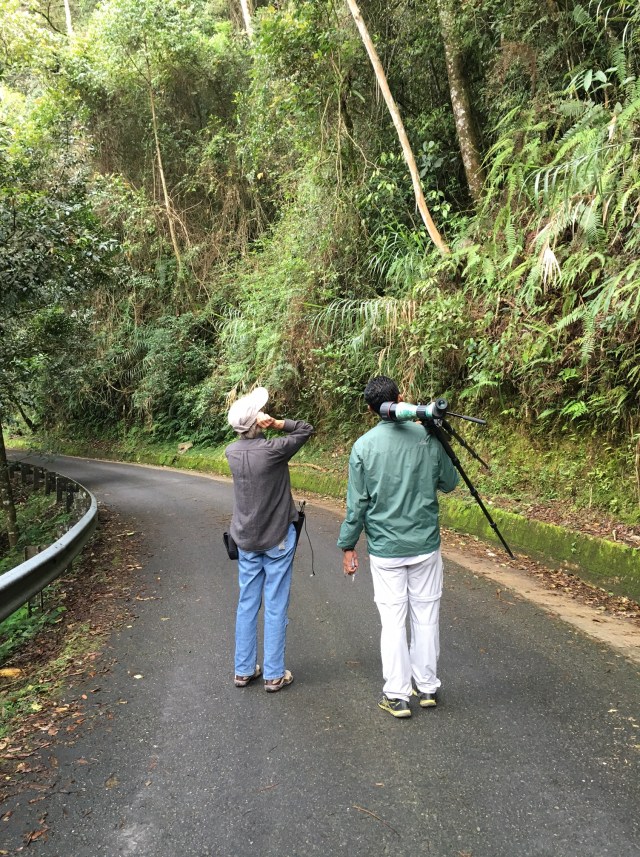
Rose Ann Rowlett and Hazwan bin Suban listening for the Fruithunter (Chlamydochaera jefferyu) on the road at Mt. Kinabalu Park. Photo by Suzanne Winckler

Rose Ann Rowlett and Hazwan bin Suban listening for the Fruithunter (Chlamydochaera jefferyi) on the road at Mt. Kinabalu Park.
Photo by Suzanne Winckler

What made our last morning birding in Borneo so extraordinary was not just seeing four reclusive endemics in the space of a few hours but watching our guides working to find and show them to us. It had all the elegance and intensity of a perfect game.

And then the game is over. We birded down the road for another hour, performed the various mundane tasks of checking-out of our accommodations, like paying our laundry bills, ate a tasty Chinese lunch at Rose Cabin, a small hotel just outside Mt. Kinabalu Park, and then our bus was rolling down the highway to Kota Kinabalu. We were homeward bound and I had a sly hermit messenger in my pocket.

Footnotes

1 Sabah is one of the two Malaysian states on the island of Borneo (Sarawak is the other). Sabah has the poetic Malaysian nickname of Negeri Di Bawah Bayu—Land Below the Wind—a reference to its (and Borneo’s) latitude below the zone of tropical typhoons. We visited four conservation areas—three in the lowlands (Sepilok Rainforest Discovery Center and Forest Preserve, Kinabatangan Wildlife Sanctuary and Sukau Rainforest Lodge, and the Danum Valley Conservation Area and Borneo Rainforest Lodge) and one montane area in the Crocker Range (Mt. Kinabalu National Park). Outside of forest preserves large portions of Borneo’s lowlands have been converted to oil palm plantations while the foothills are agricultural areas for vegetables and fruit.

2 Mt. Kinabalu National Park is a spectacularly beautiful World Heritage Site situated in the Crocker Range and encompassing Mt. Kinabalu (13,438 feet), the highest mountain in the Malay Archipelago and a pilgrimage for people who hike the peak with the goal of witnessing the sunrise from the summit. The plant (e.g., 800 species of orchids), avian (326 species), and mammalian diversity is phenomenal. There is a great trail system, gorgeous vistas, comfortable lodging, and the climate (mean temperatures between 70F – low 80F) provides quite a contrast to birding in the steamy lowland forests. Although as a native Texan I rather enjoyed the steamy lowlands.

3 Kota Kinabalu (population about 450,000) is the capital of Sabah located in northern Borneo. It is a sophisticated, friendly, bustling port city on the South China Sea with great vegetable, fruit, meat, and fish markets, and ethnic and cultural diversity of which I would like to be a part.

4 For non-birders: the standard method for getting birds to come into view is to do playback of their songs and calls. Additionally, guides sometimes use playback of diurnal owls, which can agitate birds and cause them to fly toward the sound and thence into better view. Playback is widely debated in the bird watching community; bird-guide writer and artist David Sibley has a useful essay on the proper use of playback. See: http://www.sibleyguides.com/2011/04/the-proper-use-of-playback-in-birding/. For obvious ethical reasons, playback is prohibited in places where hundreds of birders come to see a rare bird for a particular location and/or season (e.g., Elegant Trogons in Cave Creek Canyon in the Chiricahua Mountains of southeast Arizona).

5 It was the world’s largest insect, until this year (2016), when Phryganistria chinensis (62.5 cm) was discovered and described from China. https://en.wikipedia.org/wiki/Phobaeticus_chani and http://www.popsci.com/introducing-worlds-longest-insect

6 xeno-canto is an open-source website for sharing recordings of wild bird sounds from around the world: http://www.xeno-canto.org.

7 For non-birders: a lifer is a bird seen for the first time in one’s life.

8 The dynamics of a participant on a birding trip not seeing a bird are complex. I feel badly in the moment for the guide who is trying to show it to me and a little frustrated and embarrassed with my inability to see it. But not seeing a bird, even if it is my last chance to see it, is not ultimately disappointing to me. Perhaps this makes me not a genuine birder. I figure it was not meant to be and in a few moments, hours, or the next day, I will see or hear another bird that will bring me great joy.

Final note: Use of anthropomorphic terms

I am aware of the pitfalls of using anthropomorphic terms when describing or talking about non-human organisms. When I am in the company of biologists talking about their research of non-human organisms (or with non-biologist friends who like me have an interest in scientific topics like evolution and animal behavior), I understand and agree that the rules of the conversation restrict the use of anthropomorphisms. In casual non-scientific contexts—watching birds, for instance—I believe it is justified and inevitable to use human-centric adjectives, similes, and metaphors to describe perceived qualities of the non-human organism or more frequently our human response to the non-human. Even in casual contexts, I make an effort to restrain my use of anthropomorphic terms simply because layer upon layer of humanoid descriptors can quickly become cloying, like the frosting on a store-bought cake. But I am human and human language is all I have to work with when I see and describe the world. So I anthropomorphize from time to time. Some readers may wince or raise an eyebrow with “sly hermit messenger” or “endearing partridge plumpness.” I don’t think the Bornean Stubtail as a species is “sly”—rather I mean the one Stubtail I saw cleverly made me think about birding in Borneo in a way I might not have had I not seen it. I cannot deny, I find small, reclusive, plump partridges to be endearing, especially when observed going about their non-human business largely oblivious of me. I suppose if I were taking a Crimson-headed Partridge out of a mist net and it seized my finger in its vise-like beak, I might feel otherwise.
Posted in Borneo | Comments Off on The Bornean Stubtail

Donald J. Trump Is Not the Woman for the Job

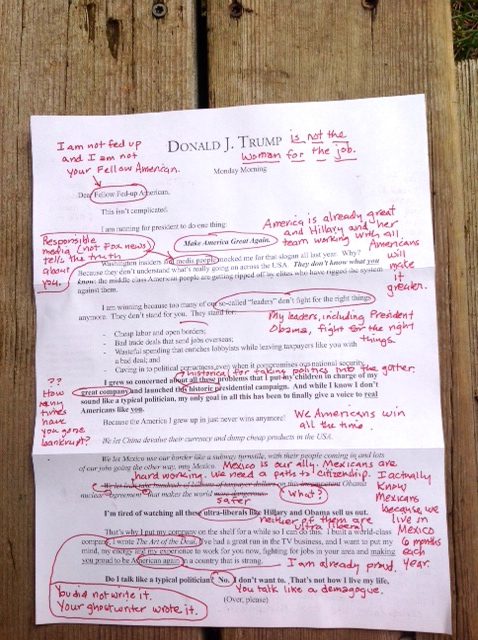
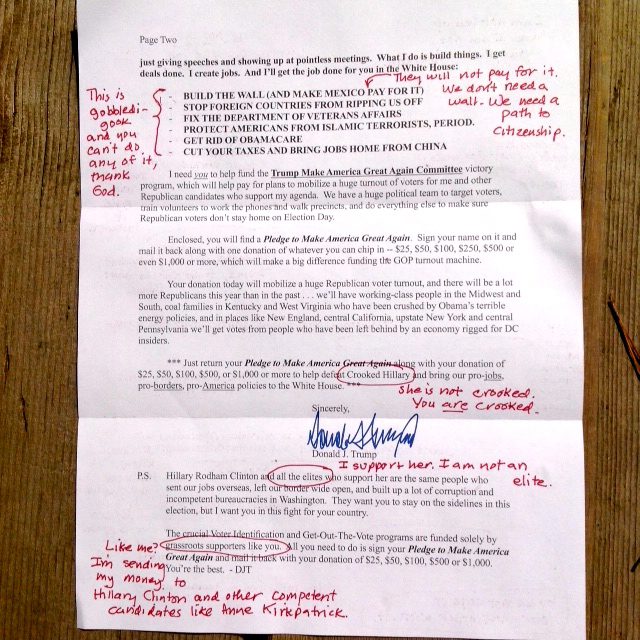
On August 4, The New York Times reported that small donations are helping Trump close his campaign funding gap. Two days prior to the article, one of Trump’s solicitations arrived at the wrong house. It was addressed to my husband. I read it, made edits and comments, and put it back in the response envelope. I did not affix my own first class stamp to the envelope as requested, because I want Donald to pay the postage.

I was puzzled that we received the letter at all. Most campaigns purge mailing lists of persons who vote consistently for candidates in the other party—why waste the time and money sending solicitations to people who will never, ever send them money? Why further energize them to go to the polls to vote against them? My husband’s and my voting records are quite clear: he has never voted for a Republican; I voted for one in 1988—Minnesota Senator David Durenberger, who is my idea of a thoughtful, moderate, compassionate Republican.

Everyone knows Trump is desperate for money. But are Trump’s people so dumb or lazy as to simply broadcast solicitations to every Tom, Dick, Harry, or in our case David, across America? But then I thought, perhaps that’s it. Segmenting by gender! Perhaps Trump’s people are purging females, or least female Democrats, from the lists and retaining males regardless of how they have voted in the past, and then further segmenting the lists by zip codes where mostly white males live on the bet that the white-male sector is Trump’s most fertile field for fund-raising.

Our deeply rural zip code—55732—is on the Iron Range in the northeast corner of the largely Caucasian state of Minnesota. This is Democrat Farm Labor Party country, but a lot of white males up here are understandably disillusioned and disgruntled about the regional economy, which for more than a century has been driven by the boom-and-bust cycles and exploitive labor practices of mining.

If indeed Trump’s people are segmenting voters by gender and race—men versus women, white men versus all men of other colors—the strategy would be right in step with Trump’s divide-and-conquer philosophy. The other even sicker way (in my opinion) Trump and his operatives (and for years the conservative news media) are slicing and dicing the American electorate is with the bombast of “the elites” versus “you.” To quote from his letter (with underlines by me): “P.S. Hillary Rodham Clinton and all the elites who support her are the same people who sent our jobs overseas, left our border wide open, and built up a lot of corruption and incompetent bureaucracies in Washington. They want you to stay on the sidelines and not vote in this election, but I want you in this fight for your country.”

To whom exactly is Trump referring? Who are the elites? Who is the you?

It is biologically and genetically possible to distinguish between male and female and white and non-white males—as divisive as it is to exploit those differences in society and politics—but there is no way to differentiate an elite from a you. To attempt to set up some conspiracy of “the elites” versus “you” is to trade in smoke and mirrors and snake oil. It also admits to no understanding of how the English language works.

“You” is a utilitarian part of the English language, a second-person singular or plural pronoun. “You” is not a gender, not a class, not a race, not a voting bloc. To repeat, “you” is a pronoun.

As for “elite” it is a noun (which can be used as an adjective) with two clear, concise definitions:

  • A group that is superior to others in terms of abilities or qualities (e.g., all athletes performing in the Olympics who are not taking performance-enhancing drugs)
  • A group or class seen as possessing the greatest power or influence in a society, especially because of wealth or privilege (e.g., gee, that sounds a lot like Donald J. Trump—something he surely doesn’t want his “you” to discover).

The 2016 presidential election—indeed all free elections in all free countries as well as all the daily decisions families, friends, communities, and societies make—comes down to language and to what people chose to hear and read or chose not to hear or read.

If I take any solace and hope in the last painful year and last 94 days (and counting: http://www.timeanddate.com/countdown/election?p0=401&iso=20161108T00&msg=Next%20Presidential%20Election) of this presidential election, it is in the power of language and in our freedom as a nation to use it. For every nonsensical and appalling thing that spews out of Trump’s mouth, scores of investigative reporters, writers, speakers, commentators, satirists, editorial boards of many newspapers, President Obama and many other elected leaders and their family members who spoke at the Democratic Party Convention, Gold Star Family members Khirz Khan and his wife, Ghazala (whose eloquent silence spoke volumes), one Supreme Court justice (but Ruth Bader Ginsburg, why did you later apologize for dressing down Trump? Scalia never apologized for anything), and even ordinary citizens have countered Trump and his machine of hatred and obfuscation with the very gift he lacks: beautifully crafted and courageous words.

Page 1.

Page 1.

Page 2.

Page 2.

Just a few reading recommendations:

Former CIA deputy director Michael Morell’s endorsement of Hillary Clinton:http://www.nytimes.com/2016/08/05/opinion/campaign-stops/i-ran-the-cia-now-im-endorsing-hillary-clinton.html

Timothy Egan on Trump as a national security risk: http://www.nytimes.com/2016/07/29/opinion/the-real-plot-against-america.html?rref=collection%2Fcolumn%2Ftimothy-egan&action=click&contentCollection=opinion&region=stream&module=stream_unit&version=latest&contentPlacement=1&pgtype=collection

Houston Chronicle editorial board endorsement of Hillary Clinton:http://www.chron.com/opinion/recommendations/article/For-Hillary-Clinton-8650345.php

Jane Mayer on the ghostwriter of The Art of the Dealhttp://www.newyorker.com/magazine/2016/07/25/donald-trumps-ghostwriter-tells-all

Michael Arnovitz’ defense of Hillary Clinton: https://thepolicy.us/thinking-about-hillary-a-plea-for-reason-308fce6d187c#.qeoikpidp

A special commendation to Mark Singer, who before his 2016 book Trump and Me has followed the nefarious Trump for two decades:

http://www.newyorker.com/magazine/1997/05/19/trump-solo


Posted in West Saari Road | Comments Off on Donald J. Trump Is Not the Woman for the Job

Big Thinking: Why conservation professionals are important to society and the economy

There is a prevailing notion in the conservation nonprofit world that spending money on personnel is a sign of misplaced priorities. I have frequently heard people who profess to care deeply and urgently about conservation say things like, “Well, that organization is bloated, it just has too many employees.” Individual philanthropists, foundations, and government granting agencies regularly exclude or skimp on funding to support the salaries of conservation staff. And I have heard employees of small nonprofits dis big nonprofits—BINGOS they call them (and the target of their dissing is usually the Nature Conservancy)—by saying something along these lines: “Look how small our annual expenditures on salaries are? We only have three employees, but we get a heck of a lot done.” I call this small thinking.

Funny how these folks are happy to take home their own paychecks while failing to think about what their organizations could accomplish if they had more—not fewer—employees. They write off the value of having other like-minded, well-trained, and equally committed individuals getting paid to work alongside them or in any number of other conservation endeavors of which there is no shortage. They fail to consider the wider economic and societal value of their profession: that is, having a robust, well-paid, and well-respected population of conservation professional living and working in communities across the U.S., buying homes, paying taxes, sending their kids to school, talking to their next door neighbor about nature and the environment, serving on community boards, maybe even running for public office.

Moreover, they telegraph a message to the world that conservation professionals—in other words, they themselves—are superfluous, some sort of expensive luxury. I believe this mindset helps explain why people who work in conservation, when compared to other professionals like teachers and healthcare workers, are marginalized in their communities and not infrequently vilified when confrontations arise over environmental issues.

I am a former employee of the Nature Conservancy. Like other so-called BINGOS such as National Audubon Society and World Wildlife Fund, TNC recognizes that investing in human capital is the most effective way to achieve its mission while at the same time supporting a workforce that sets an example for society and plows money back into the economy. The Nature Conservancy’s largest program expense is its personnel. In 2014, with revenues of $1.1 billion, the organization paid $309,859,000 in salaries and $13,877,000 into retirement plans for employees.

Think about it. Nature Conservancy employees, paid largely by means of philanthropic contributions, spend and save their earnings, putting that $300 million back into the private-sector economy, where a percentage of it will be donated back to conservation or other worthy causes. It is as elegant as the water cycle—money flowing from the private sector into the philanthropic pond then back into the private sector in a never-ending process (that is, as long as there are generous people who understand the power of philanthropy).

I believe a spectrum of conservation nonprofits—from small and local to huge and international—provides flexibility, intense focus, and broad continuity to addressing the manifold conservation challenges we face and there should be manifold business models for getting the work of conservation done. But I think the smaller nonprofits should take a cue from the BINGOS’ playbook. They should be investing more in human capital.

Small to medium-sized nonprofits often point proudly to robust volunteer rosters—people who work for free to help organizations achieve lofty and often challenging missions. Volunteerism is noble; we should all volunteer for something sometime in our lives. But running a nonprofit with volunteers is ridiculously naïve. More small thinking.

Volunteers work when they want to. They don’t necessarily feel obliged to follow orders (they can’t get fired and they often think “they know better”). Many volunteers bring valuable skills but just as many, while well meaning, are incompetent. Paid staff often have to “baby-sit” volunteers when they have more valuable work to do. Younger conservation professionals who may have jobs or are finishing up degrees often volunteer for nonprofits. In part, they are building up their résumés but in addition the vast majority of them have a passion for a conservation cause—until they are overworked and exploited because of their enthusiasm and idealism. Commitment turns into resentment.

There is a similar trend in the world of field biology and wildlife ecology. These professions rely too heavily on volunteer or poorly compensated (below minimum-wage) technicians—38% of the work force in one recent study (A.M.V. Fournier and A.L. Bond 2015)—to gather biological data about virtually every living thing—fishes to birds to plants to plankton—as well as information about systems function—marine acidification to climate data to soil chemistry to aquifer recharge. It is this vast pool of data that helps drive the missions and agendas of conservation nonprofits. And all this data is being collected and often analyzed by a whole lot of underpaid people. I happen to know quite a few of them personally, and many of them are, to put it bluntly, pissed off. They are becoming disillusioned about the things they care most about.

Field biology research, typically the academic pursuit of university professors, is funded primarily by governmental grants (federal, state, county, municipal). In this funding scenario, a negative feedback loop has developed that perpetuates the under-funding of salaries for the people who actually do the research. Professors (and their institutions, who want funding streaming into their coffers) submit grants with budgets that invariably and cynically skimp on reimbursement for technicians to increase the odds of their grants being funded. Granting agencies invariably and cynically fund the low-wage grants and broadcast the message that they are unlikely to fund grants with bigger budgets for salaries. The professors and their institutions do not challenge the feedback loop, and thereby they broadcast the message that their endeavors in field and conservation biology are of lesser importance than other types of research. In the realm of medical research, for example, post-doctoral students and career lab technicians actually earn living wages, because in our current culture medical research is deemed of greater importance than research that, well, might save the planet.

This pecuniary shortsightedness, madness, cynicism—call it what you will—drives competent and dedicated people out of the profession, stifles cultural diversity in science and conservation, and demeans people who continue to slog along poorly compensated (or not at all) for their time and effort and commitment. To quote a person with window on this world, ecosystems scientist Darroch M. Whitaker: “In my experience, underpaying new professionals almost invariably causes them extreme financial and consequent emotional hardship.” He continues, “A commonly reported frustration results from the widespread attitude among natural-resource professionals that financial motivation, even out of necessity, is in some way impure” (D.M. Whitaker 2002).

Read: This work is so noble and important you should do it for little or nothing.

Imagine if teachers, physicians, nurses, fire fighters, police, plumbers, electricians, investment bankers, farmers, pilots, truckers, lawyers, longshoremen, and software developers went around saying “My work’s so important to society, I’ll just do it for free.” Or “My employer can prosper with fewer of me, so I’ll just quit my job.”

A number of these professions have experienced, or currently are experiencing, some level of worker exploitation (e.g., teachers, nurses), but all of them have organizations or unions that promote the importance, indispensability, and nobility of their workers in the social and economic fabric of life, lobby for their welfare and remuneration, and provide some form of educational assistance, job training, and ongoing professional development. Conservation nonprofits, biological researchers, and conservation professionals themselves simply haven’t followed the example of other professions. They have failed to organize to make their case for fairer pay and fairer play from their employers and funders. Indeed, they seem resigned to the status quo.

Without some mighty prodding—or more likely, some mighty incandescent economic light bulbs going off—private and corporate foundations, governmental funding agencies, philanthropists, and business and industry will continue to short change conservation nonprofits and conservation professionals. What is it these sectors of our society don’t get? Do they really not understand the fundamental economic importance of ecosystems services? Do they really not see that global climate change will cause, is causing, global economic disruptions? Do they believe that fixing all the myriad other conservation problems—widespread loss of biodiversity, ocean pollution and acidification, shrinking wetlands, dying coral reefs, crashing marine fisheries, the dead zone in the Gulf of Mexico, illegal poaching of megafauna in Africa, poorly regulated mining or mining in sensitive areas, declining avian populations, to name just a few—will somehow miraculously happen without paying for a well-trained conservation and science work force?

My arguments—small conservation nonprofits should not apologize for hiring conservation professionals; conservation professionals enrich the communities where they live, socially and economically; funders of conservation should more vigorously support an expanding conservation work force—come from a moral-value position, although I think a strong economic case could be made for these arguments. I personally regret that I am only now in my seventh decade trying to educate myself about economics, especially as it pertains to global climate change and broader conservation issues. I do believe the conservation movement, including myself, has leaned too heavily on moral suasion in the absence of hard economic arguments and to the detriment of our cause.

Moral authority and economic reality do not exist in parallel universes—examples: Everything for Sale: the Virtues and Limits of Markets by Robert Kuttner; Moral Markets: The Critical Role of Values in the Economy by Paul J. Sak; Generation Investment Management, founded by Al Gore and David Blood—but purely moral arguments in the absence of economic motivation seldom incentivize people or governments to change their behavior. A case in point: Pope Francis’ beautifully reasoned moral arguments in Laudato Si’, his encyclical on climate change and the environment issued on May 24, 2015, neither swayed the five Catholic U.S. Supreme Court justices who on February 9, 2016—Scalia died four days after the ruling—ruled to temporarily block the Obama administration’s efforts to control global climate change by regulating emissions from coal-fired power plants nor me and my husband who drive twice a year back and forth from Minnesota to Mexico, about 6,000 miles, in a 4WD truck that gets not very good mileage because we use the truck to access beautiful, wild areas of Mexico that we love for their relative intactness and rich biodiversity. We also do so because so far we can afford to.

On October 8, 2015, my husband and I attended a lecture at the University of Minnesota by economist Michael Greenstone (http://www.michaelgreenstone.com), an authority on U.S. energy policy and the economic impact of global climate change. It was a fascinating lecture about Greenstone’s research, especially in China, on the implications of government energy pricing in confronting global climate change. During the Q&A session, a mechanical engineering student asked the kind of long-winded and earnest rhetorical question I might have asked about changing behaviors and lifestyles to reduce energy consumption. His question concluded,

“…if you are looking at solutions, why look at solutions only as energy pricing and not at the real driver for that energy consumption, which is the lifestyle of different societies.”

Greenstone replied:

“OK, that is a fabulous question and I am just going to knock that one right out of the park here. And I will reveal how narrow-minded I am on this and you can walk out of here with a sense of moral superiority that I don’t understand the way the world works, but as an economist, it’s prices. All that stuff is a function of prices—the way societies are formed, cities are shaped—that is all a function of the prices we set out and how people respond to those prices.”

I might have let the questioner down more gently, but Greenstone got my attention. Since then I have been thinking more about how I respond to prices (it’s pretty much according to Greenstone: prior to my retirement, I would buy the occasional bottle of Veuve Clicquot; those days are history) and about how our society allocates resources for different purposes. Here, for example, are the President’s fiscal 2016 budget requests for several governmental agencies and departments:

  • U.S. Fish and Wildlife Service—$1.6 billion
  • National Park Service—$3 billion
  • Environmental Protection Agency—$8.6 billion
  • Department of Homeland Security—$41.2 billion
  • Department of Defense—$534 billion

This list is just one of many possible metrics for gaging the prices our government—i.e., we the taxpayers—set for doing the business of conservation and environmental protection versus pricing for other priorities in our complex society. We get what we pay for. We don’t get what we don’t pay for.


Sources and further reading:

Fournier, A.M.V, and A.L. Bond. 2015. Volunteer Field Technicians Are Bad for Wildlife Ecology. Wildlife Society Bulletin. DOI: 10:1002/wsb.603. https://www.researchgate.net/publication/283791283_Volunteer_Field_Technicians_Are_Bad_for_Wildlife_Ecology

D.M. Whitaker. 2003. The Use of Full-time Volunteers and Interns by Natural-Resource Professionals. Conservation Biology 17:330-333. http://www.webpages.uidaho.edu/css385/readings/whitaker_volunteer.pdf

Listen to Michael Greenstone’s lecture on economic incentives related to global climate change: https://cla.umn.edu/heller-hurwicz/news-events/news/energy-hat-trick-possible

James Fallow’s article on Al Gore and Generation Investment Management:http://www.theatlantic.com/magazine/archive/2015/11/the-planet-saving-capitalism-subverting-surprisingly-lucrative-investment-secrets-of-al-gore/407857/

Fiscal 2016 Budget of the United States Government

https://www.gpo.gov/fdsys/pkg/BUDGET-2016-BUD/pdf/BUDGET-2016-BUD.pdf


Posted in Conservation | Comments Off on Big Thinking: Why conservation professionals are important to society and the economy