The hummingbird

It was late afternoon. David saw a shadow of a hummingbird in the window of our bedroom onto our little portal. I looked up. The hummingbird was perched on the sill. I could see through the window that it had cobwebs on its beak. I quietly walked out on the portal and saw it was distressed, hunched over, its eyes half closed. It was covered in a spider web. I was able to pick it up. Together, David and I pulled off the silky webs around its beak, legs, feet, and wings. There were a few infinitesimal poops in the webs. As we were gently teasing off the webs I worried about breaking a leg or a wing. Its toes were so tiny. It felt weightless. All I could feel in my hand was its beating heart. David got a dish of sugar water, and it drank and drank. We walked down to the patio — to share a beer, being that time of day —and to give the hummingbird freedom to fly. It drank more sugar water from a cap of a soda bottle. It nested in my palm. Then it flew up and perched in the palo verde. It preened and rested and after a few minutes flew down and drank from one of our feeders. We were able to follow its flight for awhile from the tree down to the feeder, back to the tree, back to the feeder, but soon we lost it in the frenzy of feeding hummingbirds, being that time of day.

Footnote:

It was a female or perhaps immature broad-billed hummingbird, Cynanthus latirostris.

Posted in Mexico | Comments Off on The hummingbird

1-18-13, Tucson

In memory of Peter Warshall

He knows he is dying. We know he is dying.
We sit in the dying light, the fading velvet light of dusk, talking,
building a wall of words to forestall his dying, our dying,
exploring the mysteries of movement, the terrain of the jaguar
the migration of birds.

Posted in The Occasional Poem | Comments Off on 1-18-13, Tucson

Butchering

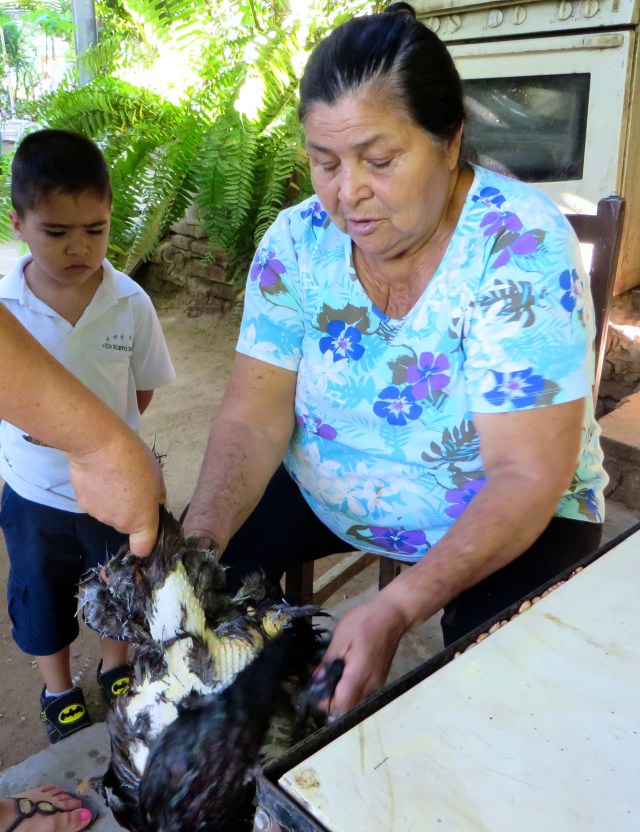
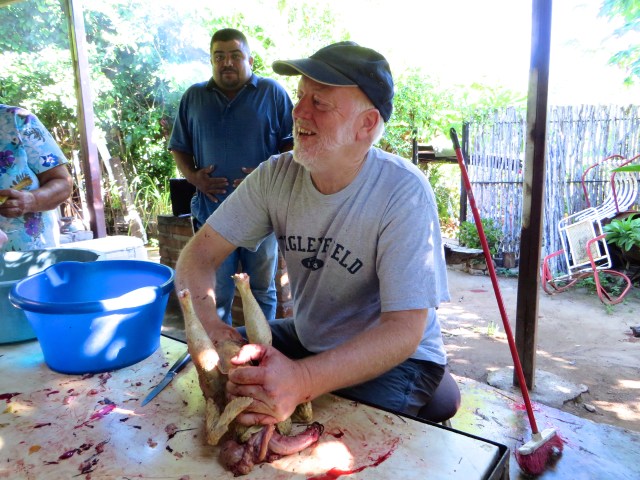
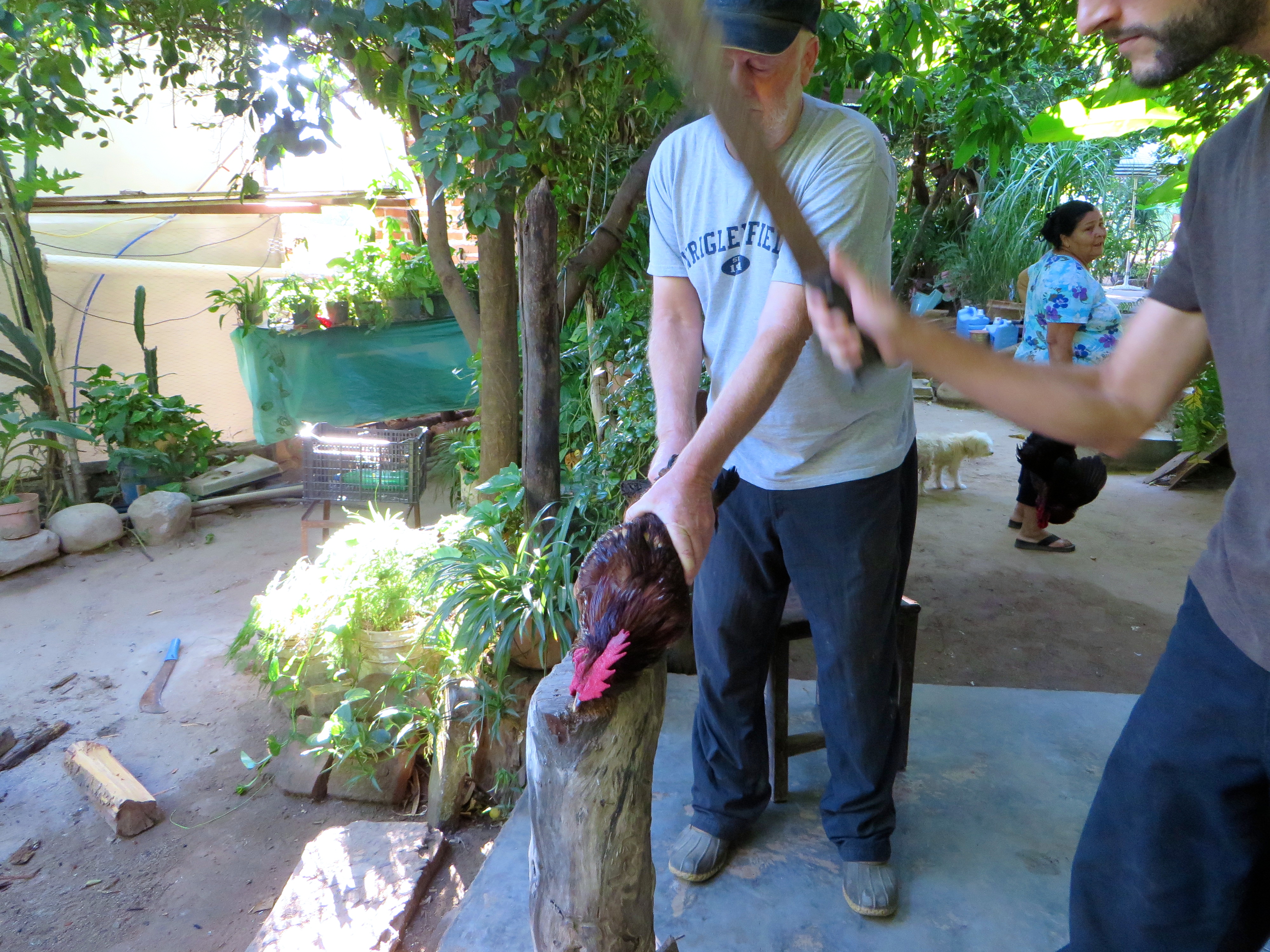
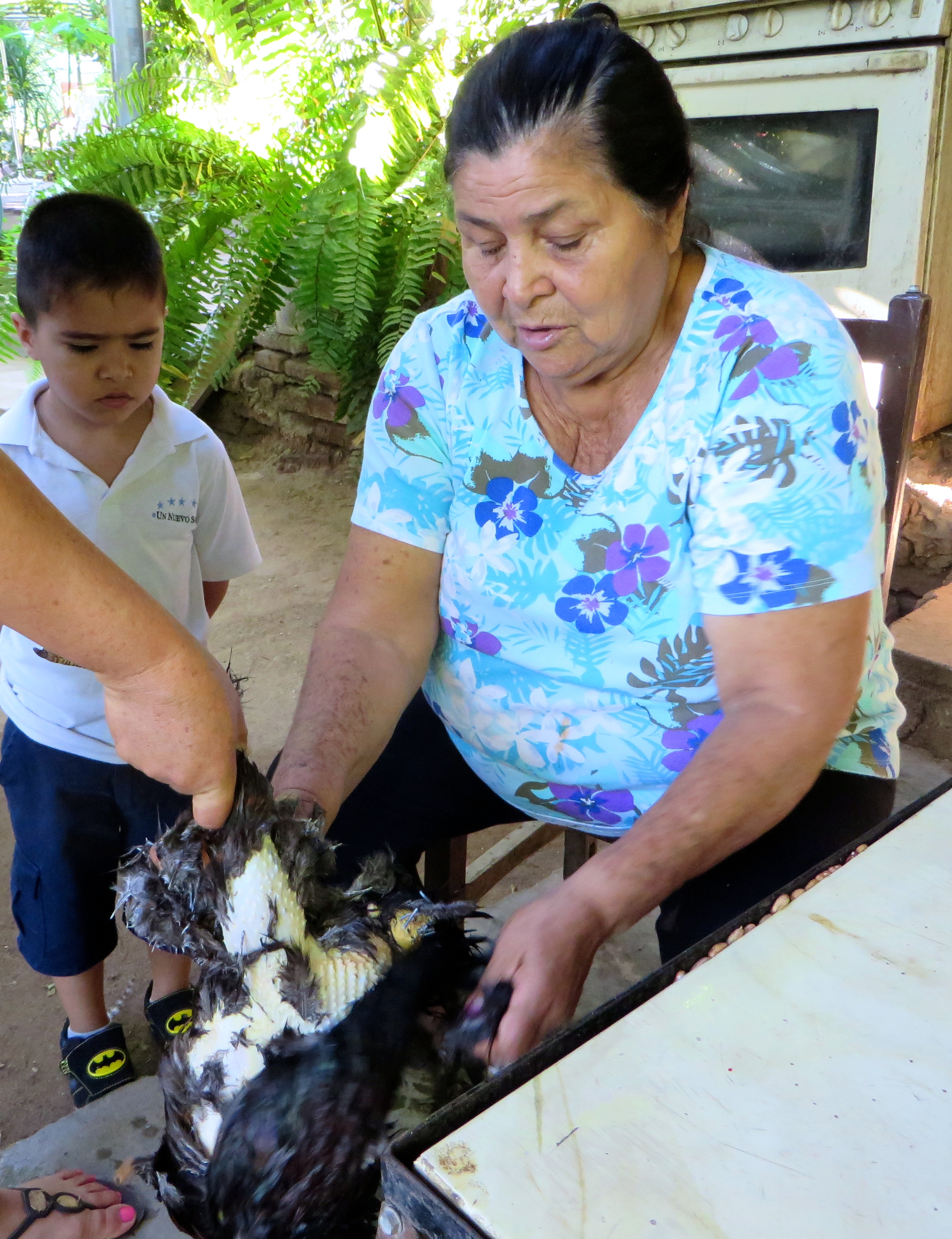
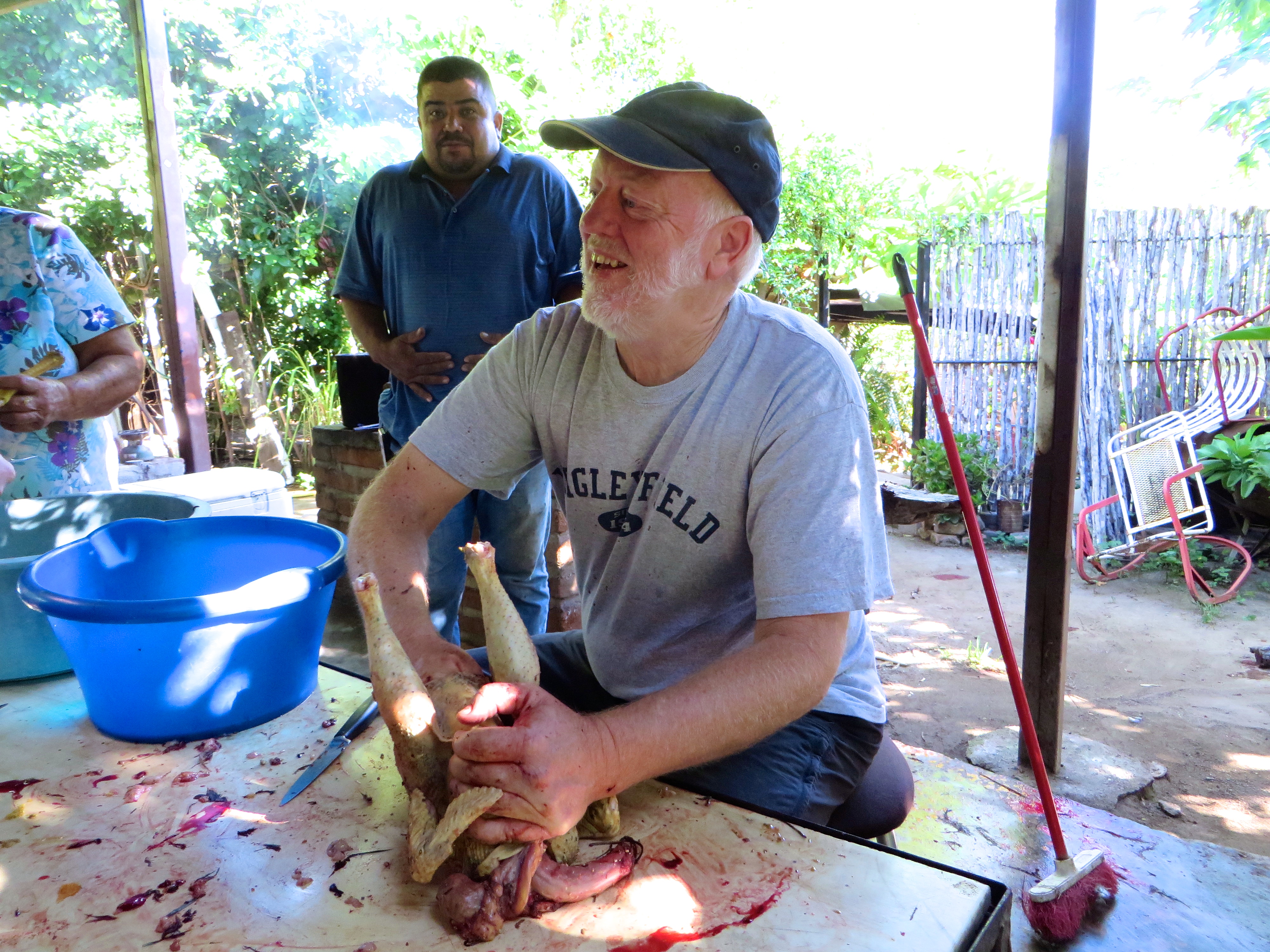
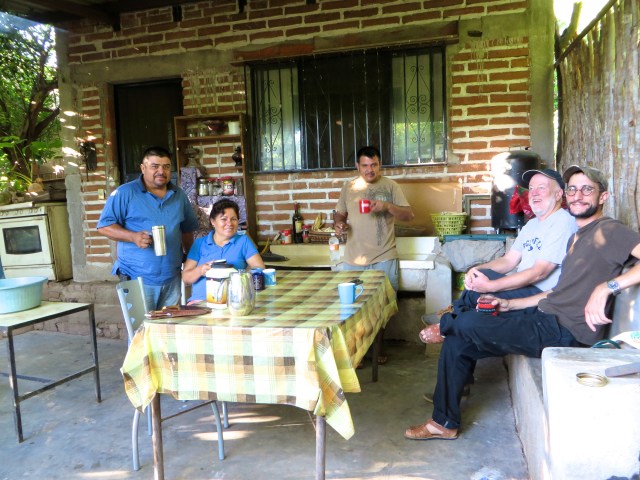
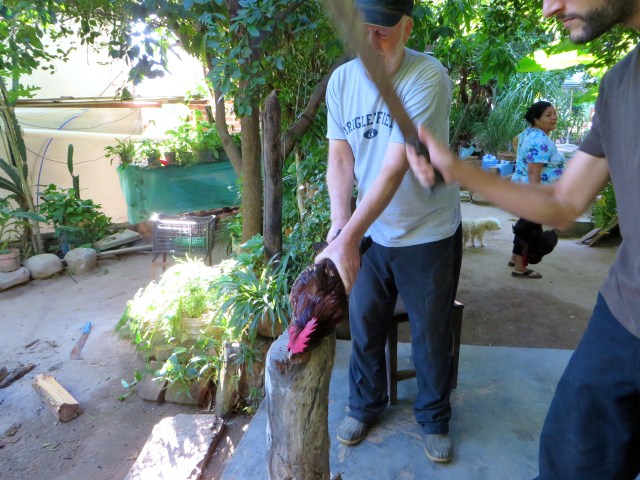
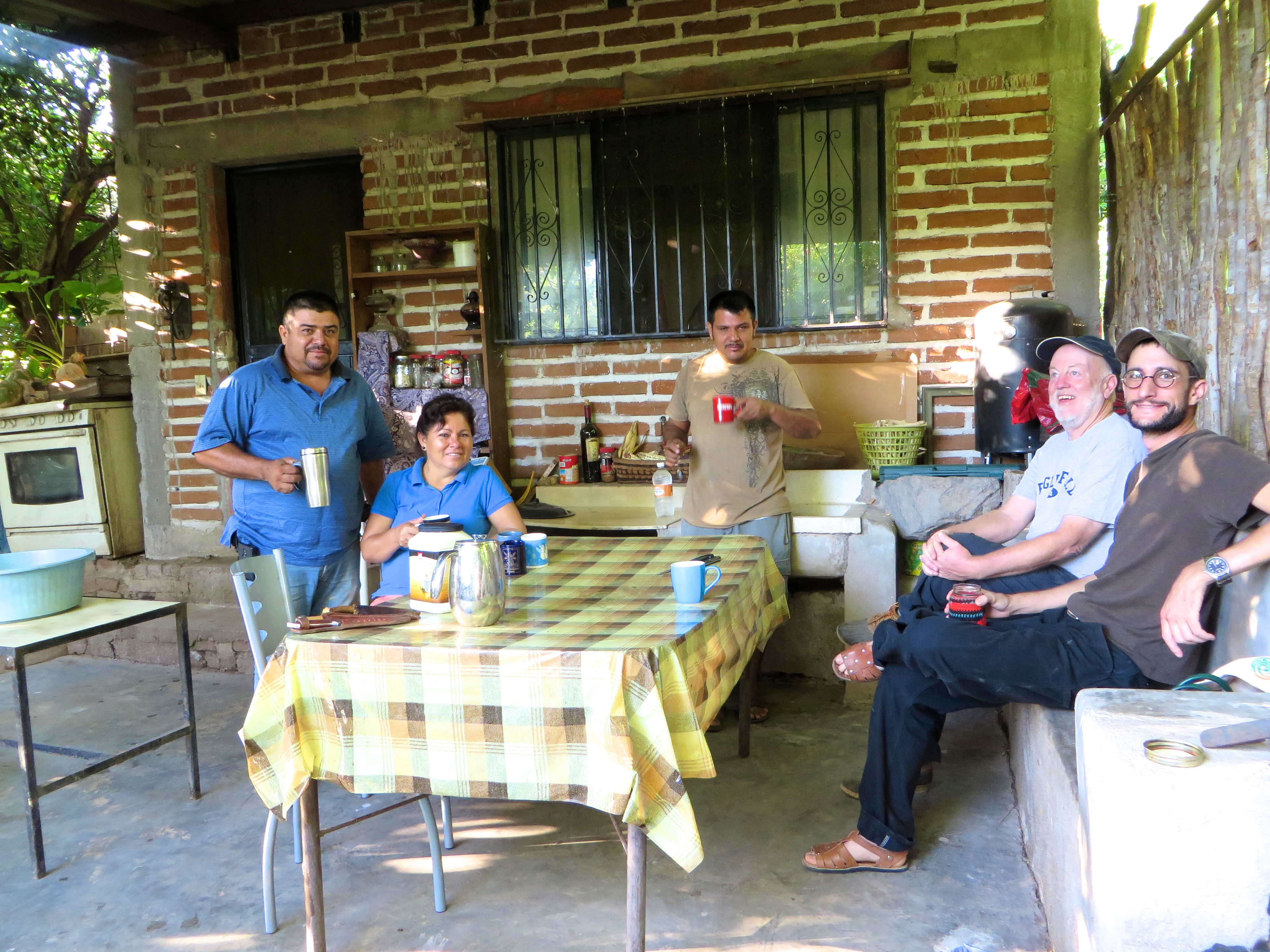
This morning, we helped a good friend here in Alamos butcher six young roosters. He has a large flock of egglayers, plus he incubates fertile eggs and raises his own chicks. Hence, he occasionally has to reduce the number of males in his flock because of the roosters’ unfortunate habit of harassing hens. We met at 7 am in his family’s outdoor kitchen, where a large pot of water was heating on the wood-fired stove. The approach of butchering this morning was basically identical to how we butcher in Minnesota. There is the sharpening of knifes, the assembly of basins and buckets, the heating of water in which to dunk the birds to loosen the feathers for plucking. We sat for awhile around the big table on the patio, drinking coffee and talking. This is what I call the time of mental preparation for the task at hand. IMG_0655 We then rounded up the roosters and began to butchers. The only differences in the work today from my prior experiences: The language was Spanish, not English. The water was heated on a wood stove, not propane. The chopping implement was a machete, not a cleaver. And our friends showed us the practice of making a cross in the dirt, where the headless chicken is placed to alleviate thrashing. The first rooster was placed on the cross. The others were placed around it. There were seven of us working, so it took less than an hour to dispatch the six roosters. IMG_0659 IMG_0668 IMG_0670
The following essay appeared in the New York Times Sunday Magazine on February 7, 1999:

“The Savage Life”

Every few years I butcher chickens with a friend named Chuck who lives near the farm my husband and I own in northern Minnesota. Chuck buys chicks and takes care of them for the 10 weeks it takes them to mature. I share in the feed costs, but my main contribution — for which I get an equal share of birds — is to help slaughter them.

One day last fall, Chuck, two other friends and I butchered 28 chickens. We worked without stopping from 10 A.M. to 6 P.M. By the time it was over we had decapitated, gutted, plucked, cleaned and swaddled each bird in plastic wrap for the freezer. We were exhausted and speckled with blood. For dinner that night we ate vegetables.

Butchering chickens is no fun, which is one reason I do it. It is the price I pay for being an omnivore and for eating other meat, like beef and pork, for which I have not yet determined a workable way to kill. The first time I caught a chicken to chop its head off, I noticed, as I cradled it in my arms, that it had the heft and pliability of a newborn baby. This was alarming enough, but when I beheaded it, I was not prepared to be misted in blood or to watch it bounce on the ground. Headless chickens don’t run around. They thrash with such force and seeming coordination that they sometimes turn back flips.

When I first saw this, three things became clear to me. I realized why cultures, ancient and contemporary, develop elaborate rituals for coping with the grisly experience of killing any sentient creature. I understood why so many people in my largely bloodless nation are alarmed at the thought of killing anything (except insects) even though they eat with relish meat other people process for them. I saw why a small subset of my contemporaries are so horrified by the thought of inflicting pain and causing death that they maintain people should never kill anything.

One risk I run in this self-imposed food-gathering exercise is leaving the impression, or perhaps even furtively feeling, that I am superior to the omnivores who leave the killing of their meat to someone else. I don’t think I am. Slaughtering my own chickens is one of two opportunities (gardening is the other) where I can dispense with the layers of anonymous people between me and my food. I have no quarrel with them. I just don’t know who they are. They are not part of my story.

Killing chickens provides narratives for gathering, cooking and sharing food in a way that buying a Styrofoam package of chicken breasts does not. I remember the weather on the days we have butchered our chickens, and the friends over the years who’ve come to help, who have included a surgical nurse, a cell biologist, a painter of faux interiors, a Minnesota state representative who is also a logger, a zoologist, a nurse with Head Start and a former Army medic who now runs the physical plant at a large hospital. I can measure the coming of age of my partner’s two kids, who were tykes the first time we butchered chickens 10 years ago, and who this go-round were well into puberty with an array of pierced body parts.

My mother, who was born in 1907, belonged to the last generation for whom killing one’s food was both a necessity and an ordinary event. Her family raised chickens for the purpose of eating them, and her father taught all his children to hunt. My survival does not depend on killing chickens, but in doing so I have found that it fortifies my connection to her. It also allows me to cast a tenuous filament back to my feral past. In 1914, Melvin Gilmore, an ethnobotanist, wrote, ”In savage and barbarous life the occupation of first importance is the quest of food.”

Having butchered my own chickens, I now feel acquainted with the savage life. As exhilarating as this may be, I do not thrill at the prospect of beheading chickens. Several days before the transaction, I circle around the idea of what my friends and I will be doing. On the assigned morning, we are slow to get going. There are knives and cleavers to sharpen, vats of water to be boiled in the sauna house, tables and chairs to set up, aprons and buckets to gather, an order of assembly to establish. In their own ritual progression, these preparations are a way to gear ourselves up. I feel my shoulders hunch and my focus narrow. It is like putting on an invisible veil of resolve to do penance for a misdeed. I am too far gone in my rational Western head to appropriate the ritual of cultures for whom the bloody business of hunting was a matter of survival. But butchering chickens has permitted me to stand in the black night just outside the edge of their campfire, and from that prospect I have inherited the most important lesson of all in the task of killing meat: I have learned to say thank you and I’m sorry.
Posted in Mexico | Comments Off on Butchering

The Oriole in the Ipomea

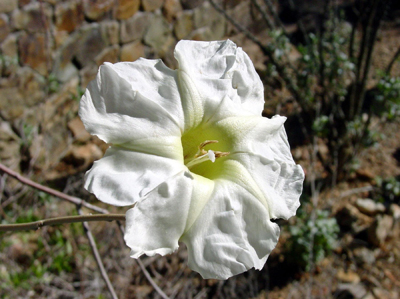
Flower of the Ipomea. 2002 ASDM Sonora Desert Digital Library / photo by Mark A. Dimmitt

Flower of the Ipomea. © 2002 ASDM Sonora Desert Digital Library / photo by Mark A. Dimmitt

We were walking on the path along the rim of the Chalatón Arroyo. It is one of the numerous, bouldery, deeply dissected drainages that tumble off the Sierra de Alamos on the edge of our town in Sonora, also called Alamos.

It was a morning in December when the Ipomea trees are leafless and in bloom. At this time of year, their skeletal white trunks stand out in the forest landscape and their many pearly white flowers perch one by one on the tips of the skyward-pointing branches. If a candelabra could be a tree, it would be an Ipomea.

We came upon an Ipomea on the path. A brilliant yellow-and-black oriole was acrobating in the tree, dangling from one branch tip, hopping to another, eating the flowers or perhaps some insects on the flowers or both. I should be more observant.

Flowers were strewn on the ground around the base of the tree. Other flowers nested in the branches of surrounding bushes, captured in their free fall. While we stood there, a few flowers drifted down. Ipomea flowers are diaphanous, moist and gauzy and glow with an inner light. I can imagine a gown of Ipomea blossoms. We stood there, looking up at the oriole in the Ipomea and down at the halo of flowers. At that moment I silently proclaimed the Ipomea as my favorite tree, but I have made silent proclamations about other trees on other occasions of clarity.

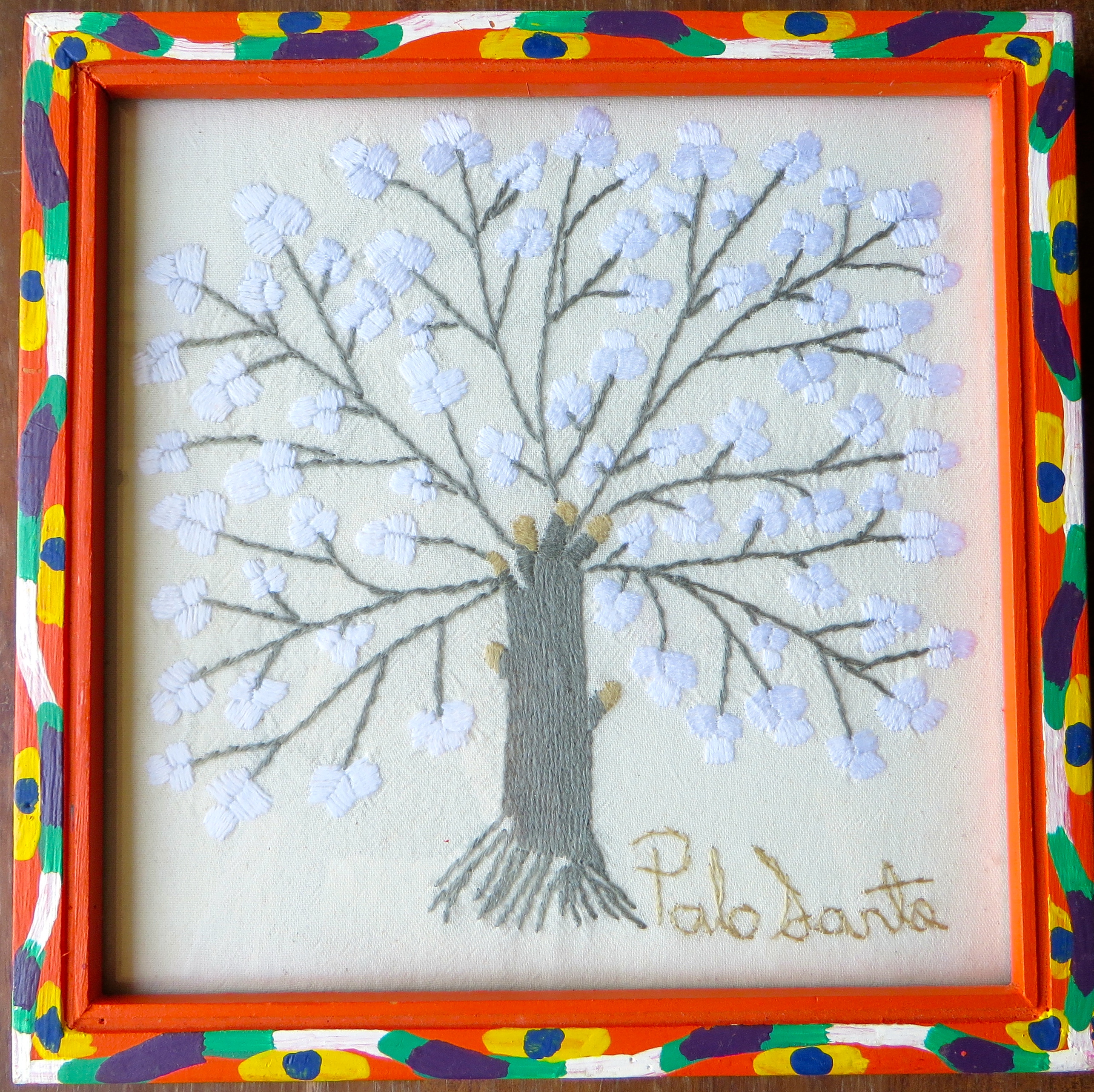
This embroidery captures the joyful essence of the Palo Santo. Alicia Sánchez de Cano, of Alamos, Sonora, is the embroiderer. Her husband, Hilario Cano, made the frame.

This embroidery captures the joyful essence of the Palo Santo. Alicia Sánchez de Cano, of Alamos, Sonora, is the embroiderer. Her husband, Hilario Cano, made the frame.

A footnote about the oriole and the Ipomea:

The black-vented oriole, Icterus wagleri, is a robust bird of semiarid scrub landscapes ranging from Mexico to Guatemala, El Salvador, Honduras, and Nicaragua. It is not shy. It’s plumage — shiny black above with a lemon yellow breast — makes the bird look like it is wearing a tuxedo. As Steve Howell succinctly writes in A Guide to the Birds of Mexico and Northern Central America, “Often seen in leafless flowering trees.”

Ipomea arborescens is a distinctive tree of the thorn scrub and tropical deciduous forest of Mexico. It ranges from Sonora and Chihuahua in the northwest of Mexico to Veracruz and Oaxaca in the south. The genus name is pronounced ee-poe-MEE-ah. Its common names are Tree Morning Glory and Palo Santo. In the winter months, Ipomeas are leafless but profuse with white flowers. Across the landscape, even in broad daylight, they flicker like candles.

Posted in Mexico | Comments Off on The Oriole in the Ipomea

Aunt Jeannette

When I was seven or eight — old enough to stand up and pay attention when an elder spoke in an authoritative voice — Aunt Jeannette taught me how to iron a shirt. The occasion was the funeral of my maternal grandmother.

Various relatives were staying in the family homestead at 17 Wilson Street in Struthers, Ohio. It was my archetypal house, white frame, two stories, laundry chute, front porch with gliders, gauzy curtains on the windows, and any house with an address of less than four digits was undeniably very special.

I remember the adults scurrying around, as I later learned was the behavior of people preparing to go to a funeral. I was trying to iron a shirt in a haphazard way, even though I was not invited to the funeral. In the 1950s, children, at least in my subculture, were not permitted to see dead bodies in caskets. Perhaps Aunt Jeannette was nervous. Well, Aunt Jeannette was always nervous, twisting and turning her tall, thin body like a preening heron. She certainly was perplexed, standing there watching me ironing.

Collar first.

Collar first.

Then the yoke.

Then the yoke.

Right sleeve next.

Right sleeve next.

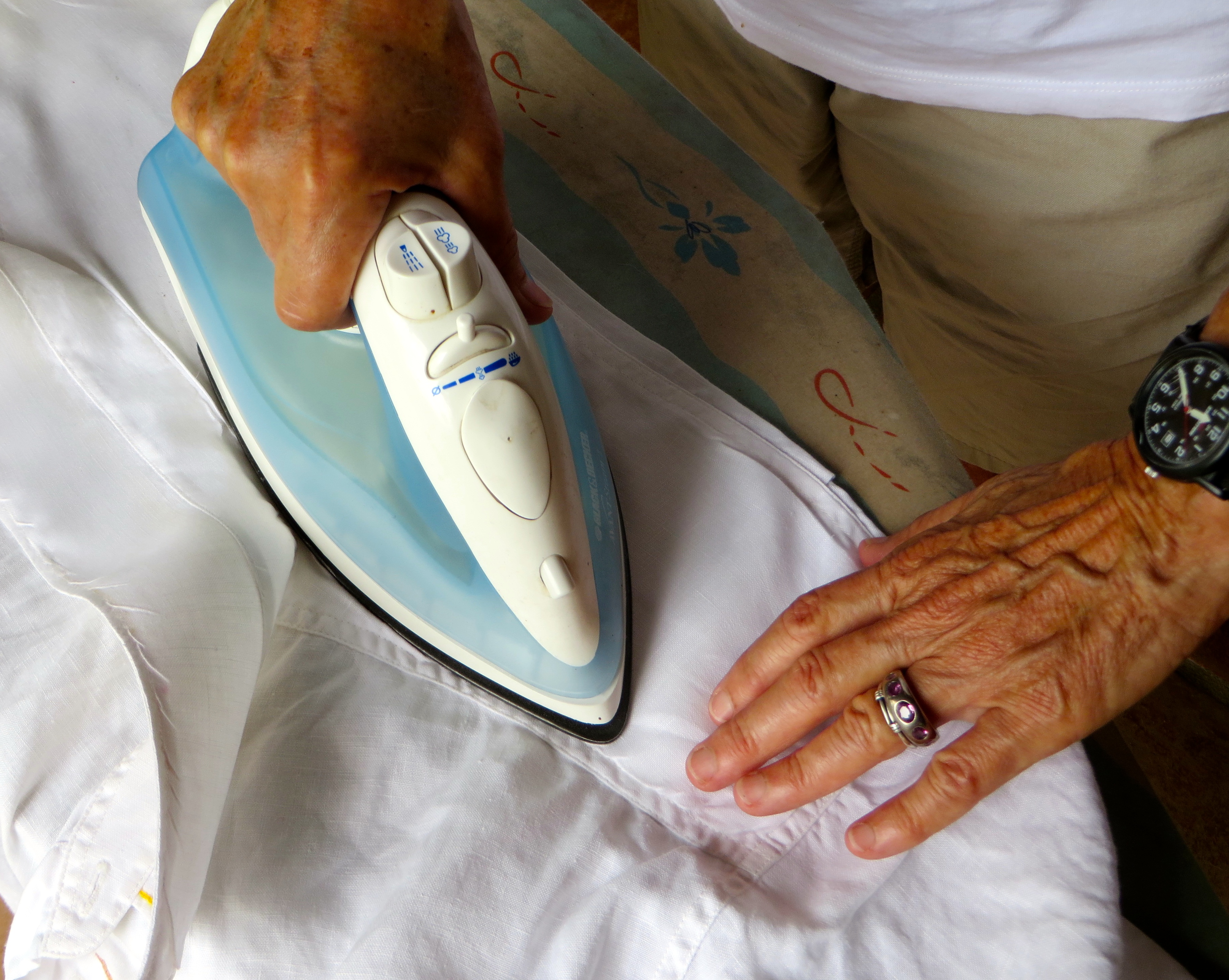
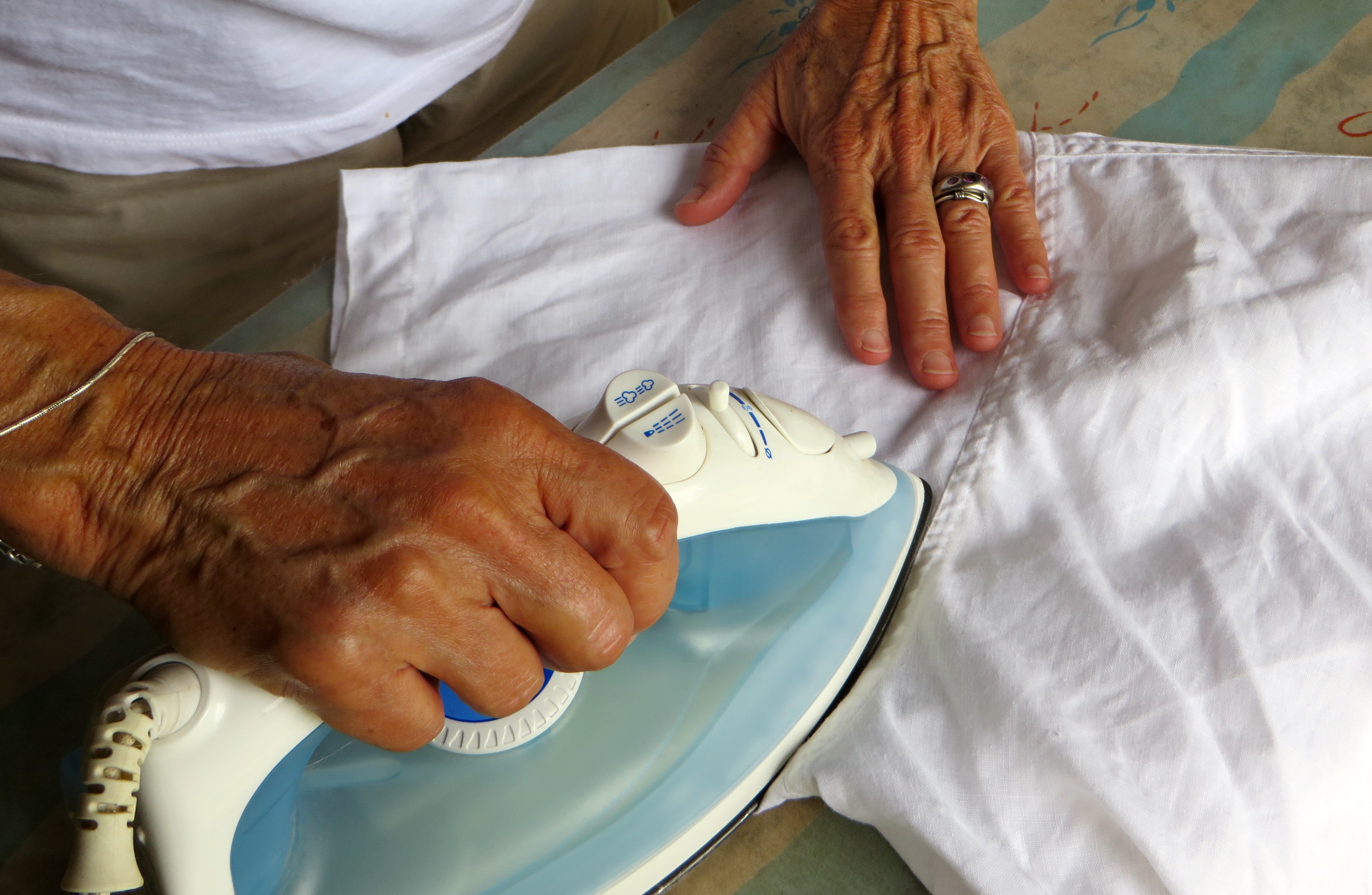
She took the shirt and marched me through the method. Always iron the collar first, then the yoke. Iron the right, then left sleeve, front and back sides of each. Position the shirt so the upper right front is flat on the ironing board and iron that portion. Swing the shirt around to likewise position and press the upper left front. Now place the left placket on the board and pull it taut to iron it. Whether there are buttons on the left (female) or right (male) placket will depend on the gender of the shirt. Iron the remainder of the left front. Pull the shirt forward, smoothing and ironing the leading portion of the back and continuing to iron the rest of the back. Pull the shirt again to position the right front on the board, then iron the right placket, not forgetting to pull it taut. As for the buttons, treat them as an archipelago, carefully maneuvering the prow of the iron between each island but also pressing hard. Being two folds of fabric, the placket needs extra heat and force.

I suspect few people these days know the architecture of a shirt and even fewer iron them. Not me! Aunt Jeannette’s lesson has guided my life and may also explain why I wear cotton and linen — it is an excuse to iron. Sometimes I iron a shirt to calm down. I never iron a shirt without thinking of Aunt Jeannette.

She was the odd aunt who married my Uncle Rusty, so called for his red hair that turned white during his service in World War II. His siblings, who adored him, and their spouses, and their offspring, who included me, always twittered about Aunt Jeannette but we embraced her. She was an intrinsic part of the family, and while we thought we had license to twitter, no one else did. Among her quirks was her birdlike appetite. From my earliest memory she only ate nuts and other small handfuls of food.

They never had children. I do not know why. Their decision or inability was a boon to the nieces and nephews. Every Christmas of my childhood, Aunt Jeannette and Uncle Rusty sent me and my sister, Peggy, each a book. My mother early-on instilled a love of reading in her two daughters. Her brother and his wife simply made it clear that there is no better gift than a book.

In their retirement, Aunt Jeannette and Uncle Rusty spent some years on the Florida coast where they both became knowledgeable about sea shells. I like to think this shared interest was a clue to a mysteriously happy marriage that onlookers could not fathom. Through parsimony and planning and caring about family, they saved money. He died. Quite some years later, she died. Through their bequest, I inherited approximately $24,000. This was enough to pay cash for a 2010 4WD Toyota Tacoma that has taken my husband, David, and me into some very remote and rugged parts of Mexico. I ironed a shirt today.

Posted in West Saari Road | Comments Off on Aunt Jeannette