11-02-24

The cemetery at Rancho Tlacuachi in the municipio of Alamos, Sonora, Mexico

Today we went out to the cemetery at Rancho Tlacuachi with Leobarda and her two grandchildren Guadalupe and Rogelio. It is Día de los Muertos. We’ve been to the cemetery several times with her but never on this day. 

When we got there, we saw that the cemetery had been cleaned and all the graves dusted and decorated with flowers, fresh and fake, as well as candles called velas. The place almost seemed to luminesce. 

David, Leobarda, and Guadalupe carrying candles and flowers

Leobarda, the children, and David set to work adding more flowers and candles to her family’s graves – her brother, mother, father, some siblings who died young. I watched. Another family arrived in a pickup truck. 

A wisp of a man in tattered clothes with about four teeth in his mouth appeared as if from thin air. Leobarda knew him – and, for that matter, everyone else who was there. He lives at a nearby ranch and is the current caretaker of the cemetery. His name is something like Raimundo. His nickname, no surprise, is Mundo. I assume he did the tidying up (or supervised it), and there must be some cemetery fund for purchasing the flowers and velas. We laughed with him. He went to join the other families in a shady spot where he sat on his haunches with a Tecate and cigarette. Off and on, he would mill around talking to folks and straightening flowers on graves. 

Mundo, the cemetery caretaker, and Leobarda

I went to look at the newest grave, still with mounds of dirt around it. The date of death was October 24th, and the age of man interred was 35. I shuddered. I asked a woman Leobarda had been talking to if she knew what happened. She put her hand around her throat. He had committed suicide leaving five children and a wife. He was from her same village.  

Several more families arrived and went to work around the graves of their departed ones. It is always striking to me, coming from a city, how quiet the campo is. Just the breeze and murmur of people talking and laughing. 

The breeze, though slight, kept blowing out the velas, and Leobarda and her grandchildren spent a fair amount of time relighting them. The wind would extinguish a certain portion again. We don’t want the candles to go out. We don’t want the people we love to die. I suspect over the afternoon and evening, more people came, and tonight, in the dark, perhaps a few candles will still flicker in the cemetery at Rancho Tlacuachi. 

Posted in Mexico | Comments Off on 11-02-24

A Cloud over Alamos

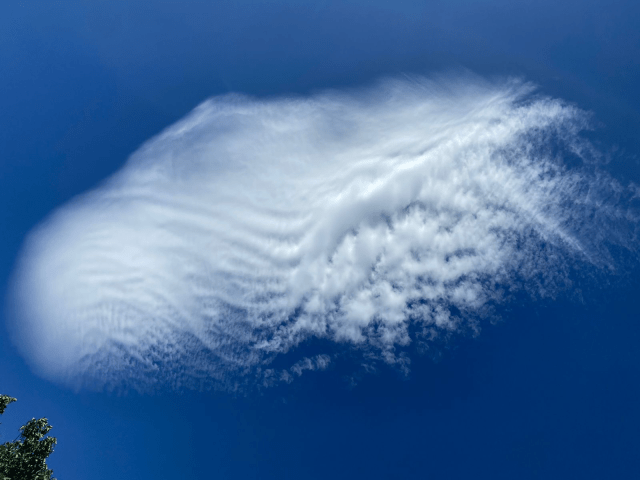
This cloud was hovering over the Sierra de Alamos in the dawn light when I walked onto our portal at 5:30 a.m. on September 16, 2024. It was a peach and silver flying saucer. It seemed to glow. It was calming. I climbed the stairs up to our roof and took some photos.  

The name for this cloud is lenticularis. It is a type of cloud that forms most often on the lee (downwind) side of hills and mountains in persistent standing waves of invisible air. It is a cloud that because of its ethereal permanence calls attention to itself. 

I climbed down from the roof, retrieved my cup of coffee I had left on the portal, and went about my day. 

People around here know I watch clouds. Over the morning two friends, Elly and Rafa, sent me photos of the same cloud. It had changed from shadowy pastel to brilliant white. Clouds are mirrors of the light that shines on them. Its shape had change, too – my birdwatching friend Rafa called it a wing cloud – but it was in the same place, silently hovering over the flank of the mountain and over our town of Alamos. Its presence indicated that the invisible waves of air were still steadily coursing over the crest of the sierra.  

Elly MacKay’s cloud, 9:05 a.m.
Rafa Arenas Wong’s cloud, 10:40 a.m.

Around 11:30 I went outside to hang up some clothes. The cloud had diminished in size but was still there, hovering, silent. 

By now the cloud had hovered in place for at least six hours. I went inside to our kitchen and a few minutes later looked out the window. The lenticularis had extinguished, or rather evolved, into a lacy patch of cloud called lacunosus. This formation appears when pockets of cold air sink through a cloud layer, creating a spiderweb-like cloud that, unlike lenticularis, is fleeting. It lasts for a few minutes to seconds. I ran to get my cellphone but the lacunosus had vanished. (I am still kicking myself for missing this one.) 

Later, I started to wonder if other folks in town, besides my friends Elly and Rafa, had noticed the hovering lenticularis. It is such a gorgeous and eye-catching cloud – plus I knew there would be a lot of people outside. September 16th  is Mexican Independence Day – a very big day all across the country. Alamos, along with every city and town in Mexico, has a big parade. Some of the parade goers must have looked up and noticed. 

So I uploaded my early-morning image and Elly’s later photo on Mitotech Alamos Informa, the community Facebook page, and asked if anyone had seen the cloud or a variation of it. To my surprise, more than 200 people responded, and quite a few posted photos and videos. What can I say? I was thrilled that so many of my fellow citizens in Alamos, Sonora had looked up and marveled at the lenticularis we all shared on Día de Independencia

Here is the lenticularis, captured by Carlos Cuadras, hovering above Mexican flags wafting in the breeze over the Palacio, the city hall in Alamos. Carlos’ photo is used with his permission.
It was one of many photos taken by people in Alamos and posted on the community Facebook page.

Posted in Mexico | 4 Comments

It’s a toad, no it’s a bug

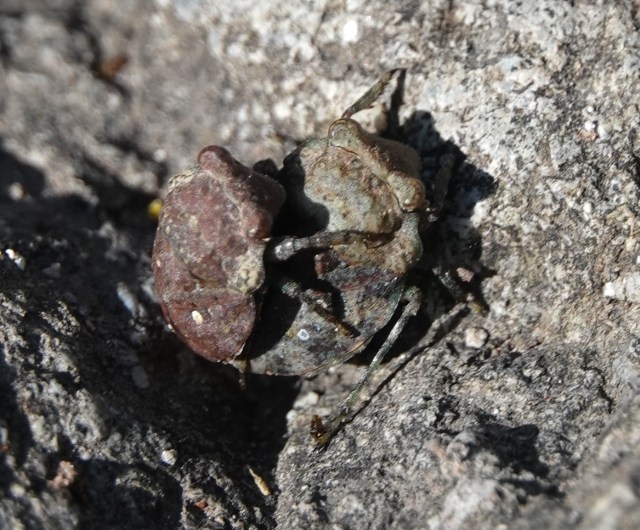
On August 28, 2024, while looking for odonates at stream crossings in El Arroyo Taymuco, I happened to be staring down at a boulder I was about to crawl over when I saw something tiny teetering in a crack in the surface of the rock. “What the heck?” I thought. It looked like a chip off the old boulder – the same speckled coloration – except it was alive and moving, sort of. I nudged it. It lurched. I figured it must be some sort of insect, even though I couldn’t make out any distinct features. I photographed it. Back home, at my computer, when I zoomed in on the image, “it” was not one, but two bugs piggy-back presumably copulating. They looked like tiny frogs, smaller than a dime. 

These warty creatures are distinctive enough that even a novice can identify them to family with a fair degree of certainly – not often the case with many thousands of insects. With the help of Stephen A. Marshall (Insects: Their Natural History and Diversity), Stephen Cresswell (Insects of Latin America: A Photographic Guide), and my husband, David Smith (who has encountered these bugs before), I was able to put a name to them: toad bugs in the family Gelastocoridae (order Hemiptera). I will even be so bold to say they are probably in the genus Gelastocoris. 

It is a small family, as insects go, with about 100 species worldwide, divided into two genera, Gelastocoris  and Nerthra. Not much is known about the life histories and behavior of individual species, especially in the wild. In the early 1990s, Lara N. Brown and J. E. McPherson, entomologists in Illinois, collected individuals of the widespread toad bug, Gelastocoris oculatus oculatus, and reared them in a laboratory. Their findings published in 1994 (see citation below) make for interesting reading. I noted with glee that they frequently observed their specimens “riding and copulating” just like my wild ones. 

Toad bugs are not easy to study in their habitats. They are mostly secretive, cryptic, and most species dwell in the tropics, which are still in many places remote and difficult to access with hot climates. Nerthra species seem to be mostly nocturnal, making them especially challenging to find. It was thought that toad bugs were strictly riparian, living and breeding in the sandy, muddy, rocky edges along streams and ponds, but toad bugs in the tropics have been observed far from water in litter of vegetation – rotting logs, under banana leaves, etc. 

Toad bugs do hop, a mode of moving that is also useful when feeding. They are mighty little predators, with specially adapted raptorial front legs for pouncing on and grasping prey (other insects). Like all species in the order Hemiptera, toad bugs have piercing-sucking mouth parts for consuming their prey. 

In 1955, Edward L. Todd (citation below) published a taxonomic revision of the toad bug family that apparently has not been superseded by more recent molecular-based taxonomic assessments. I say “apparently” because in the small Mexican town where we live I am limited by what I can dig up on internet searches. What delighted me about Todd’s publication was coming across, among the listings of all the museum specimens he examined, a number of specimens of four species of toad bugs collected by Howard Scott Gentry on the Río Mayo and around Alamos, Sonora, where we live and wander.

Gentry (1903-2005) is a legend among the clan of naturalists who have an interest in the Tropical Deciduous Forest of Sonora and the surrounding Sonoran Desert. Starting in 1933, he spent twenty years roaming Northwestern Mexico – when it was really wild – searching for and collecting plants. As well as a botanist and ethnobotanist, he had wide-ranging interests and collected, shared, and sold specimens of other organisms besides plants. Like toad bugs. Gentry’s Rio Mayo Plants (University of Arizona Press, 1998) is a posthumously updated version of his classic work on Sonoran-Chihuahuan botany.   

I have no doubt that I’ve overlooked toad bugs when walking along or wading in streams here in Mexico. Now that I have a search image, I do hope to stumble on more. 

Lara N. Brown and J. E. McPherson “Life History and Laboratory Rearing of Gelastocoris oculatus oculaturs (Hemiptera: Gelastocoridae) with Descriptions of Immature Stages” (Proceedings of the Entomological Society of Washington 96(3) 1994, 516-526). 

Edward L. Todd, “A Taxonomic Revision of the Family Gelastocoridae (Hemiptera)” (University of Kansas Science Bulletin, October 15, 1955 vol 37, no. 11, 277-475). 

Posted in Mexico | Tagged | Comments Off on It’s a toad, no it’s a bug

Vote

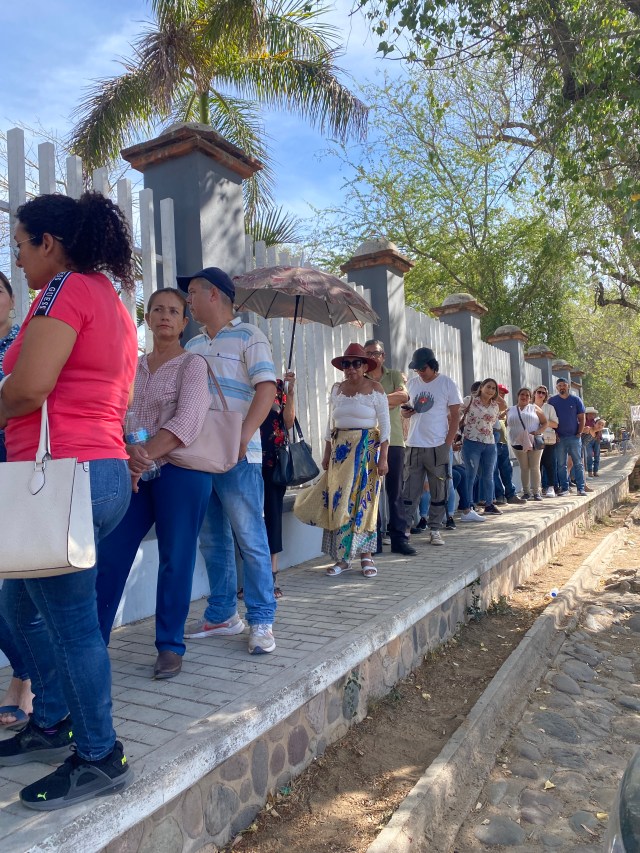
Election Day, June 2, 2024, in Álamos, Sonora, Mexico.

June 2, a Sunday, was election day in Mexico. It was also the quietest day I can recall in Alamos, Sonora, where we live. Ordinarily, Sunday is hopping with tourists (our town is a popular weekend destination) and with locals out and about shopping and relaxing (Sunday is the only free day most Mexicans have off work). The classic tip-off that it’s Sunday in Álamos are the scattered congregations of men in white cowboy hats, jeans, and boots standing around the tailgates of pickups drinking beer. On my comings and goings on June 2, I did not see any of these congregants taking their communion. It seemed to me that people had one destination in mind – their specified casillas, polling places. 

A significant contributor to the peace and quiet is the authority vested in the 32 states of Mexico to ban or restrict the sale and consumption of alcohol the day before and the day of elections. Most states do so. It’s called la ley seca – the dry law – and it just makes life and election day simpler and saner. In addition, political parties cannot campaign for several days before elections, and they absolutely cannot gather with their paraphernalia outside the casillas on election day. 

An American has to wonder. Why are US federal elections not held on Saturday or Sunday when most voters are off work? Why don’t we restrict campaigning in the days leading up to elections? Why don’t we ban the gathering of increasingly rowdy political party operatives at polling places? 

For a number of reasons, the June 2 election was the largest in the history of Mexico. In addition to the presidential election (which occurs every six years), there was an unprecedented number of races around the country – all 128 senators, all 500 members of the chamber of deputies, nine gubernatorial candidates, and more than 19,000 local elections. Also more and more Mexicans living abroad have been voting since 2006, when the National Electoral Institute (INE) granted these citizens the right to vote in presidential elections. They have the option to vote online or to mail in their ballots, and this year, for the first time, Mexicans aboard could vote in person at Mexican consulates around the world. In major US cities the lines were long, very long

And then there was the fact – and motivation for many voters – that Mexicans would elect the first woman president in their history. Two women and one man were on the ballot (he and his party never got traction). As the polls predicted, Claudia Sheinbaum, of the Morena party and the protégé of the current controversial president AMLO – Andrés Manuel López Obrador – won by a landslide. 

An American has to wonder. When will the US elect a woman president? 

I am not going to pretend I do not know this: the electoral process in Mexico is not safe for candidates running for local offices in areas of cartel lawlessness who challenge these barbarians or cannot be bought off or otherwise intimidated by them. Millions of Mexicans, and thousands of local candidates, are not under this menace – something the US media fails to explain to American readers – but still that does not mitigate the fact that 37 local candidates across Mexico were assassinated while campaigning this year.  In 2021, for the midterm elections, 36 candidates were assassinated. So this bloody cartel mayhem is not an anomaly but a norm. It is far and away the biggest trauma and problem facing Sheinbaum and the Mexican people. Just as domestic gun violence and mass shootings are America’s biggest nightmare.

It is hard to put this havoc aside. But I will for a day. I will never forget June 2.  It was serene in my village, and I got to observe the greatest privilege of my species – the right to stand peacefully in line and vote.  

Two main sources: 

https://www.wilsoncenter.org/article/mexican-voters-united-states-voting-power-and-process-those-voting-abroad

https://www.reuters.com/world/americas/mexican-candidate-assassinations-hit-grim-record-ahead-sundays-election-2024-06-01/

Posted in Mexico | Comments Off on Vote

Phasmatodea

This is a stick insect. It is in the order Phasmatodea. I photographed this one at Playa las Mariposas on the Río Aguas Verdes in Perú on March 15, 2024. I wish every part of it were in focus, but photographing a gangly, swaying organism in dim light is challenging for me. Notice its large lower lip. The mandible is a key feature of Phasmatodea. Stick insects are herbivores. Their primary occupation is masticating plant matter. To avoid predators, adult stick insects are largely nocturnal. Their compound eyes are adapted to allow mature phasmids to move about and perceive details in the dark. 

I knew basically nothing about stick insects – or most insects for that matter – until recently when I assigned myself the belated task of learning the major orders of the class Insecta. My husband and quite a few friends are far ahead of me in their insect mastery. Where have I been? 

Phasmatodea is a relatively small order containing about 3,500 described species – compare that with Coleoptera, the beetles, with around 400,000 described species. But as a group they are very poorly known. According to this informative website https://phasmatodea.com/identification, entomologists who study phasmids are still struggling to correctly identify and organize all the genera and species. The obstacles are many: males and females of the same species, not to mention the nymphs, can look quite differently from one another; one species can be extremely variable in terms of morphological features such as coloration, size, body armature and camouflage. Add to these challenges the facts that phasmids disguise themselves as twigs and leaves, are nocturnal, and most species are found in the tropics, which are difficult, often remote environments to work in. It sounds like a Sisyphean task. The order is unlikely to be untangled until more molecular tools are used to identify species. 

Needless to say, there is no consumer demand for a field guide to the Phasmatodea, as wonderful as they are. There are a few guides in specific geographic areas where stick insects are relatively common, and where there is a critical mass of entomologists who study them, like Borneo. I will poke around from time to time in the phasmid literature online, but it is unlikely I will ever identify “my” stick insect to genus and species. That is just fine. I am happy I stumbled across this one, and as I am adapting to moving through the world more slowly in search of insects of all sorts, I hope to stumble on a few more. 

Posted in Insecta | Comments Off on Phasmatodea