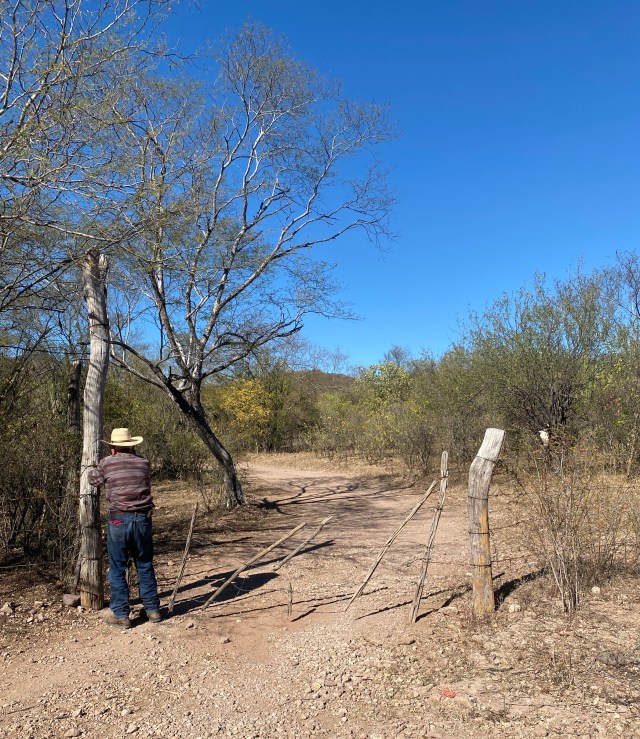
This stretch gate looks like any of its kind in any landscape where livestock need to be kept in or out and where people do not have the means or inclination to invest in a more substantial barrier. This gate is in southern Sonora, Mexico, in the Municipio of Alamos.
We have been passing through it for more than twenty years. Maybe not this exact gate, but some version of it. The tensile stress of repeatedly opening, dragging, and stretching a stretch gate causes wear and tear on its materials, especially the tree branches that serve as pickets. These are easily and affordably replaced. It just requires the knowhow to wire the pieces together and to not get nicked on the barbed wire in the process. Stretch gates cause a certain amount of wear and tear on the people who open and close them.
In the photo above, taken on December 10, 2023, Don Ángel Esquer, 92 years old, is closing the stretch gate at the end of an overnight trip we took with him.
The road ahead goes through cattle pastures and thorn-scrub woodlands then begins to climb up into the foothills of the Sierra Madre Occidental, becoming rockier and gnarlier as it ascends. The landscape becomes wilder, the scraggly vegetation giving way to galleries of columnar cactus, giant fig trees, oaks, pines, and palms. The vistas extend across multiple ranges of mountains to a faraway horizon. In places it passes along sheer cliffs falling into shadowy barrancas. The road ends at Rancho Santa Barbara. It was our destination with Don Ángel.
In the United States, an equivalent landscape might well have the status of National Park or Wilderness Area. The entry would be well marked. There would be a kiosk with informational maps and checklists, if not a visitor’s center and gift shop. There would be tourists with cellphones.
Here, there is just a stretch gate.
I think of the gate as my secret passage. It is quite possible that sooner or later multitudes of people with discretionary incomes – tourists, in other words – will discover what lies beyond the gate. I have no control over this possible future. I am an interloper of sorts myself.
As recently as fifty years ago these parts were populated with ranches and small communities. This road and others crisscrossing the Sierra formed a network well-traveled by cattlemen and their families, tradespeople, and folks on the move, on foot or beast of burden, mule, burro, horse. Today the rugged landscape is mostly absent of people. They have moved away to the city of Alamos or beyond for work, education, medical care, electricity, connectivity, cold beer, to find a partner and make a family, to leave behind the body-breaking, slim-profit-margin life of ranching, to acquire some measure of comfort and modernity.
It is silent out here now except for birds, breezes in the trees, jets flying over, a cow bell, the chance braying of a burro.
Don Ángel is our primary source for stories about this landscape which he knows like the back of his work-worn hand. He was born on Ranchito El Saucillo in the Río Mayo watershed, which drains to the north and west off the steep inclines of this stretch of the Sierra. He married María Ramirez Vega, who grew up on another small ranch at Arroyo Citorijaqui in the Río Cuchujaqui drainage which cuts its downward path to the south. These two river systems have etched deep arroyos in the Sierra. This pattern of erosion has determined the system of roads and trails used by people, while the seasonality and location of surface and ground water have governed the planting of crops and management of livestock. Geology creates landscapes which shape the behaviors of humans. In turn, humans, during their short tenure on the planet, alter the landscape to meet their needs and designs. All landscapes are in limbo.
Rancho Santa Barbara is tucked in the Sierra between these two river drainages. Four generations of the Alvarez family have lived and made a living here. The current members of the family still work cattle and grow corn and frijoles. They come and go, often staying for days or weeks, but no one lives here all the time. I understand the ties of custom, the economic incentives much less so. Don Ángel spent a lot of time here as a young man. His sister and only sibling, Ramona, married Gaspar Alvarez. The ranch is packed with memories for Don Ángel. He remembers, for instance, the day when Gaspar, quite a bit older, laid eyes on sixteen-year-old Ramona and made known his plans to marry her.
We intend to take Don Ángel up to Santa Barbara until we can’t. There are eight gates along the way to open and close. Some are metal, some are stretch. Don Ángel and I will take turns opening them until we can’t. This stretch gate – the first to open, the last to close – I hold special because I know where the road leads.
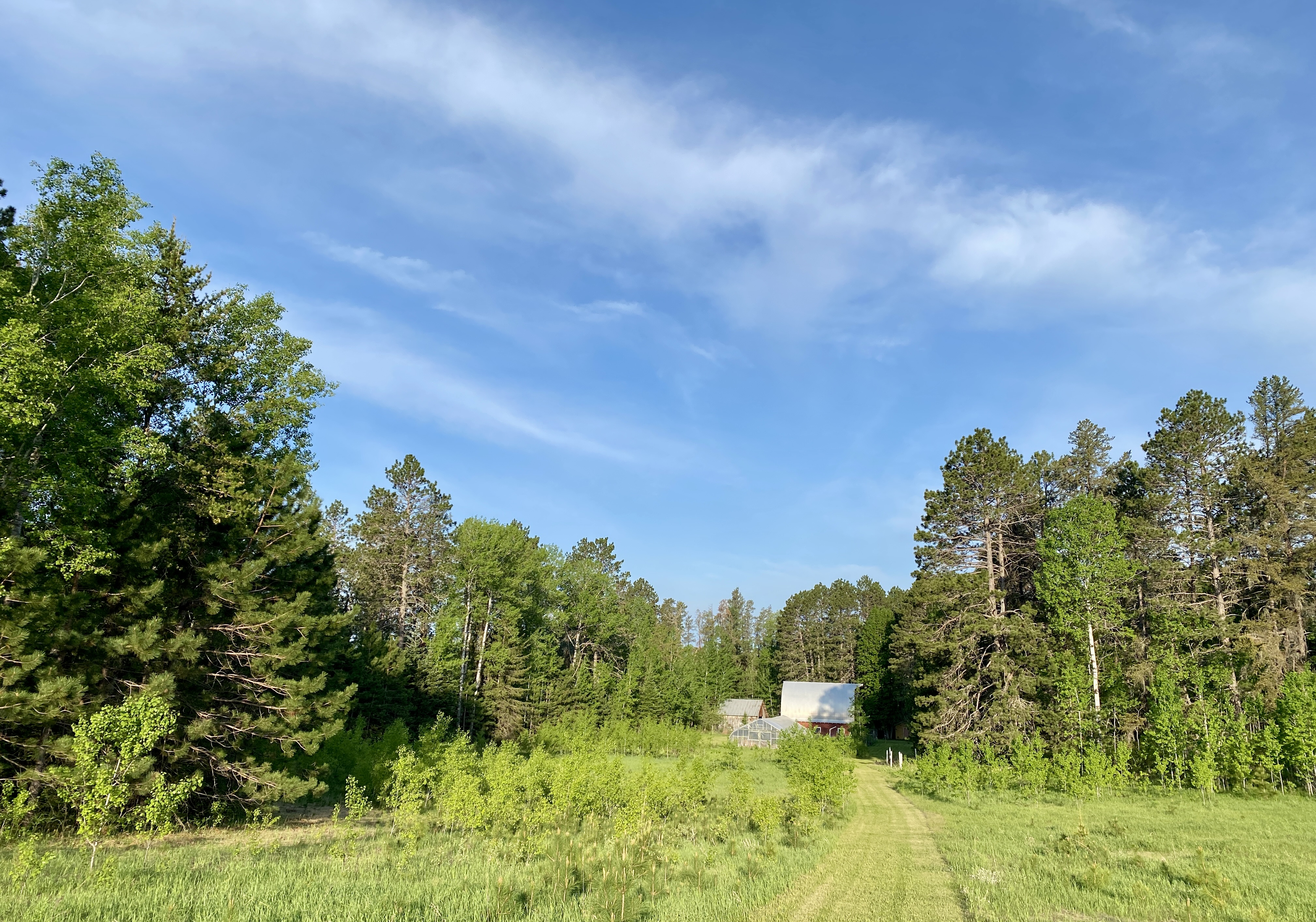
May 30, 2023, the farm in the distance as seen from the slope of our east meadow.
It was from this slope, covered in snow, that we first saw the farm over Christmas 1988.
We are selling the farm. We bought the homestead and 80 surrounding acres in Pike Township, Minnesota, in 1989 from Inez Saari, widow of Arvo Saari. She could no longer keep up the place and was moving into Alice Nettell Tower, a retirement home in Virginia, Minnesota.
We are still fit and fully capable of taking care of farm chores and upkeep, but the day will come when we’re not. I don’t want that day to sneak up on us. Neither do I want to be warehoused in Alice Nettell Tower. Better to take charge while we have our physical and mental capacities. This summer we are going to pack up a few possessions and turn over the keys to the farm to our friends Lisa Garretson and Sam Harvey-Carlson and their new baby Winnie who will start accruing their own memories at the farm. We are moving to our other, now only, home in Sonora, Mexico.
For quite a while, our world on West Saari Road has comprised five people, Chuck Neil and Mickey White, David Smith and me Suzanne Winckler, and Virgil Saari, the last Saari to live on West Saari Road. I have known Chuck the longest, since 1974. What will be unspoken here – what cannot be unraveled or explained to others and is private to me – is the depth and intricacy of love and friendship.
I can explain how we came to buy the farm and write about a handful of many memories.
Inez and Arvo were Finns, and Finnish was their first language. Arvo and his brother and sister grew up a mile to the west in the Saari homestead on the banks of the Pike River. Arvo acquired land adjoining the family place. His sister Helia and her husband John Lahti had a place across the road. Arvo’s brother Tom and wife, Nannie, settled in the old homestead. Their son Virgil Saari still lives there. He took care of Nannie until she died in 2014 at age 100. Virgil is the last surviving Saari to live on Saari Road.
We were skiing across a gently sloping snow-covered field when we first saw Arvo and Inez’s farm off in the distance – the big red barn, the yellow bungalow, an assortment of sheds, and the sauna – sheltered in a stand of red pine. We were visiting Chuck and his family over Christmas 1988. He told us it was for sale.
I still get a thrill when I’m walking down that slope and see the farm, little changed in the years we have owned it.
I don’t think I am embellishing, but it seems David and I barely discussed buying the place. It was as if we both knew when we saw it that we would. Within a few days we had contacted the agent selling the farm on behalf of Inez. We drove back north to meet with him on January 15, 1989. We negotiated a price, and he drew up a contract for deed. It was impulsive and impractical. Neither of us had ever bought a house, much less a farm. The last thing we needed was property in northern Minnesota. We knew we weren’t going to live there, at least not any time soon. David was finishing his post-doc at Mayo Clinic in Rochester in southern Minnesota and would be looking for a full-time position at a university or medical school most likely out of state.
Looking back, I think three things propelled us to make this crazy purchase. I had a small legacy that allowed us to put down a substantial down payment. There was something compelling about owning a place with an authentic Finnish sauna. And, though largely not articulated or even very well understood, owning the farm would seal our friendship with Chuck.
I had met Chuck in 1974 at the University of Minnesota, where I’d gone for a semester. I kept up with him through letters. In 1977 he and his wife Susanna – part of the back-to-the-land movement in the 1970s – left the Twin Cities and homesteaded on an acre of land given to him by his Finnish great uncle George Warho. They had two kids – Maley born in 1979 and Sedge in 1981. A few years after we bought the farm, they divorced. Time past. David and I watched Maley and Sedge, mostly from faraway, grow into adulthood. Chuck had a number of relationships with women, none lasting or right. Then in 1996 he met Mary Margaret White, Mickey. He met his match, they married in 1999, and we glided into friendship with her.
Over the years, we came to the farm on holidays and during the summers from homes in Memphis, Omaha, and Phoenix. Then in 2008 David retired from his research position at Mayo Clinic Arizona, we sold our house in Mesa, and we moved to the farm. Since then we divided our time between Embarrass and our place in Mexico, but West Saari Road has been home in the strict sense of the word. Many friends have visited the farm over the years. The sauna has been lit countless times. How many feasts have we prepared and shared? How many have we partaken at Chuck and Mickey’s table? Numerous dogs have come and gone, four buried by Billie’s Pond in our west woods.
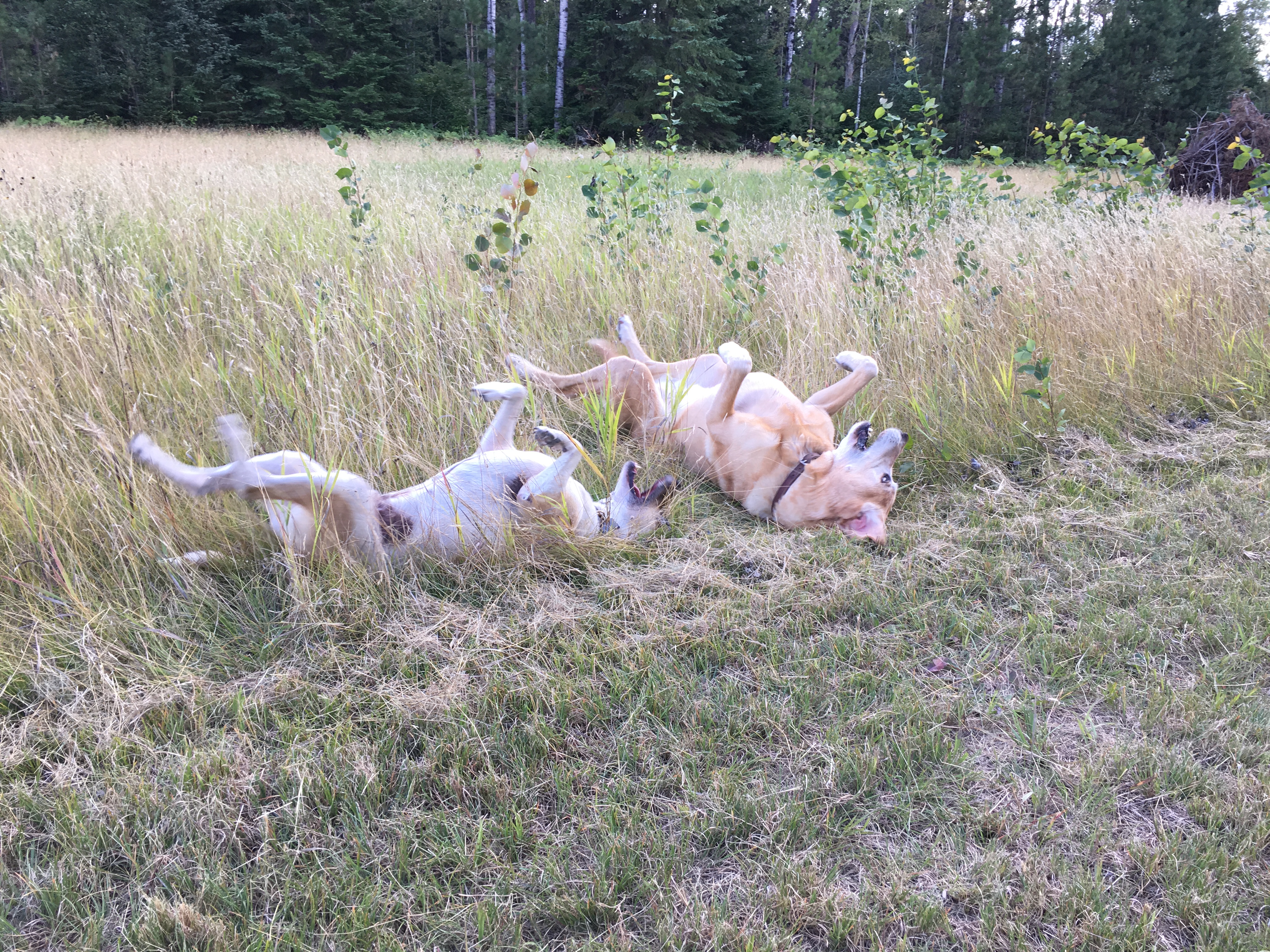
Pochote and Jack in our west meadow, August 24, 2019. Jack died in May 2022 at age 14. Pochote, who is Mexican, has been going back and forth with us for 12 years and will live out his life in Alamos. Over 34 years, six dogs have ruled at the farm. Four of them — Billie, Jabo, Phoebe, and Ray — are buried at Billie’s Pond in our west woods, named of course for Billie, who loved to swim there. Jack is buried in our backyard in Alamos under a giant Pochote tree. And someday the dear dog Pochote will rest under the tree for which he was named.
Sauna
Our sauna in winter.
The first time David and I took an authentic Finnish sauna was under the supervision of Chuck. It was in his Uncle George’s old log sauna, which was just a short walk through the woods and brambles from Chuck’s to George’s homestead. It remains in my mind the most beautiful and picturesque of all saunas and to walk through the door into the changing room is to enter a time a century ago. When Uncle George died, Chuck inherited the land, house, and sauna where he and Mickey live. We have taken sauna there countless times. On September 7, 2023, the night before I flew to Mexico to join David, I took sauna with Chuck and Mickey. It won’t be my last sauna there, but it was a culmination: the last night of our 34-year ownership of the farm.
Given the impression Uncle George’s sauna made on us, it’s no wonder we wanted our own. Arvo Saari, undoubtedly with help from family and friends, built all the structures on the farm, including the sauna. It is a simple rectangular box with a gable roof. It looks like a child’s stick drawing of a little house. We have done practically nothing to alter its exterior or interior since the day we took ownership. We did upgrade the old wood-burning stove with a Kuuma, built by Lamppa Manufacturing, the premiere maker of wood stoves headquartered in nearby Tower, Minnesota. Numerous friends were on hand the day we installed the Kuuma. I stupidly failed to properly secure the ball hitch on the trailer. As our helpers were shoving the stove to the back end of the trailer to lift it off, of course the trailer tipped up. It fell with full force on Francie Lovejoy’s foot. Francie was a nurse, her partner Dan Michener, a medic. But it didn’t take medical expertise to know she’d broken one or more toes, for which little could be done. She was in excruciating pain. We called Renner Anderson, Chuck’s brother-in-law doctor in the Twin Cities, who phoned in a prescription for codeine to a pharmacy in Tower.
Over three-plus decades, Francie’s broken toe is the only medical calamity that occurred on the farm – which I think is something of a miracle. In the early years, the sauna was the locus of high-spirited bathing with multiple friends, often chased with beer or champagne. In recent times, suiting the onset of maturity, taking sauna is a more subdued event. There is one timeless lesson sauna teaches about mutual respect. No one is ever pressured to take sauna except on their own terms regarding personal preferences for nakedness and companions.
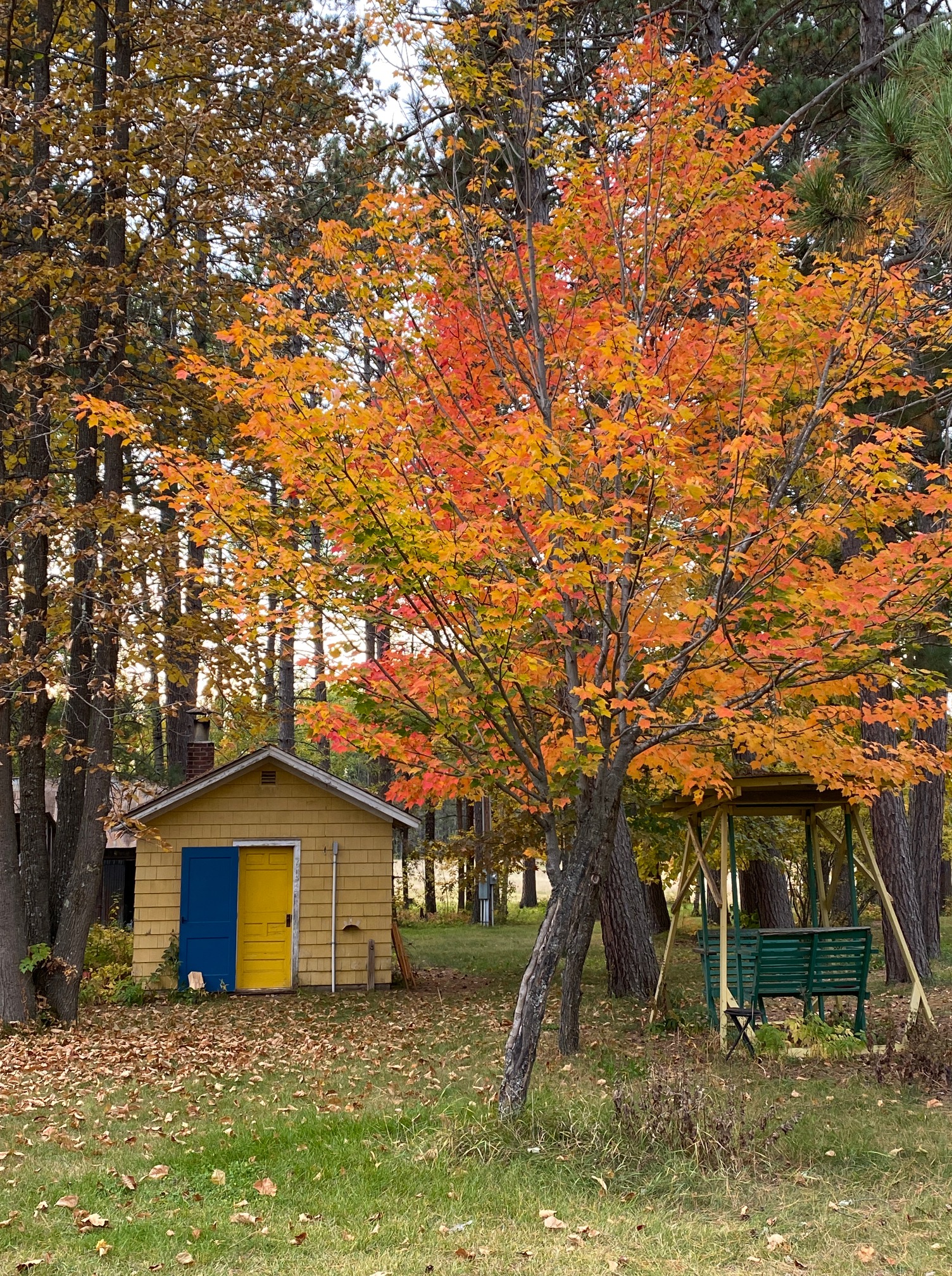
Our sauna in autumn.
The Chevy
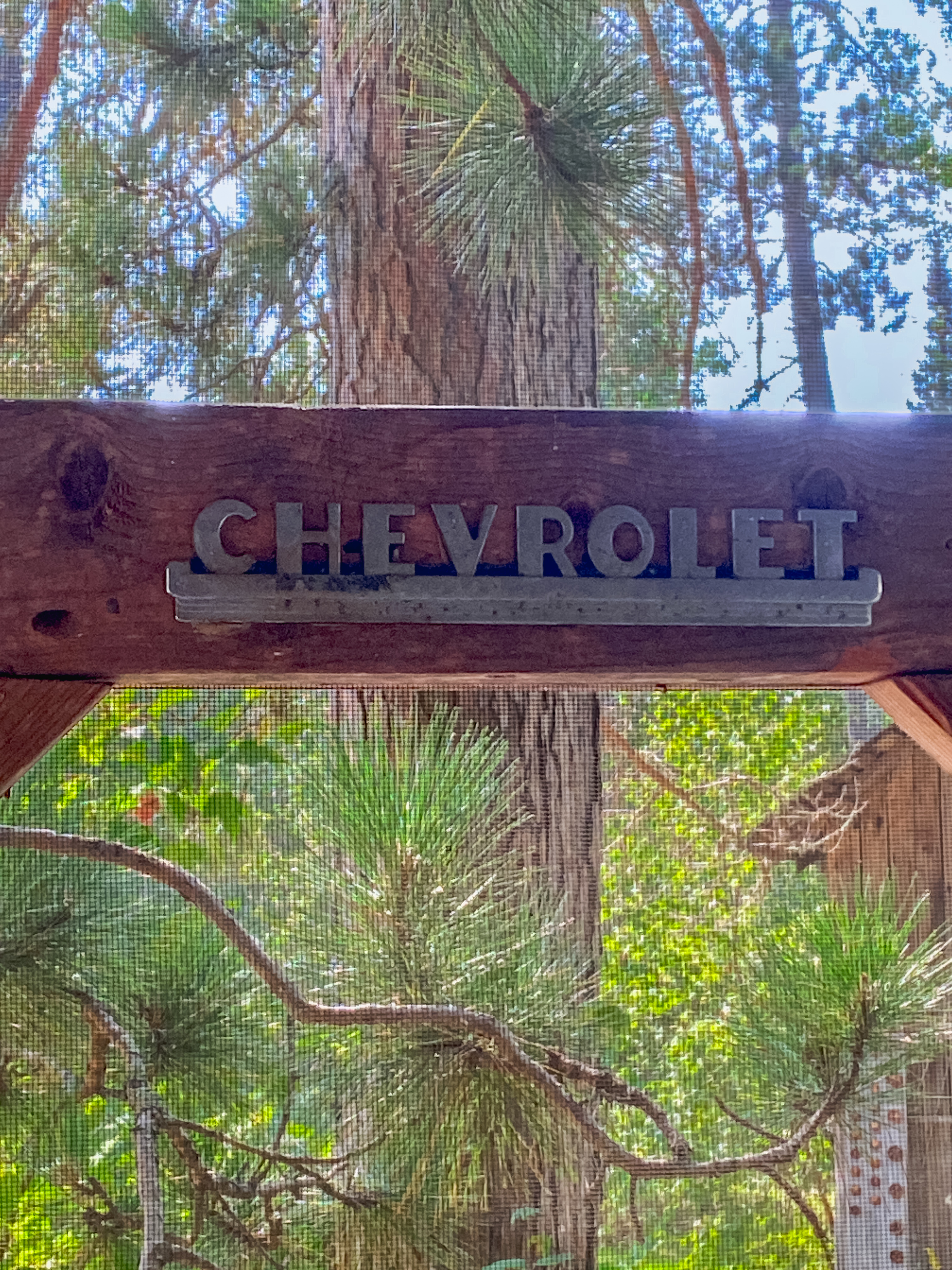
In the summer of 2008, when we moved to the farm, David almost immediately began constructing an outhouse of his own design. He obtained the specific regs from the county and inquired about permits (none, as I recall). He dug a pit, a big, deep pit almost his own height. Our sandy soil made the task easier. But, still, it is a big pit. While excavating, David found a metal medallion from a Chevrolet – Arvo was a shadetree mechanic; we were always coming across old car parts in the yard and woods – and at that moment or soon thereafter David christened the outhouse the Chevy.
The Chevrolet medallion David found while constructing the outhouse.
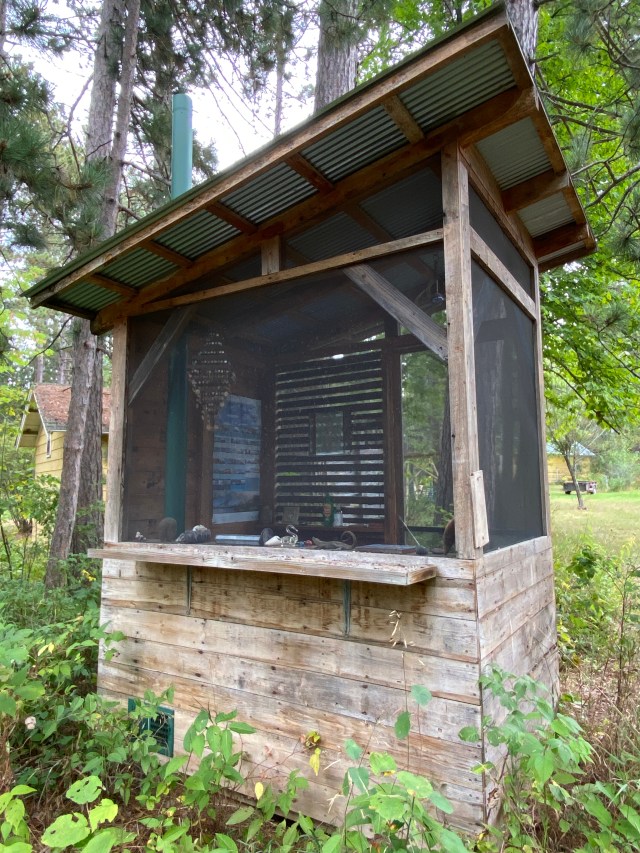
Standing like a sentry next to the wood shed and the sauna, it is an airy and serene place – David understands structural proportions. Rather than an airless, dark closet, the Chevy has screened windows, the better to enjoy the surrounding trees and buildings in all seasons, and a bird feeding tray for sunflower seeds, so visitors in their privacy can enjoy chickadees and nuthatches and the occasional pine siskin or redpoll up close.
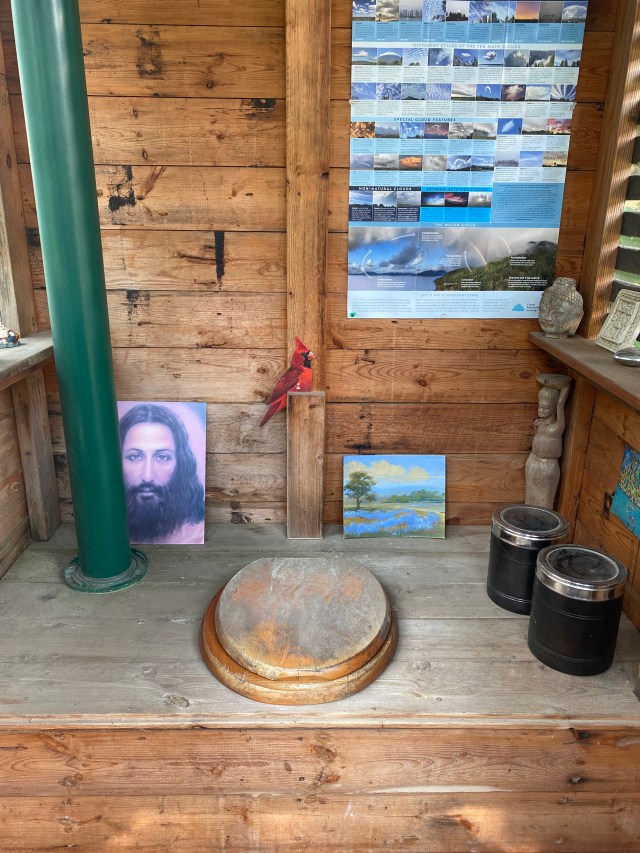
We have appointed the Chevy with art and various objects like rocks and shells. There is a winking Jesus and a cloud identification chart, which includes my photo of a shelf cloud taken near the Pike River. I use the Chevy from time to time (I found myself there more often this summer for sentimental reasons), and guests occasionally use it. But it is David’s place. He retires there almost daily when we are here and in all kinds of weather. The lowest temperature of his visits over the years was -35oF.
The Chevy, September 7, 2023. Inside the Chevy, August 5, 2023. The winking Jesus was a gift from friends who purchased it at the Vatican. The Cardinal is a wood cutout by Nancy McGowan. The bluebonnet painting I have had for years. Perhaps some visitor to the Chevy will peruse the cloud identification chart.
The Farmall B
David with Oscar Sullivan-Wetzel on the Farmall B, August 16, 2015.
Keeping in mind that memory is faulty, this is how I remember it. We saw a sign on Highway 52 for antique furniture near Zumbrota, Minnesota, one of many small farming towns surrounding Rochester. We needed some furniture for the farm, so we followed the sign. Minnesota – indeed the entire Midwest – is chocked full of small antique stores that deal mainly in farmhouse and bungalow furniture, crockery, and knickknacks galore, or ad nauseam, depending on your opinion of knickknacks. Though seldom authentic brands, much of the furniture is reminiscent of Craftsman and Mission style furniture – or at least that is what I gravitated to in these second-hand places. We bought a beautiful simple drop-leaf dining table which has carried the bounty of many wonderful dinners with friends. I will miss that table. We also bought a church pew to serve as a bench for two or three worshippers at our pagan table. The husband of the couple who owned the antique store sold Farmall tractors that he had meticulously restored and mounted with mower decks. David grew up driving Farmall tractors on their cotton and soybean farm in Mississippi. It was immediately apparent to me that we would not be leaving the premises without buying a Farmall B tractor.
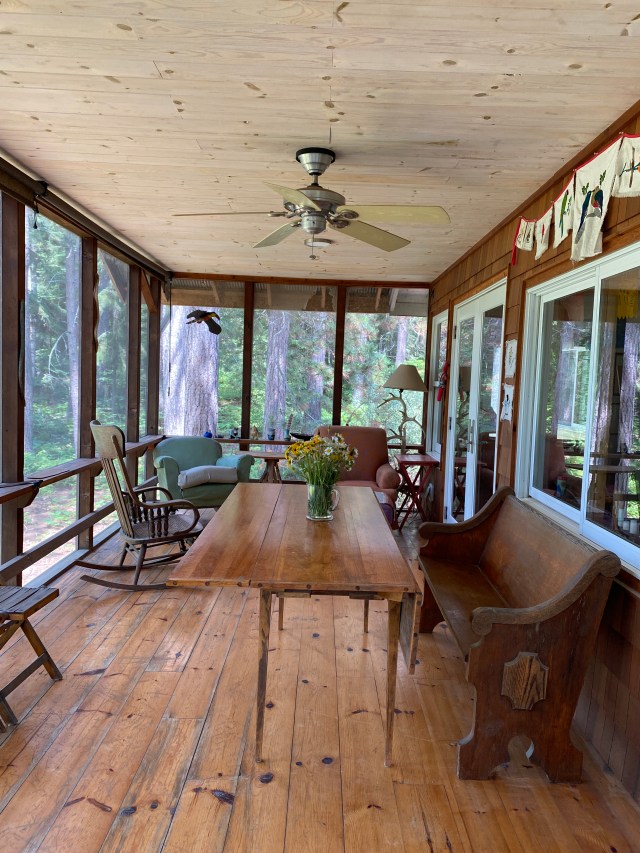
The drop-leaf table and pew on the screen porch Chuck and Mickey built for us over several months in 1997-1998.
We then had to figure out how to get the tractor up to the farm, about 300 miles north. At the time we were living in a farmhouse south of Rochester. David rented a flatbed trailer from a local farmer. We picked up the trailer and headed north. Driving in construction zones and urban traffic on Interstate 35 through the Twin Cities was nerve-wracking for me. Returning south pulling the trailer was even worse – with no weight to hold it steady, it bucked, bounced, and shimmied the whole way. I don’t like to think back on the tractor journey. When packing up for the move to Mexico this summer I came across the receipt for the tractor. I’m a haphazard archivist. I’ve thrown away thousands of receipts; a few I have kept. At the moment of sale, a receipt is typically of little interest. Only as time passes does it serve as proof and fact of a transaction, in this case a significant one. We purchased the Farmall B on September 6, 1989, for $2,500. The receipt was signed by Allen Graves. I recently read that he passed away in 2022 at age of 77. He was a church-going family man, farm equipment mechanic, owner of a farm supply business, with his wife the proprietor of two antique stores, and a life-long tractor man. The Farmall B is one of the best farm purchases we ever made. David and Chuck maintain all the trails on our places – a contiguous area of about 160 acres – which we and friends use year-round for walking, skiing, and snowshoeing. Many kids have gotten their first tractor ride on the Farmall B, sitting on David’s or Chuck’s lap. Before we left this summer, David made sure Sam and Lisa, the new owners of the farm, know how to drive it.
The Cedar Bog
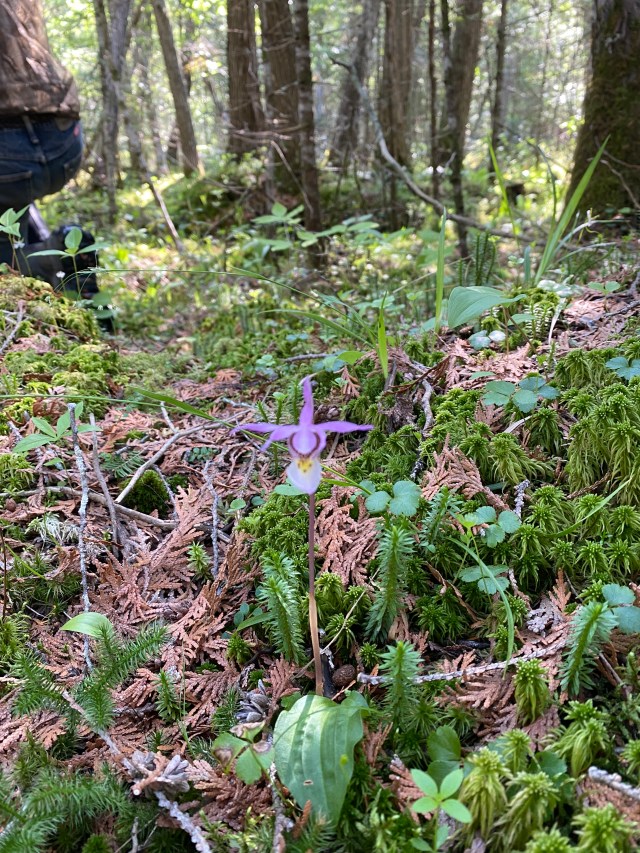
Calypso bulbosa in the cedar bog.
On June 3, 2023, David and I went to the cedar bog with Chuck and Mickey on our annual trek to look for calypso orchids. The bog is on the Goldberg’s property who own land just east of Chuck and Mickey. We’ve been going there to look for calypsos for a number of years now. We descend from a north-south running ridge into the bog, a watery, hummocky, sun-dappled wonderland. Do the Goldbergs know what a treasure they own? It is gnarly walking down into and around in the heart of the bog. It is the kind of slow-going I love. We met Chuck and Mickey at the top of the hill at 8 a.m. We first stopped to see if the Saw-whet Owl would appear in the hole of the giant nest box where it seemed to be roosting. Chuck scraped the tree trunk with a stick. The Saw-whet popped its head out, looking exasperated (forgive the anthropomorphism). Mickey found the first calypsos around 9:20 a.m. They typically grow in clusters, so if you see one you likely will see several. It is a dainty orchid, only a few inches in height, and would be virtually impossible to find but for its glowing hot-pink-purply inflorescence. We noticed some faded trail tape tied around a cedar tree, which one of us put there a few years ago to mark a calypso area. David also found a number heart-leaved twayblade orchids, tinier and more inconspicuous than the calypsos. Over the years he has identified fifteen species of orchids that grow in various specific habitats and soil types surround us.
Wolves
On July 17, 2023, around 7 in the morning I was lying on the kitchen floor doing some stretches. I was listening to some Spanish on my earphones. David came running into the kitchen, imploring “Get, up, get up!”, which is not so easy for me anymore. “Wolves,” he said. I managed to upright myself. There outside the kitchen window, I saw one, then two wolves moving through the trees to the west of the house. They paused, or at least this is what I recall, for nanoseconds and stared piercingly around looking for who knows what. They seemed to quiver with concentration. They trotted along the driveway and up the east meadow and disappeared. Their fur was mottled black, brown, golden orange. They had long legs. One had a squarer, bulkier head. I assumed it was the male; the other slender headed one, the female. Seeing wolves is freakishly uncommon. Even though we live among them, it is as if they exist in a parallel universe that rarely intersects with ours. We have heard wolves call from time to time off in the distance. We see wolf sign regularly. The dogs find and bring us bones of kills, most often a deer shank. We see scat. The only other time we have seen wolves on the farm besides this recent event was on the morning of September 25, 2020, when we watched in amazement as a pack of nine wolves ran south along the far edge of our west meadow and disappeared up the path going into Guy Johnson’s property.
Wolf pack, September 25, 2020. Video by David Smith.
Garlic
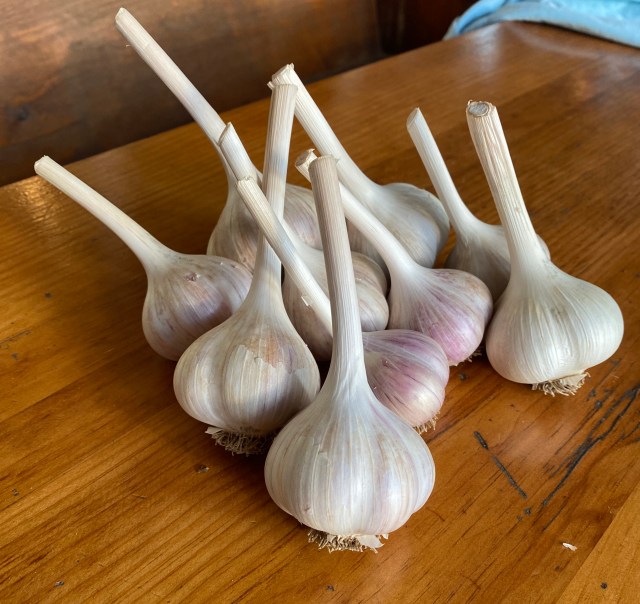
My last garlic crop.
This is the last summer I will harvest garlic. I planted a row of garlic on September 27, 2022, before we left for Mexico – a third of what I typically plant. The garlic is the only crop in our outdoor garden this year. It is a lonely patch amid the weeds. I am embarrassed about it. I pulled the first heads on July 28 – big heads of Music and German White, two hard-neck varieties. My soft-neck Nootka Rose variety looks pitiful. I will let it go a little longer and hope for the best. For years I have always purchased my seed garlic from Filaree Farm in the Okanagan Valley of Washington state. I could hold back some of my own seed garlic and save a lot of money, but I have a strong customer fidelity to Filaree. The family-owned business has been around since 1977 and they have the largest publicly available collection of garlic varieties in North America. They still have real human beings who provide customer service, and the seed garlic arrives in a box, each variety packaged in a tidy brown paper bag. Receiving this box in the mail is one of my life’s greatest joys. The other company with whom I have unflagging loyalty is McMurray Hatchery in Webster City, Iowa, renowned supplier of heritage chicken and poultry varieties. The task of harvesting garlic in late summer and hanging it in the garlic shed to dry is a seasonal passage and marker as exhilarating as neighbor Craig Keskitalo haying the fields, the first frost, the maples and tamarack turning, the birds heading south. I have made a ritual of cleaning each head of garlic, using a pocket knife our friend Dennis Lorenzen gave me. Because for years I raised far more garlic than I could use, I took to mailing friends small boxes with several heads of garlic nestled in tissue. I believe my garlic procedures might qualify as a fetish. Besides Chuck and Mickey and a small tribe of other human beings, the two things I will miss most about the farm are my garlic and my chickens.
The Fence to Nowhere
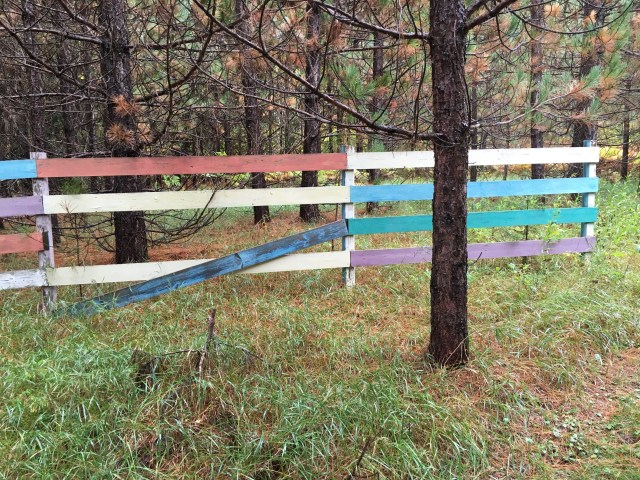
The Fence to Nowhere, hidden in the woods, September 27, 2016.
Early on at the farm David and I talked about assembling large sculptures and earthworks in the west meadow. Like many musings we discussed over beers in the afternoons, we never implemented this grand plan, except for one piece constructed by David in 1990 to commemorate our fifth marriage anniversary. We called it the Fence to Nowhere. It is a wooden slat fence which we stained in bright colors. Standing on the eastern edge of the west meadow in an alcove, it was quite striking and became the subject of many photographs and several pieces of art and pottery by our friend Dennis Lorenzen. It was especially beautiful in winter when the fields were snow covered. At some point we decided to let the red pines grow back in the alcove, which happened fairly rapidly over a few years. The Fence to Nowhere – its bright colors long faded to pastels and some of its slats askew – has become a hidden treasure discovered when friends walk or ski on the trails cutting through the woods. In 2021, as the result of two utilitarian decisions to upgrade the farm’s infrastructure, we added by happenstance two more pieces to our west meadow art enterprise – a sleek sculpture that is a solar panel and a septic mound that is an earthwork we seeded in prairie grasses and flowers.
Clouds
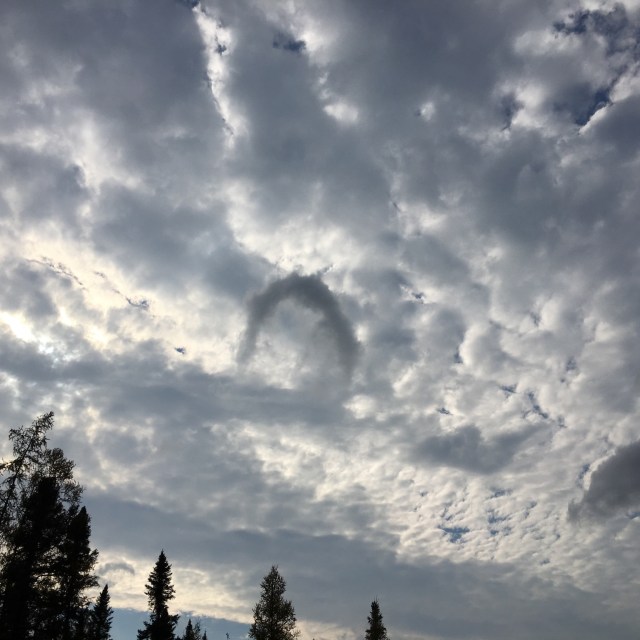
Horseshoe Vortex, a rarely seen cloud formation, over Virgil’s field, October 4, 2016.
I’ve always admired clouds in passing, but in 2016 I fell into their thrall when I uploaded the Cloud Appreciation Society’s Cloudspotter app on my smartphone. A tenet of cloud-watching is to pay attention to the clouds out your door. I have seen some of the most fleeting, most beautiful, most ethereal, most fearsome clouds on West Saari Road, often in my bathrobe. Horseshoe vortex. Sun pillar. Cloud bows. Crepuscular rays. Mammas. The titans of clouds, Cumulonimbus thunderstorms, a couple of them decked out in front with a formidable arcus, or shelf cloud. We have watched countless flame-colored cloud-enhanced sunsets over Virgil’s fields. One blazing sunset I will never forget was during the COVID pandemic when we spent the winter on West Saari Road. It was on January 6, 2021, the day the insurrectionists stormed the U.S. Capitol.
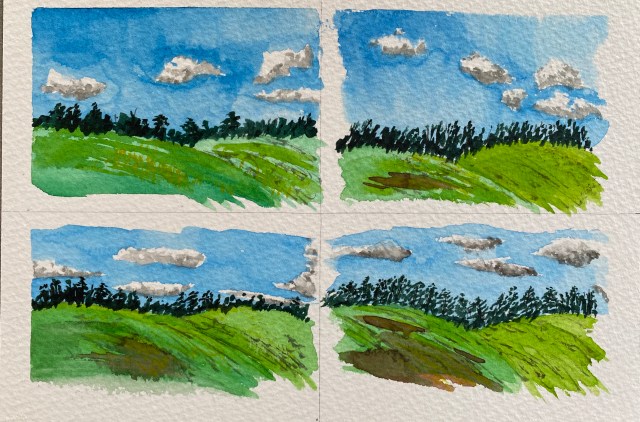
Watercolor studies, by me, of clouds over Clyde Johnson’s fields.
On promising cloud days, I wandered the backroads in my cloud-mobile (our old Subaru). One of my favorite stops, a few miles from West Saari Road, will always be Clyde Johnson’s fields. Here, the road crests a hilltop, and the sky opens up to become a grand stage for clouds. Someone still maintains the farmhouse and yard, but the barn is collapsing. I never met Clyde (now deceased), but Chuck knew him. He had a missing limb, but Chuck couldn’t remember if it was a leg or an arm. It is not all that unusual for farmers to be missing a body part. When I am looking up at the clouds over Clyde Johnson’s fields, I sometimes think if I lifted my arms skyward, I would float up and join them.
Dark, quiet
By selling the farm, we are moving from a rural place to an urban one. We are relinquishing all the particulars above – the seasons, the rituals, the routines – and much more not enumerated here. One aspect of our life on West Saari Road which seems to me the most irrevocable, like the palace gate slamming shut, is the dark and quiet. There are fewer and fewer places on Earth where night is unadulterated. There have been nights when we walked home from Chuck and Mickey’s that were so pitch dark we piloted our way by touch – our foot falls on the gravel road, calculating by memory the distance to our driveway, then catching a glimmer through the pines of a light in our house. Many nights we stood outside under a vast black umbrella strewn with diamonds. On moonlit nights the dark gave way to a spectral glow – these were the best nights to go skiing across the fields and through the woods. The absolute quiet on West Saari Road is even harder to describe than the dark. It is like being enveloped by a void. Some people are unnerved by such silence. I am not one of them. To underscore what a profound decision we have made by leaving the farm: Alamos, like most Mexican towns, is never dark, never quiet.
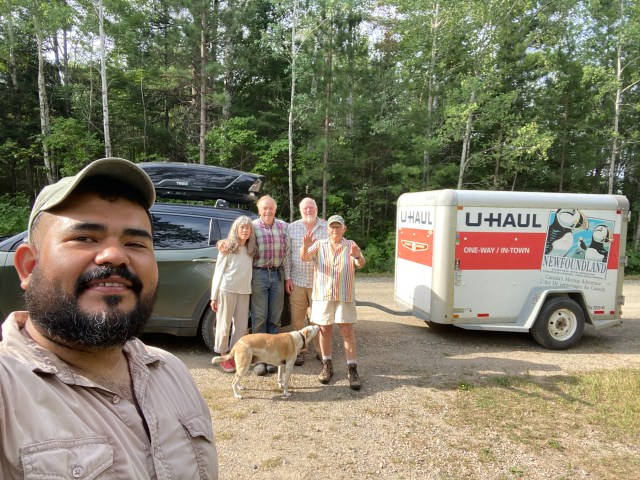
August 16, 2023, leaving West Saari Road for Alamos. David drove the U-Haul trailer with his trusty companions, Pochote and Rafa Arenas Wong, our friend from Alamos. Mickey, Chuck, David, Pochote, and I mark the occasion. I left the road on September 8, flying to Mexico City, then Ciudad Obregón where David picked me up.
The U.S. media is obsessed with the most recent capture of El Chapo, a chubby man in a filthy T-shirt, and an American male movie star who is not a journalist and a Mexican female soap-opera star who says silly things on Twitter. How stupid.
Why are they not obsessed about butter? Maybe Sean Penn traveled to Mexico with his own stick. I can promise you, in the so-called “Golden Triangle” where they supposedly met and in most parts of Mexico there is nothing that approximates butter as we in the United States and many fortunate Europeans know it. Julia Child, bless her heart, could not have lived in Mexico. I will assume in Mexico City, an international culinary capital, there is butter somewhere.
I do not wake up in the morning worried about people like El Chapo (who was “detained”—President Peño Nieto’s word, as if he was afraid the guy had not really been captured). I think about how bad the butter is in Sonora where I live half of every year (so scary—only three hours away from where they caught El Chapo).
I buy Mexican butter and use it. It sort of behaves like butter but not really and it is awful. Tonight, I put a little sliver in my mouth. It tastes like petroleum. I went ahead and put some in the polenta. Does this product have anything to do with cows and real milk? How is it made? Why do they call it butter? Soon, we will go to the United States—utilizing a real petroleum product—so I can buy ten pounds of butter to bring back to Sonora to last until May.
Note: I wrote this little diatribe several days after Chapo was recaptured on Highway 15 fleeing from Los Mochis, Sinaloa, and a few months after the asinine rendezvous concocted by Sean Penn and Kate del Castillo to interview Joaquín Guzmán in his lair in the Golden Triangle. The suckered readership of U.S. media, including such esteemed outlets as The New York Times and Rolling Stone, gobbled up their sinister yet ever-so-frothy meringue like voracious idiots while I fumed about something really important, the status of butter in Sonora. Eight years have gone by, and the U.S. media remains unchanged in its dismal coverage of Mexico.
Ghana visa application and my passport with Ghana visa stamp.
Our world is built on a shared trust in strangers who we hope are competent. From the earliest prehistoric trade routes to this very day, trust is implicit in the transport and exchange of goods and services. Without trust our anthropocentric world would unravel.
These days many politicians, media, social media, extremists, and angry individuals try to undermine our trust in each other. But universal trust prevails – in some measure for selfish or self-preservation reasons. We need and want stuff – SARS2 vaccines, Gucci bags, in my case, Cheetos. We trust strangers of all cultures, religions, races without thinking how important that trust is. We take it for granted. We benefit from it constantly. Recently, however, I abruptly put my trust in strangers to a test.
We are going on a birding trip to Ghana, West Africa, flying there from our home in Mexico. Ghana is one of many countries, mostly in Africa and Asia, that require tourists to apply for a visa in advance of their travel. Ghana’s application process is detailed, tedious, and expensive, but more vexing, it requires mailing one’s passport with the application.
You have to relinquish your passport to strangers.
In Mexico, my passport is the single most important proof I have of my existence and the only document that permits me to reenter the United States – without enormous hassle and expense. I do not have a U.S. passport card. David, my spouse, does. He will vouch that I was not happy about parting with my passport.
On February 1, after submitting our visa applications online, we shipped printed copies of the applications along with our passports via DHL in Navojoa, Sonora, Mexico to the Ghana Embassy in Washington, DC.
I stood in the DHL office on the main street of Navojoa having a thrum of apprehension about this process. It is a friendly and dingy place. These two factors go hand-in-hand where we live. Mexicans, as a general rule, are habitually friendly, and dust, especially during the dry season, is ever-present. An insidious, translucent film seems to coat all surfaces and windows. Why dust when it will be back tomorrow?
We turned over our documents to a young woman who was, yes, friendly, as well as calm and competent, able to accomplish the task at hand and engage in small talk at the same time. I watched her eyes and hands as she double-checked details she had entered into the computer.
She knew we were turning over valuable documents. I think she saw me twitching. But, really, that’s her job, day in and day out, to take charge of items that other people prize, or, at a minimum, want to be handled competently. What is routine for her was consequential to me. We had pre-paid the Ghana Embassy $100 each so they would expedite issuance of the visas. The expedited DHL cost (3-business-day delivery) to ship each application was $40US.
The young woman in the DHL office was the first in a line of innumerable strangers on whose competency we now relied. My trust was wavering. David’s was not. I also started to dwell on the whole stochastic process of two packages containing our passports, each weighing about 6 ounces, making a round trip of approximately 5,000 miles across an international border, moving by truck, aircraft, and conveyor belt. Random variability – what might go awry – over that space-time continuum rattled me. Not David.
At some point I reminded myself of the recent successful launch of the James Webb Space Telescope from the Guiana Space Center in French Guiana, South America, now orbiting almost a million miles beyond the Earth’s orbit of the Sun. That made my concerns seem trivial.
I tracked the packages on the DHL app, rather obsessively. You may wish to skip the following information, even though I find it fascinating, even momentous. Each leg of the journey and each sorting facility involved how many strangers entrusted with my passport? Several? Dozens? Do they love or hate their jobs? Are they male, female, other, married, single, divorced, widowed? Do they have children? Grandchildren? Do they have a dog? A cat? What music do they listen to? What did they eat for breakfast? Did they eat breakfast?
Here is the path of our packages.
February 1-2: Ground transport from Navojoa to Ciudad Obregón to Hermosillo, all cities in Sonora, then by air from Mexico to DHL’s global hub in Cincinnati, during which time our packages had to clear U.S. Customs. At this point, there was a choke – caused perhaps by the weekend of reduced staffing?
Monday, February 6: our packages left Cincinnati at 2:48 am – my sympathy to the people who work the night shift. Things sped up.
5:58 am: packages arrived at Ronald Reagan National – a wince remembering him, the earlier kid-gloved version of Trump.
9:42 am: packages “out with courier for delivery” – please, driver, no T-bone at an intersection.
2:22 pm: packages delivered to the Ghana Embassy on Embassy Row – which is between the Israeli Embassy and the Embassy of Bangladesh and across the street from the Embassy of the People’s Republic of China. Do employees from these embassies meet each other for lunch?
The Ghana Embassy personnel now had 7 business days to process and return our visas. The intervening weekend added two days to the process.
Wednesday, February 15: I received an email that our packages had arrived at our UPS Store post office box in Tucson, Arizona.
Another wait. I felt like I was swimming in a vat of molasses. The young woman who has a courier business taking mail and running errands in Tucson for people living in Alamos was going to Tucson on February 20, returning February 24. No hang-ups, please, at U.S. and Mexico ports of entry, no T-bones at intersections.
Friday, February 24, 9:16 am: after walking our dog at a ranch on the edge of Alamos, we picked up the packets from the courier. She was sitting on a high curb under a cottonwood tree across the street from her apartment. Of all the competent people across Mexico and the United States who had handled our passports in the last 24 days, she was the only one we know. Her name is Ashley.
A sign in front of an eatery at the intersection of Stone and Speedway in Tucson, Arizona.
We arrived in Tucson just as the sun was setting and checked into the Best Western on the southwest corner of Stone and Speedway. We know the intersection well. When passing through Tucson or coming up from Mexico to run errands, we have stayed at hotels in the area. Over the years we’ve watched the intersection fall into despair.
Anza Park on the southeast corner of the intersection has served as an encampment for the unhoused or a place for them to hang out. It is a forlorn, edgy, trash-strewn, some would advise dangerous area. We’re not so convinced of the danger designation – that’s just how lucky people tend to think about the places inhabited by people down on their luck.
The motel is caddy-corner from the liquor store – we wanted beer – and Popeyes –connoisseur David wanted to try their new blackened chicken sandwich. We set out on foot. Why would we drive across the street? There was an assortment of people walking on the streets or across vacant lots or sitting at bus stops. A couple of them were tattered and babbling.
I am disillusioned by America. Disillusionment spawns an all-encompassing negativity that is hyper-judgmental and biased. It suffocates the least little breath of joy. It pulls the shades on the least glimmer of optimism. Objectively, I know this. I admit I have cultivated my disillusionment to a point that is almost detrimental to me and certainly unnuanced and unforgiving about the country of my birth. I know countless acts of kindness, beauty, genius, and goodwill occur every second of every day across the U.S. Yet here I am at the intersection of Stone and Speedway wanting to scream out to passersby, “Can’t you see? This place is heartbreaking. This is America unraveling before your eyes.”
Of course, people in their cars wouldn’t have heard me, and therein lies a big American problem. The automobile. Sixty years ago, a car to a white middle-class teenage girl – me – was the embodiment of freedom and adventure. But, really, even then and certainly now, the car has always been a cage of isolation. Cars, in every way, shut us off from others. They have prompted the design of impossibly wide streets that accommodate drivers but ruin the lives of pedestrians. People who never stand on a street corner in a big American city have no idea how loud the sound of traffic is. It is deafening. It is enough to drive you crazy. It is the hideous Muzak for people who chose to be pedestrians or have no other choice.
Much later, I realized that David and I were like players on a stage where an American tragedy was being performed – except the audience wasn’t paying attention.
Coming and going on our errands, we had to cross two wide streets. We waited for the WALK signs at each crossover, then I speed-walked across the street to get to the other side, moving faster than David. It was starting to get dark, which made everything sadder and slightly creepy for me. I am more easily weirded out than David.
We are white people. I have shockingly white hair, ergo I am an old lady. I was wearing a dress. Who wears a dress anymore? We had no prominent signs of disability, poverty, or mental illness. Neither of us was pushing a grocery shopping cart or carrying a black garbage bag. We were pedestrians. We did not fit the perception of this intersection.
We knew where we were going. We had been in the neighborhood frequently.
The liquor store has a drive-up window and a regular entrance. When we bought beer here during COVID all purchases were via the drive-up window. Tonight – it was dark now – we walked up to the front door where a sign on the plate glass said “After 5:30 pm use the drive-up window.” We started to head to the window but heard a man inside saying it’s OK to come in as he unlocked the dead bolts. He was profiling us – not as a potential threat or a menace (i.e., a black male, a schizophrenic of any race) but because we looked harmless (i.e., old, white). What were we doing here, at this intersection at this time of day, on foot?
He was a big white bearded swaggering guy. I can’t remember all his banter, but I recall insinuating remarks – did we know where we were, didn’t we know better than to be walking around this neighborhood? He was making it clear that he thought we were stupid. I do remember his telling us with great bluster that he keeps a gun under the counter, his father was a Marine, and that he’d have no problem blowing someone’s head off. Well, OK, then. Welcome to America. We bought our beer and headed to Popeyes.
Telling us his daddy was a Marine seemed a little weak-kneed to me.
At Popeyes, we fell into Alice’s surreal, slow-motion twenty-first-century rabbit hole. The absurdity of the place – the catatonic wait staff, the zombie manager, the paltry number of customers milling about evermore impatient – was amusing at first and then it wasn’t. I wondered if we would ever get out of there. The young woman who took our order, which I specified to go, could not get the order straight. She kept asking me to repeat, as her eyes darted back to the kitchen where her colleagues seemed to be in gloomy chaos. I came to think she was furious with her circumstance. After ten, fifteen, twenty minutes of watching her, asking her a couple times about the status of our order, saying could we just cancel our order, while other customers fumed, she threw back her shoulders and said to me, “Your order will be up soon” and walked out the door. She was still wearing her work headphones. Perhaps she was taking a break. I like to think she quit.
At one point I noticed that a large piece of plywood was covering a panel of the plate glass entrance door. An enraged customer? An after-hours break-in?
The other few customers were resigned, semi-cordial. They wanted their orders. They knew the drive-up window customers outside were getting priority as was a wiry woman inside with us, also wearing headphones, who was picking up multiple orders to deliver to other customers. I certainly did not begrudge her. She was working hard to make some sort of money.
I became less sympathetic towards a tall, skinny pale white fellow who walked in to place an order. He reminded me of the scarecrow in The Wizard of Oz. He wore big black boots and had various chains hanging from pockets to which a wallet and other items were attached. He had a crooked, unfriendly smile and was missing several front teeth. None of these descriptors in of themselves is negative, and I have friends and acquaintances who fit them, and I believe he was compromised in terms of one or several pathologies. He challenged my tolerance, which tells me a lot about myself. He was known by the wait staff, who dealt with him with extraordinary patience. He immediately began to complain because some item he wanted on the menu was not available. He sat in the plastic booth behind us. He chattered about rightwing political stuff, hoping I think to bait us.
Then he learned they had run out of hot sauce. You don’t have any HOT SAUCE?” For him at that moment it seemed to represent the collapse of civilization. I wondered if in his mind-world he had been warped by Trump or decades of the whiners who preceded Trump.
Somehow, against all odds, our bag of Popeyes chicken sandwiches arrived. Now we had to cross the same big intersections to get back to our motel.
As we were crossing, a white woman driving a car paused and rolled down her window. She said, “Are you OK, do you need a ride?” We said no but thank you so much. It was a kind gesture and telling. We had been profiled a second time. She perceived we did not belong there. Welcome to America.





 saaribampo
You must be logged in to post a comment.