The gray man walks in
in coats and coats
and coats
against the weather.
He holds
against the gray
narcissus, lilies, roses.
The gray man walks in
in coats and coats
and coats
against the weather.
He holds
against the gray
narcissus, lilies, roses.

Photo taken in July 2010 after Fannie Lou Hamer’s grave site had been fenced and turned into a proper memorial.
This slightly revised article was originally published in the New York Times Travel Section on July 4, 1999.
Meriwether Lewis is buried on the Natchez Trace, right where he died in 1809. The spot, in the deep green, still rural back country of Tennessee, is among my favorite places. Because his grave is one of the treasures of the Natchez Trace, it is well marked and easy to find. It is near milepost 386, about 70 miles south of Nashville, near Hohenwald.
Lewis died of gunshot wounds, most likely self-inflicted during a siege of depression, though some historians contend he was murdered. The post-mortem speculations are of little interest to me. I am just happy I can come stand here.
If you edit out the modern trappings — the parking lot and signs, the background noise of cars — it is easy to drift back to the night of Oct. 11, 1809, and imagine the explorer going around his final bend. He was 35.
His grave is marked with a broken column, erected in 1848 and signifying a promising life cut short. Behind the monument is a log cabin built to resemble Grinder’s Inn, the roadhouse where he had stopped to spend the night.
Thanks to skillful biographers (David Lavender and Stephen Ambrose) and my own perhaps overactive imagination, I fell head over heels for Lewis a decade ago and have remained so. The fact that he is a titan of exploration explains my high regard for Lewis. The reason I like him is that in many endearing and a few worrisome ways, he reminds me of a number of my favorite living friends. He just seems like a person I would have gotten on with.
My visit to his grave, on a spring day in 1990, was one of the first of what has become a continuing, occasional effort to visit the graves of people who have made an impression on me and who, in my estimation, have made the world a better or more interesting place. It is a way to pay my respects.
On another spring day, in 1992, I visited the grave of Fannie Lou Hamer. She was a leader in the civil rights movement who, among other courageous acts, was a delegate for the Mississippi Freedom Democratic Party, which challenged the seating of the all-white Mississippi delegation at the 1964 Democratic National Convention in Atlantic City.
But finding Meriwether Lewis’s grave was much easier than locating someone who could direct me to Fannie Lou Hamer’s. Not all my heroes, I’ve learned, receive the posthumous recognition they deserve.
Hamer died in 1977, several months shy of her 60th birthday. She is buried in Ruleville, the Mississippi Delta town where she lived, not in a cemetery, but in a little park near a basketball court. She seemed almost abandoned. I will never forget standing with my husband, who grew up in Drew, the next town over, peering at her lonesome headstone, while some kids drummed a basketball in the background and a meadowlark sang.
If you had no knowledge of Hamer, you would not be enlightened at her grave site. Her epitaph, however, conveys a world of meaning to anyone with even a modest store of information about the history of civil rights. It reads, ”I am sick and tired of being sick and tired.”
(Update: We returned to Fannie Lou Hamer’s grave in July 2010. The site has been turned into a more proper memorial with signage about her role in the Civil Rights Movement, and she is no longer alone: her husband “Pap” Hamer is buried next to her. In 2012, a statue of her was unveiled at the site.)
One of my favorite memorials to the triumph of justice is the Huron Cemetery in Kansas City, Kan., where Ida, Lyda and Helena Conley are buried. An anomalous patch of serenity in the middle of downtown, it contains many marked and unmarked graves of Wyandot Indians. When attempts were made to sell the cemetery in 1906, the Conley sisters, of Wyandot and English parentage, protested, in part because family members were buried there. Litigation followed, reaching the Supreme Court in 1910. Lyda, a lawyer who was reputedly the first American Indian and one of the first women to argue before the Supreme Court, won the case.
I keep a running list in my head of the people whose graves I intend to visit, but I don’t want the searches to be the main focus of my travels. I’d rather fold my pilgrimages into trips with other objectives, making them part of my ordinary life, like visiting the graves of friends or relatives.
Trips that include a grave visit become more memorable than they might otherwise have been. In the winter of 1993, I was at a conference in the Missouri Ozarks at one of those self-contained resort complexes that after a day or so begin to seem like a minimum-security prison. The Missouri Ozarks are beautiful and full of wonderful, quirky historical details, some of which pertain to my native state of Texas.
It was in this part of Missouri that Moses Austin, whose lead-mining interests were failing during the depression of 1818, concocted the scheme to found an Anglo-American colony in the Spanish province of Texas. His scheme was carried out by his son Stephen F., after Moses died.
I knew he was buried in Potosi, about 20 miles from the conference site, so a historically minded colleague and I escaped and drove over to the grave, in the city cemetery. It looked more like a concrete bunker (a pavilion has since been built over it), but what the grave lacked in architectural refinement it made up for in historical resonance. As far as I was concerned, I was standing on the birthplace of Texas.
Of a blurred cross-country trip some years ago, the purpose and date of which now escape me, the only remaining memory is visiting Abraham Lincoln’s tomb in Springfield, Ill. Because of the sway of biography and my rampant imagination, I’ve never quite got over his assassination.
The tomb is in Oak Ridge Cemetery, at 1500 Monument Avenue, and as we drove around looking for it, I remember thinking that finding the grave of my favorite President should have been easier. I also remember, or think I remember, the weather being overcast and chilly and the gray of the soaring granite monument, with its 117-foot obelisk, blending with the monotone day.
In 1876, some men tried to steal Lincoln’s body and hold it for ransom, so he is entombed under the floor of the monument to keep his remains safe. Mary Todd and three of their sons are interred there as well.
My husband and I were the only people there, except for a guard. It was an eerie place of echoes and gloom, the shining moments of which were reading excerpts from Lincoln’s speeches etched on bronze plaques throughout the monument.
Last January, I was in Chicago with some discretionary time. The weather wasn’t ideal, but I knew this was my chance to visit Louis Sullivan’s grave in Graceland Cemetery. In anticipation of this opportunity, I have kept for some years, and was even able to find and take along, a little book called ”A Walk Through Graceland Cemetery,” by Barbara Lanctot.
The cemetery is just north of Wrigley Field at North Clark Street and Irving Park Road. Graceland is like the grounds of a grand estate. The rolling terrain is beautifully landscaped and shaded by old trees. Many graves, including Sullivan’s, are situated around the serpentine edges of Lake Willowmere.
The cemetery harbors the graves of many prominent Chicago citizens, including a remarkable number of architects, and the tombs and monuments scattered across the hills form a kind of city within a city.
I went with a friend with an interest in architecture and Louis Sullivan was our main objective. But along the way we also visited the graves of many other people, including the hotelier Dexter Graves (with a wonderful Lorado Taft sculpture of a haunting, larger-than-life cloaked figure, ”Eternal Silence,” often called the Statue of Death).
We found the graves of George Pullman, inventor of the sleeping car (deeply interred, like Lincoln, under a Corinthian column, in this case to prevent workers who hated him over his strike-busting tactics from disinterring him), and of the architect Daniel Burnham, whose park plans make Chicago such a wonderful city (he is buried under a granite boulder on an island in the lake). We tried to find Ludwig Mies van der Rohe’s grave, but the modernist’s flat headstone was buried in snow.
I was first introduced to Louis Sullivan by way of his jewel-box bank buildings in small Midwestern towns, of which my favorite is the one in Owatonna, Minn. ”The Curve of the Arch,” by Larry Millett, is an account of how Sullivan came to build the Owatonna bank. Sullivan’s grave, which includes his parents, is a simple granite stone adorned with a filigreed medallion that looks like a little bank. I was happy to stand by it, or him, and on some spring day, when the snow has melted, I’ll return and uncover Mies van der Rohe.
We are leaving the parking lot of a grocery store in Tepic. Taped on a post, a flier with a photo of a missing teenage boy. He is shirtless wearing Bermuda shorts and standing barefoot on a beach in the shallow foam of surf.
Eleven in the morning. We are crossing Laguna San Marcos southwest of Guadalajara. It is a vast, flat, barren lakebed. Dancing tolvaneras – dust devils – whirl and skip across the plain. Espejismos – watery mirages – form, then evaporate. Devils and mirrors.
On the outskirts of Oaxaca a woman is standing by the highway. Cars are speeding by. In her outstretched hand she is holding a dead rabbit.
Three Oaxaca airport employees are standing by a malfunctioning parking ticket dispenser. One is handing tickets to drivers as they enter the parking lot. The task of the other two must be to keep him company.
A small haggard Indian woman in authentic or invented indigenous garb steps out into the Oaxaca traffic at a red light. She kneels down and her young haggard daughter steps on her shoulders. The mother stands up. The girl starts juggling two balls. The mother, whose blouse is hiked up, cradles a baby suckling her breast. The light changes. I hold out a handful of coins. The daughter dismounts. The mother takes the money. No one is smiling.
Job description: bell ringer. It is before dawn. A garbage truck in Ocotlán is stopped on the street by our hotel as we are packing up to leave. A couple of workers are gathering cans and tossing garbage into the maw of the truck’s compactor. One worker is standing by the rear of the truck with a bell in his hand. When the truck starts to back up, he rings the bell.
We are birding in the late afternoon, driving the road to Las Cascadas (the waterfalls) near the town Pluma Hidalgo on the Pacific slope of Oaxaca. We pass a family – father, mother, two children – carrying the disassembled parts of a shiny new porcelain toilet.
Isthmus of Tehuantepec. As far as the eye can see, giant wind turbines are slowly churning converting the manic winds of Tehuantepec to energy. Parques Eólicos – Aeolian Parks – is entirely too benign. I will call them Ejércitos Eólicos – Wind Armies.
Time is tall
the cloud is mauve
night will fall
the plane hurls
Roosters call
herbs flourish
dogs circle
streams murmur
A day grows
dies
trees plant
A phone rings
peace goes
returns
thunder
Ferns in walls
motion, hands
rings on hands
bonds
Time is glacial

Three inches, the standard height of the tope.
The standard height of the tope (pronounced TOE-peh) on my street, and around Alamos, is approximately three inches. A tope is a hillock of concrete spanning the width of a thoroughfare – a simple traffic engineering technique ubiquitous in Mexico. Three inches doesn’t seem like much, but driving over a tope at a speed greater than a crawl (<5mph) renders a jolt not good for the vehicle or its occupants.
Topes keep cars from colliding with each other. But their overarching purpose is to keep drivers from running over pedestrians, of whom there are many, many more in Mexico than in the United States. Mexicans are street people by culture and necessity. Many cannot afford cars so they get about on foot or bike. Mexican public schools have two sessions, morning and afternoon, which means hordes of children are on the streets around 8 a.m., 12:30 p.m., and 5:30 p.m., during which times they are horsing around and not paying attention to traffic. On major holidays and Sundays (the one non-work day in Mexico) a small percentage of pedestrians who happen to be men are inebriated and not paying attention to traffic.
I wish my country had more people on the street.
I do not recall ever seeing anyone in Mexico drive fast over a tope intentionally. People do drive over topes by accident and regret it. A lot of cursing can ensue within a vehicle during and after such an error. At least in our vehicle.
In the United States, speed cameras, cops with radar guns, and digital signs that register vehicular speed may tend to slow drivers down, but none of these schemes is as powerful at behavioral modification as the tope. Even young males show respect for the three-inch gradient.

A truck passing over a tope on the verge of the school in our neighborhood, Escuela Primaría Revolución.
Topes, like bookends, are constructed on the verges of schools, churches, markets, public institutions, and other places of high pedestrian traffic. On turnpikes they are used at the approaches to toll booths and frequently at military check points, although only a fool or a hardened criminal would be inclined to speed through a gauntlet of dozens of men and women armed with assault weapons. Topes are at intersections to facilitate drivers turning left and to regulate vehicles entering from a local street onto a higher-traffic thoroughfare.
For reasons I do not understand, the octagonal red STOP sign – ALTO in Spanish –which is a fairly effective behavioral modifier in the U.S., does not seem to register as an authoritative symbol in the parts of Mexico I am familiar with. We no longer stop at ALTO signs that everyone else around us is ignoring and when we encounter an intersection with a four-way stop (Paso por Cortesía) we do not assume the other drivers understand the concept. Those signs should read Paso con Tu Vida en Tus Manos.

A pyramidal tope in an older part of Alamos.
Topes come in many shapes (rounded, squared-off, pyramidal), and even the slightest shape difference can change the whole experience of driving over one. In the older parts of Alamos, many topes are slightly pyramidal. They are wicked. Topes are of different textures (ridged, smooth) and widths (from about 20 inches to a few feet). There is an outlier tope in front of the municipal police station on the edge of Alamos that is about 9 feet long, a width that renders it almost benign, since the wider the tope the more it seems like a natural gradient in the road bed. I don’t understand the purpose of that tope.
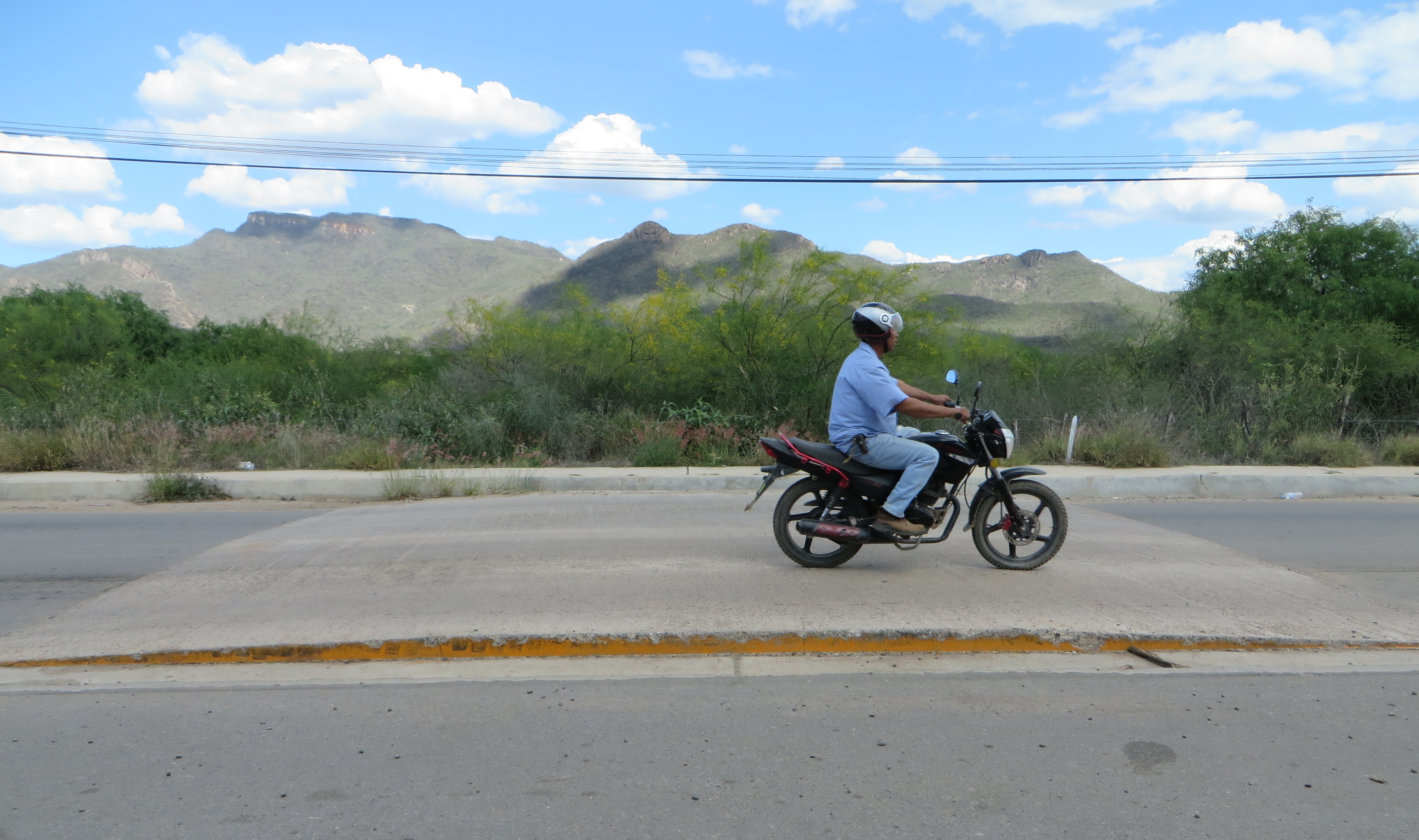
The benign tope in front of the municipal police office.
The height seldom exceeds three inches, which apparently is the engineering tolerance for slowing down drivers without causing their vehicles to bottom out, which might start to foment unrest in the citizenry. As it stands, the citizenry appears resigned to the tope as a minor nuisance of daily life. Topes, however, can be oppressive. On February 18, 2015, during a two-hour stretch driving on Highway 185 through a string of villages between the Oaxaca-Veracruz state line and the city of Catemaco, my husband negotiated 107 topes, an average just shy of one a minute. Some topes are striped or painted yellow, others not. Often, especially on busier thoroughfares, warning signs – either posted at some distance (e.g., Tope 100 meters) or next to the tope (see photo) provide advance warning. But unmarked topes can sneak up on a driver. This can be disconcerting and profanity-inducing when traveling at higher speeds.

Tope warning sign on Calle Madero in Alamos.
My husband, who does most of the driving, has noticed topes are often obscured by the shade of a tree or shrub and thereby easier to overlook, especially on unfamiliar roadways. While we jokingly assign a sinister plot to the shaded topes, his logical interpretation is that vendors who take advantage of slowed traffic to sell stuff to drivers and their passengers over time must plant vegetation so they have some shade between bouts of peddling their wares.
Thus, the tope is not only embedded in the transportation culture of Mexico; it is also integral to the country’s economy. I wonder if economists have ever calculated the regional economic impact and multiplier effect of the tope. Here are a few things we have purchased from tope vendors: chiltapines (super-hot peppers grown in Sonora), coyotas and empanadas (turnovers usually filled with something sweet), bellotas (acorns), ejotes (fresh green beans), and newspapers. Here are things we have not purchased: caged birds, bootlegged CDs of banda or ranchero music.
Besides protecting the lives of pedestrians and boosting the economy, topes serve another purpose: they promote philanthropy. Many groups, institutional and ad-hoc, collect money at topes. These groups range from Cruz Roja (Red Cross) and Bomberos (firefighters, who are often volunteer groups) to young women vying for local beauty queen and friends of the sick. On February 1, 2015, in the town of Sahuayo de Morelos in Michoacán we encountered our first group of Autodefensas (vigilantes who have lost confidence in federal, state, and local law enforcement to deal with drug trafficking and other organized crime) who were collecting money at a tope. Two men held out a can while two men with firearms stood by the side of the road. We put pesos in their can. This is small-change giving, but in a country where philanthropy is an emerging concept and pesos can make a difference in people’s lives, I think the clinking of coins in a can held out in supplication to a slowing driver may be the highest and best unintended consequence of the tope.
 saaribampo
You must be logged in to post a comment.