What Bob Means to Me

On February 2, 2011, David and I went to a favorite spot on the Río Cuchujaqui with two other couples from Alamos. The point, a misguided one, was to take our friends beyond the limits of the city and into the edge of the unfolding wilderness of the Sierra. The two men had ventured forth to some extent, one on motorcycles with his male friends and the other on weekly birding outings led by local Spanish-speaking guides who play the unspoken role of bodyguards for participants who otherwise would not go into the countryside alone. The two wives are charming and good company but not of the outdoors persuasion. I also believe they are content to cling to the idea that Mexico – even though they live here and embrace selected aspects of the culture and defend the country to their far more pigeonholing friends – is full of dread and menace.  The idea was to have cocktails by the river. We wanted to show them the beautiful river we love and the majesty of the mother mountains in that most reassuring of contexts: drink in hand.  The footwear of the women was portent enough that bringing adults to a place they would never go on their own is bound if not for disaster certainly for bumpiness.

Shortly after we arrived at the river and set up our little chairs and clinked our glasses, a party of bearded, unwashed fellows came laughing through the brush along the river carrying firewood. I forget now whether they were speaking Spanish or French or some other language, but we managed to determine they had been in Alamos for the recent music festival and were sticking around to enjoy the outdoors.  And down the river bank they traipsed to their encampment. I know their sudden rowdy appearance unnerved our friends. I admit they put me a little on edge, like seeing a mouse in a trap or a snake in the grass, but that momentary quiver was replaced by a sinking feeling that our own fragile sixsome was already beginning to disequilibrate.

I had prepared crustless cucumber sandwiches for hors d’oeuvres. Whatever possessed me to do that? I have never made such a thing in my life. They were dreadful, crumbly, and tasteless. The wind was blowing. The women did not like the wind. It kicked up dust and disarranged their hair. The small talk was infinitesimal. I was becoming quietly annoyed and impatient with our guests and with myself. I wanted to say, “Can we rewind this? Can we go back to Alamos and forget we ever asked you to come out here?”

The weather was changing. That night and the next, Sonora experienced the worst freeze in recent memory. Thousands of acres of crops along the coastal plain were lost, and in the foothills around Alamos huge deciduous trees and prickly pear and columnar cactuses were burned to a brittle crisp. Quemado. Our friends who live in the campo lost their beautiful gardens of lettuces, tomatoes, peppers, and beans. The weather was changing in more ways than one.

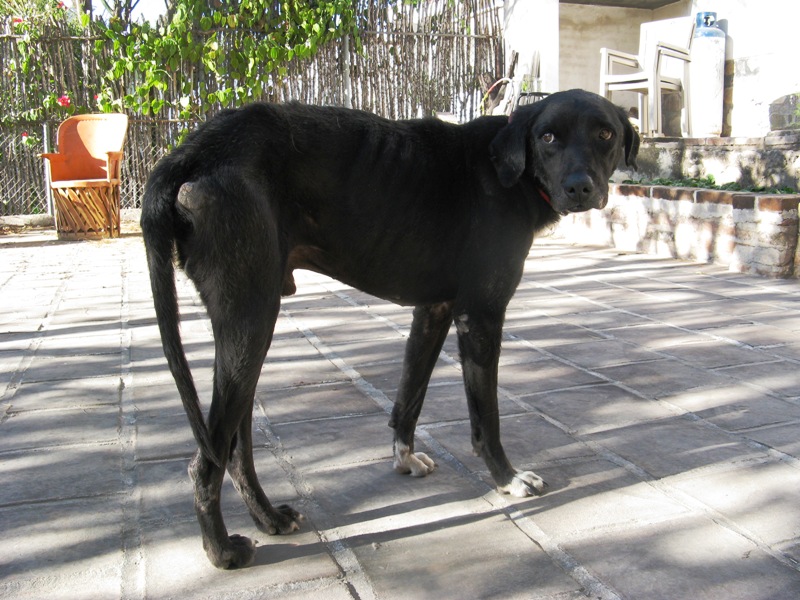
The six of us were sitting in our wobbly camp chairs on the sandy river bank when a black dog slinked up and sat on the edge of our painful circle. Not a dog, an assemblage of bones in a mangy black suit. Now things began to unravel in earnest. I have spent every sojourn to Mexico in a studied avoidance of dogs. The road dogs, the street dogs, the market dogs, the starving dogs, the bitches with tits dragging the ground, the diseased dogs, the limping dogs, the dogs with balls. Dogs in my country rarely have balls. I want one, but David does not. So I have soldiered on thwarting my urge and honoring his wish.  At this point, my armor cracked, perhaps because I was already snapping. Get me out of here, I was screaming in my head. It did not help that one of the women, a sentimentalist like me, started crying. So I started crying. The other woman remained stoical, and I don’t hold that against her. Get us out of here, the three spouses were probably thinking. All rationale people know the consequences of feeding a starving dog, but logic was not in play. We fed the dog. He was not so discerning of tasteless cucumber sandwiches.

We needed to come to a decision. I had put David is a terrible position and for this I will always be sorry. On his hands, he had a bawling wife and a starving dog. We broke our cocktail camp and put the dog in our truck. The stoical woman and her husband headed back to Alamos. The other couple, who had come with us, probably would have gone back with them but it was a two-passenger vehicle.  David thought the proper thing to do was to inquire at the nearby ranch as to the provenance of the dog. As we were leaving, another starving dog slunk out of the underbrush, a female bearing a striking resemblance to the dog now in our possession.  It was getting dark.  We drove up the winding road that overlooks the river and stopped at Rancho El Porvenir. This hilltop expanse happens to be a desolate, hammered-for-centuries landscape, and the pessimist in me always takes note when we pass this way that porvenir means the future in Spanish.

I got out of the truck and yelled a greeting. Dogs – ten, a dozen – came running out of the deepening twilight, and a young man followed. He was a local Alamos fellow, sweet of demeanor, who had been hired as a watchman by an American couple who had recently bought the ranch. He lamented the proliferation of dogs, telling me that El Porvenir is a popular dog-dumping site. I described our starving dog and he said it probably belonged to the old man who lived in the rancho across the road. He wasn’t sure the man was at home but we walked over and shouted. No response, although more dogs came running. I asked the young man to explain to his neighbor that we had taken the dog home with us and that we would return with an update. He did not protest. If anything, his tone and body seemed to approve. It is, however, risky to interpret the meaning of strangers in the dark who speak another language. I never went back to find the old man and tell him what became of his dog. That is another thing I am sorry about.

We came home with the dog. He slept on a blanket by the front door. It was a very cold night for Sonora. He curled up in the tightest ball he could with his bones. He was warmer than he would have been up at El Porvenir. He had a sweetness that David never saw. The next day I drove him to Navojoa to the veterinarian recommended to us by our neighbors – the same couple who went with us and drove home with us. My whole person was swirling. Time, money, a futile venture, a marital impasse. If the dog has heartworm I will ask that he be euthanized, if not I will ask that he be neutered. And then what? A neutered dog that I know I can’t keep? I put him in the back of the truck. We had been feeding him the night and morning before. I doubt he had ever been in a moving vehicle, not to mention at high speeds on curving roads. He started convulsing in the back. He’s dying I thought. No, he was just vomiting.  I found the vet after some searching, cleaned up the vomit, lifted the bones from the truck, took the bones for a walk to pee along the dirt road by the vet’s office. I am forever amazed at Mexico and my expectations of what the world should be like. Here was a highly professional veterinary in a fairly fancy building on a dirt street. The office person was a sweet skinny guy who said it would be 1 pm before I could see a vet. I put the dog back in the truck and went to shop. I bought some wine at the grocery store and found a music store where I bought a music stand to practice my accordion, my other futile enterprise. A Mexican dog and an accordion dream.

I returned to the vet. There was one calming interlude: I sat next to a very nice man who was a retired agronomist who was happy to engage me with my Spanish. We talked of crops and dogs and Mayo Indians and our shared preference for life in the country.  I almost felt bilingual. As we talked, I watched other clients come and go and saw that the pet culture is changing in Mexico, at least in Sonora or in Navojoa. Well-kept women usually with their daughters came in to drop off or pick up little bred-up pocket dogs. Chihuahuas, Shih Tzus. There was small talk. I explained I was “rescuing” a dog from the campo. I believe most of the clients had never been to the campo.

Daniel, the vet, who examined the dog I first called Mr. X, was a handsome and engaging young man, thorough and also willing to talk with me in his native language. I thought to myself, “Daniel, it is so nice to be with you in my personal Mexican dog saga. If you were my husband, I could keep this dog.” After some blood work and more time waiting, he told me that Mr. X did not have heartworm; he did have rickettsia and malnutrition. OK, I am not going to have the dog killed. Daniel slathered some tick-flea juice on the spine of the dog and gave me some other meds.  He said the neuter part would have to wait until Mr. X gained some weight. The cost of this first visit was one-tenth of an equivalent vet visit in the U.S. I drove back up the road to Alamos with Mr. X.  I was beginning to feel I was in a vortex. At some point, perhaps on this return trip, I decided his name was Bag of Bones – Bob.

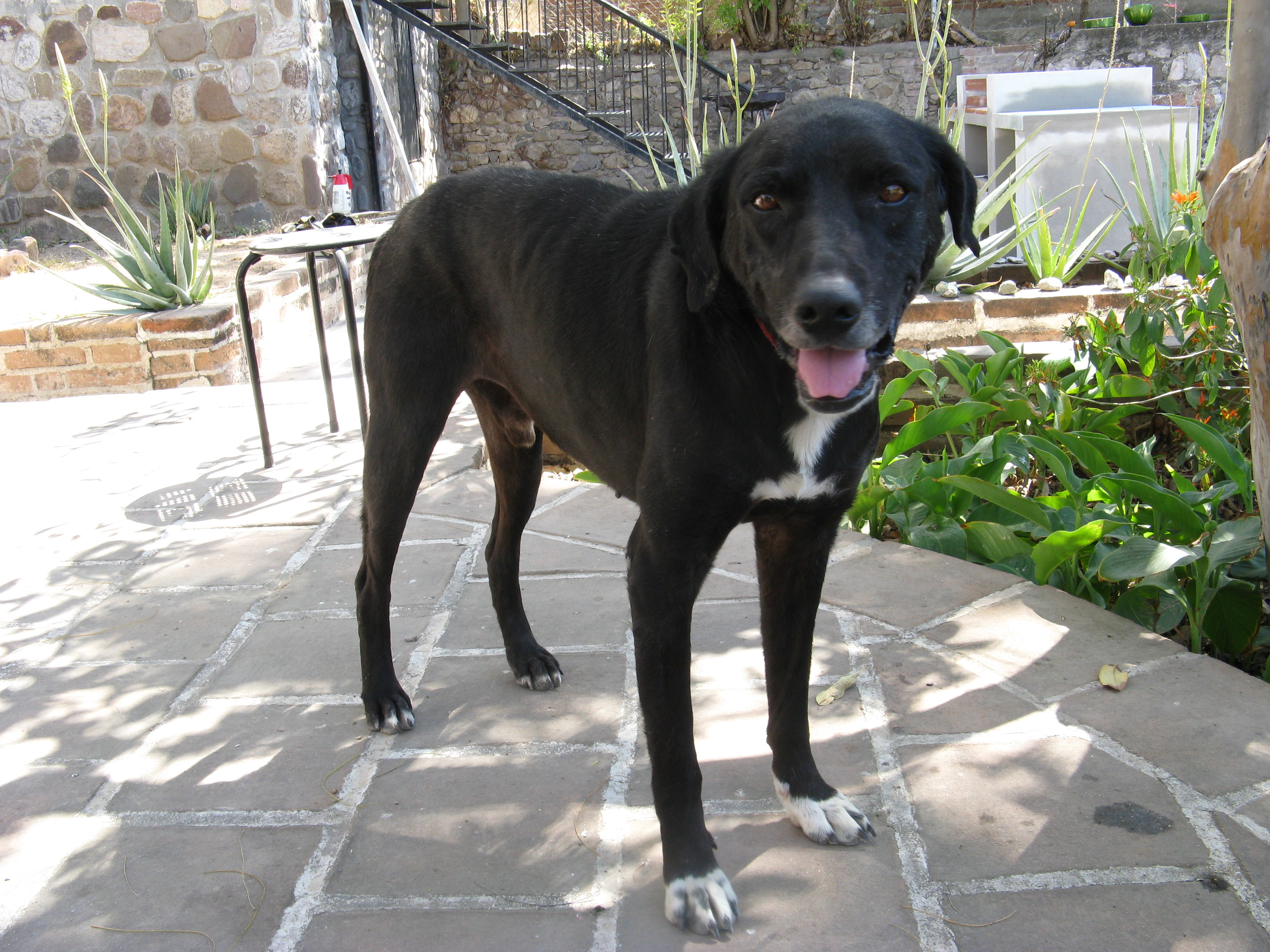
Bob flourished. He gained weight. His coat started to shine. He was frisky. He and Jack would play a little but not as much as he should have played with Jack to make David like him. He was snarly when we put food in his dish. I worked with him on a leash. I taught him to sit. I thought Bob was cute in his own campo way. David said Bob was profoundly ugly. It was a sad time. We all stood firm on the abyss – Bob and I on one side, David and Jack on the other – of mutual disagreement and discord.

February turned into March.  I took Bob back to have his balls cut off. I lay in bed many nights while David was soundly sleeping thinking what is going to happen with this dog who has but one human friend on earth. The night after Bob was neutered, the surgical area of his former man-parts was bleeding. It looked awful to me. I wrung myself up into another frenzy and the next day drove him back to the Navojoa. They said, so nonchalantly, not to worry. Bob and I drove home. The road back and forth from Alamos to Navojoa became my private trail of woe and unraveling.

We were going to leave Alamos at the end of March. I had to find a home for Bob. I made bilingual signs. Please adopt Bob.  Beto necesita buen hogar.  I rode my bike all around town with my fliers. I put a message on the Alamos gringo chat group. I had a few nibbled but no takers from the expat community. It was excruciating. I did not want to cast out Bob. I had no choice. I wanted everything to be erased.  I talked with Pancho Zavala, our friend and gardener, about how I had to find a home for Bob.  I put one of the fliers at the feed store down by the Arroyo Aduana. David said if I could not find a home for Bob we would take him back to where we found him. El Provenir – the future. David’s calculus was that Bob had had a brief reprieve – the best days of his life – and in the life of a Mexican dog that counted for a lot. That reasoning almost made my head explode.

We went birding one Saturday morning shortly before our departure from Alamos.  We took Jack with us and left Bob at home. I had come to have a chilly, distant feeling about Jack, our dog with a perfect life. When we got back home and were pulling up to park in front of our house, a man in a car was pulling away. Pancho was standing at our front door.  His wife, Cecilia, was sitting in their car. There was a swirl of confusion.  Jack jumped out of the car and I was trying to circle him out of the street and into the house. Through a jumble of Spanish, Pancho explained that Bob was in the car with the man pulling away. By a miraculous coincidence, Pancho had been at the feed store that morning when a man walked in, saw my Beto flier, and mentioned he was looking for a dog for his kids on his rancho. Pancho, in his inimitable ambassadorial way, must have told the man that he happened to work for the current keepers of Beto and he’d take the man to our house. When they arrived, and we weren’t there, Pancho opened the door and gave Bob to the man with a little bag of dog food. Pancho had lifted my ten-ton burden. I responded ambiguously, and that was another in my string of regrets in the chronicle of Bob. It all happened so fast. Bob was gone. I would never see him again. I was ecstatic and crestfallen all at the same time. I started crying. This completely baffled Pancho, of course, who now felt that he must have done a terrible thing. I convinced him, I hope, that he had done a wonderful thing. Pancho had done everything precisely right, and I had done my duty and kept the promise I did not want to keep.
ImageImage

Posted in Mexico | Comments Off on What Bob Means to Me

Janna’s Hands

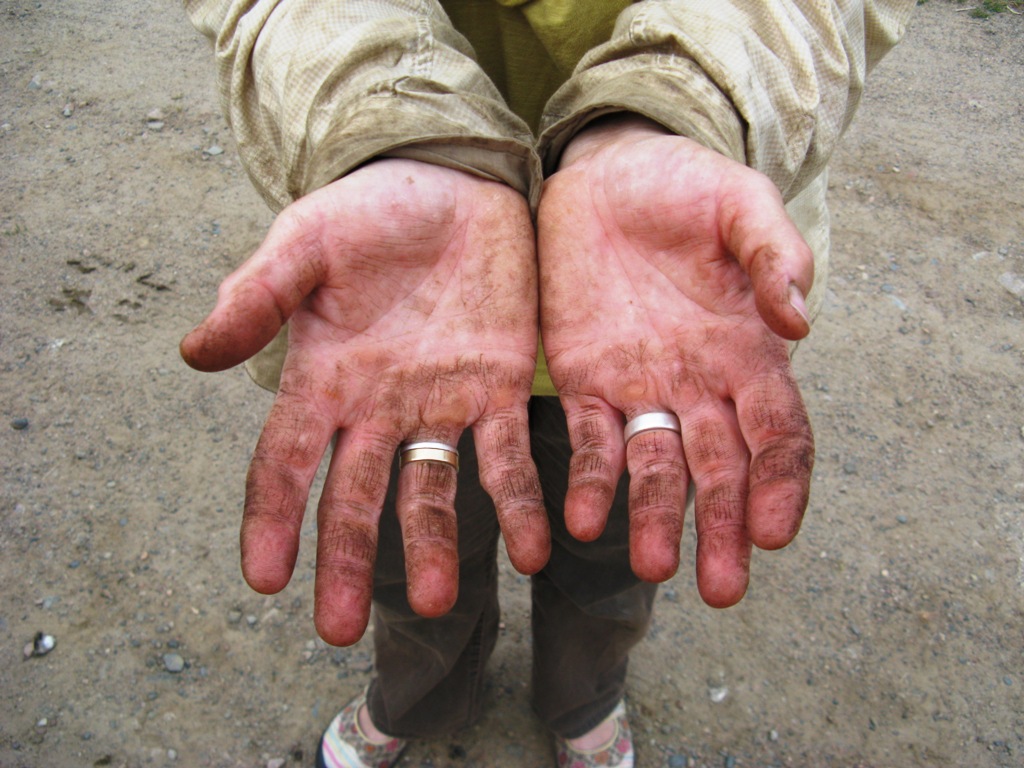
IMG_3403These are Janna’s hands. She is a gardener by trade and by choice. Her hands are in the dirt so much that she cannot scrub away the stain of the chocolaty soil where she gardens along the Pike River in northern Minnesota. Not so long ago Janna had anonymous hands. Then she quit her job as a journalist and became an organic gardener. She sells her produce and products at two farmers markets in a 50-mile radius from her farm, sells wholesale to Natural Harvest Coop in Virginia, MN, and provides weekly allotments to a dozen or so CSA (community supported agriculture) customers. She raises chickens for eggs and chickens and turkeys to butcher. She tends bee hives to make honey and taps silver maples by canoe in the Pike River to make maple syrup. She is busy and usually bushed by the end of the day. Over the course of two seasons when she was starting up her new enterprise, she cleared the land and erected three enormous hoop houses of her own design (not purchased as a kit). Her dad (retired machinist), her mom (retired English teacher), her husband (high school science teacher), and various friends with various degrees of competency in the realms of gardening and carpentry pitch in from time to time. But mostly it has been Janna working from dawn to dark, and after dark when necessary, as was the case in the spring of 2012, when an invasion of variegated cutworms descended on the gardens of our area. Short of poison, the only way to cope with the insidious little bastards, which feasted by night, was to squish them one by one by flashlight on hands and knees. Killing other living things – either because they are killing the plants or animals you are raising or because you are raising the living thing to kill it – is a perpetual backdrop, dilemma, and conversation I have with Janna and my other close friends who garden and raise livestock. We have blood on our hands as well as dirt and it is something we do not take lightly. She and her husband Tim and our neighbors Chuck and Mickey helped us butcher chickens last summer and in other summers helped us dispatch our turkeys. Last year, we helped Janna and Tim butcher turkeys on a freezing cold October day. We will offer our help again this fall.


Posted in West Saari Road | Comments Off on Janna’s Hands

Miss Tot

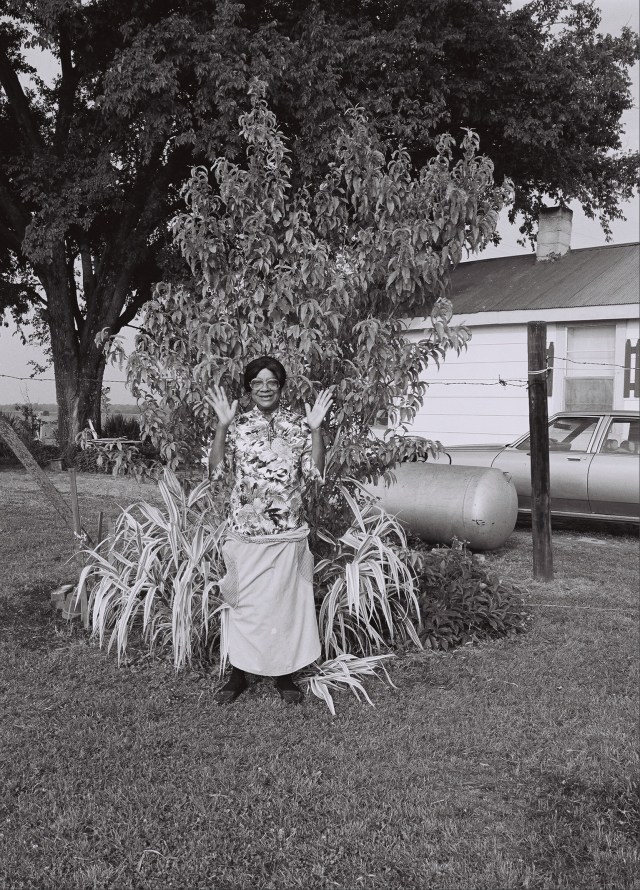
Tot in her yard in Tunica, Mississippi, in 1990

Her name is Almetter but people call her Tot, Miss Tot, or Tee Tot.  Her brothers called her Lonnie.  She also has a succession of surnames, McKinny, Lofton, Cole, the last two being the names of husbands, a subject on which she is vague.  Miss Tot is not versed in matters of the Constitution or the Bill of Rights, but she has an inborn sense of her right to privacy.  She did allow that the latter husband “got the hot feet.”  If she once harbored hard feelings about this departure, she doesn’t now.

She keeps a photograph of him, hanging high on the wall up near the ceiling.  You have to climb on a chair to look at him.  He was good-looking and slight – a bantamweight – which suggests he probably was quick and light on his feet.  In the photograph, he stands in a jaunty pose leaning against a fine, shiny car.

Tot herself is small and agile.   Tot is 74.  She does not look her age. It’s not so much that she looks fifteen or twenty years younger than her real age but that she looks ageless.  This does not mean she has led a life of leisure or that she has not been sick or near the point of death.

She was born and raised in the Hills, the rolling, wooded section of Mississippi to the east of the Delta.  She came here in 1951, with her two boys but without Evert Lofton, her first husband.  She lives in a tenant’s shack at the bend of a gravel road that snakes west from Highway 61 off toward the backwaters of the Mississippi.  Her house is in Tunica County, in the north Delta.  Tunica County is a case of poverty raised to a higher power.  In the poorest region of the country it is the poorest county.  Roughly 7,000 people live in the county – the population continues to dwindle – 80 percent of them black.  The white minority of Tunica County is particularly defensive on the subject of poverty.

There are fewer and fewer shacks like Tot’s lining Delta roads.  With the mass migration of rural blacks from the South to the urban centers of the North, which began during World War I, their abodes, hardly built for the ages, have fallen down, been enveloped by vines, razed, or burned.  Scattered around the Delta you can see squarish piles of rubble and blackened earth that have an eerie resemblance to scorch marks left by the rockets of departed spaceships.

Tot lives here with her bachelor son, whose name is William Henry but who goes by Jim or Jim Tot.  Her other son lives with his family in Texas.  The house and yard are tidy and decorative, though its flourishes – like the plastic pelican in the front yard – and the accretion of items of potential value are outlandish and cluttered by the standard of suburban America.  In the back is a hen house, a bin for collecting aluminum cans (the earnings go to support her church), a woodpile, a shed, an old Thunderbird rusting next to a now-vacant sky-blue shotgun house, and Tot’s vegetable garden fortified from the chickens by a crude fence.

This island of domesticity sits in a sea of cultivation.  The field to the east has just been leveled and compacted for the cultivation of rice.  It is so flat and packed that it looks like a parking lot.  No trees obstruct the view.  You can sit on her porch and watch toy-sized cars and trucks plying Highway 61 a half-mile away.

This shack is the center of Tot’s universe.  She knows the site of every pecan tree in a five-mile radius, the nuts of which she collects in the fall to sell.  Her church, which she organized and maintains, is a quarter-mile up the road.  She is a Samaritan, caring for the sick and afflicted in the vicinity.  News consists of local events – the Mexican migrant worker stabbed by a black fellow; the couple asphyxiated by a leaky gas stove – and she is a proficient bearer of the news she deems important.  On the other hand, she has no opinion on the appointment of Clarence Thomas to the Supreme Court because she has never heard of him.  The most important vote she casts is for road commissioner because that is the person who keeps her gravel road in passable condition.  Though she is a beneficiary of the achievements of civil rights worker Fannie Lou Hamer, who was born and died about forty miles away, Tot does not recognize the name.  “Was she a church lady?” she wondered.

The only document she seems capable or interested in reading is the Bible.  There is a Bible on the dash of her car.  Bibles lie open on several of the beds in her house. A Bible sits on the window sill behind the dilapidated couch on her screened-in porch.

This is one chapter from a project funded by the Center for Documentary Studies at Duke University to support collaboration between writers and photographers. The grant, entitled the Dorothea Lange – Paul Taylor Prize, was awarded to me and photographer Keith Carter in 1990. I will post other chapters from time to time.  And I recommend http://www.keithcarterphotographs.com/home.html to see Keith’s work. He is a wonderful photographer. 


Posted in Tot | Comments Off on Miss Tot

“The bridge is burning!”

Our bridge has burned down. I use the possessive pronoun deliberately. When you spend a great deal of time at a certain place over many years you take possession of it. And in that sense, the old wooden bridge that crossed the Pike River on West Saari Road belonged to us.

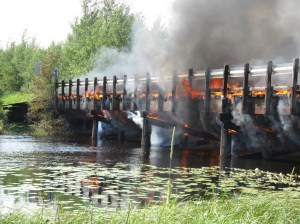
The phone rang around 2:45 p.m. on July 12. Our friend and neighbor Mickey White, who works at the Timberjay in Tower, said, “The bridge is burning.” A report had just come over the scanner about the fire. The address given with the report was 6118 West Saari Road, the old Saari farmstead that perches on the east bank of the Pike River just south of the bridge. We all know our neighbors’ fire numbers. The matriarch of our road, 98-year-old Nannie Saari, lives at 6118 with her son Virgil. We are packsackers. They are pioneers. They lend continuity and dignity and deep history to our road, so, of course, we are possessive of them, too.

Those salient details from Mickey – “6118” and “the bridge is burning” – elicited a profound physical response. The body reacts to alarming news in indescribable ways. I grabbed keys, camera, cell phone, and shouted to my husband, David, who was napping, that the bridge was on fire (only an event of this magnitude would be grounds for waking a spouse from a nap). I jumped in one car with our visiting friend, Dennis,  and we tore off toward the bridge. It was the fastest I’d ever driven the one mile to our bridge. The western sky, framed by the pickets of pine, spruce, and tamarack that line our road, was smudged with a huge, black billow of smoke moving rapidly northward. I think I thought at that moment (or perhaps I later imagined I thought this): “Thank God there’s a north wind – Nannie and Virgil are upwind.”

There was a lone person standing in the middle of the road. It was Virgil. Now, three people were standing in the middle of the road. There was little to say and nothing to do. We watched the fire.  More precisely, we watched the smoke. The flames, issuing from the support structures below, formed an almost benign-looking fringe of golden-orange flickers, atop of which rode the more ominous billowing of black smoke fueled by the creosote timbers of the bridge.

The men were pillars of calm. I like to think of myself as a composed person, but an objective observer would probably have described me as fidgety – trotting up close to the bridge edge to take pictures, retreating, trotting back, calling Mickey to say what people always inanely say on cell phones (“I’m here now”) and to state the obvious (“Yes, the bridge is burning”). David arrived with our dog Jack, the first time he (or any of a long succession of our dogs) had ever been at the river on leash. They were followed shortly by Mickey’s husband, Chuck Neil. We now had a quorum of what we jokingly call the West Saari Road Neighborhood Association.

An officer from the St. Louis County Sheriff’s Department drove up and assumed authority, not that there was much authority to command over a small assembly of law-abiding citizens. He wanted us to keep our distance – I assumed for our safety – until he said he didn’t want us to destroy any evidence. In a whiplash, I realized he meant, like, arson evidence. Someone would burn down our bridge?

Time passed fuzzily. Over the next 10 or perhaps 30 minutes, a series of vehicles and firefighters arrived from Vermilion Lake, Embarrass, Pike, Sandy, and Britt townships and the Minnesota DNR. (Virgil, at the height of the response, counted 17 official vehicles of various kinds.) Some were stationed on our – east – side of the river. Some could be seen through the curtain of smoke on the west side of the river. We began to feel superfluous and drifted  home.

The Pike River bridge has been part of our life for 23 years in every season and all kinds of weather. It pulled like a magnet. It was where we went – on foot, bikes, skis – and where we launched canoes and kayaks for cruises on the river and where we crossed in a vehicle when the destination was farther west on the maze of gravel roads through Pike Township. I associate thumping and thwacking across the old bridge timbers in our car with going to vote at Pike Town Hall. Therefore, our bridge was an essential part of democracy – with discharging my fundamental right and responsibility as a citizen. I walked there alone (well, alone with a dog), with David, with friends and visitors, and countless times with Mickey. We swam in the tannic river below the bridge as have all of our water-loving, stick-chasing dogs – Billie, Jabo, Ray, Phoebe, and Rufus, and now Jack.

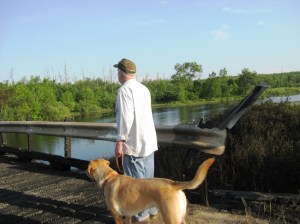
David and Jack on the bridge the morning after the fire.

David, Dennis, Jack, and I went down to the bridge at 7:30 a.m. the next day. It was a sad cup of coffee. Of course, there was an orange-and-white-striped three-panel barricade with night flashers and a big sign with a stark message: BRIDGE CLOSED. We walked around the barricade to the charred black carcass of the bridge. The extreme heat had torqued the metal guard rails in places. The bridge timbers – across which we had thumped and thwacked so many times – were silvery black and cracked like the hide of a crocodile. In the approximate middle of the bridge was a jagged crater of collapsed timbers.

It is far too soon to know the circumstances of the fire (and beyond my interest to speculate – regardless of what or who caused the fire, our bridge is gone). And who knows what lies in store for our river crossing, although it is most unlikely the bridge will be rebuilt. A bridge is a tangible thing with heft and dimension and structural integrity. It is also a metaphor. Parents, aunts, uncles, and teachers instill in children many important lessons, from the practical (brush your teeth before you go to bed) to the ethical (respect your elders). One of those lessons, which at times of high emotion can be difficult to implement, is the metaphor: Don’t burn your bridges behind you. With deliberation, I have burned a couple of bridges in my lifetime when certain individuals became too troublesome to cope with, but for the most part, I’ve taken that message very seriously. A bridge lets you cross where you otherwise could not and it lets you come back again. That is just too valuable an asset to tamper with. The day after the fire, with my sad cup of coffee, I stood with my friend, my husband, and my dog on the edge of the metaphor and saw what the lesson looks like when you break it.

Clifford Scott, Chuck Neil, and Mickey White at the First and Last Supper on the bridge.

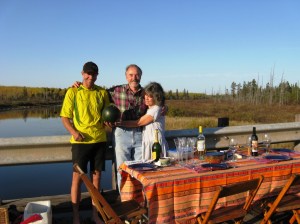
Last October – on one of those perfect fall evenings – we had a picnic on the Pike River bridge. We set a beautiful table with real plates, knives, forks, and stemware. We popped a bottle of champagne and ate a meal composed of the last great bounty from our gardens, including a Blacktail Mountain watermelon. We had already started talking about this year’s picnic on the bridge. As it turns out, it was the first and the last supper.

This essay appeared in Hometown Focus on July 20, 2012. 

Posted in West Saari Road | Comments Off on “The bridge is burning!”