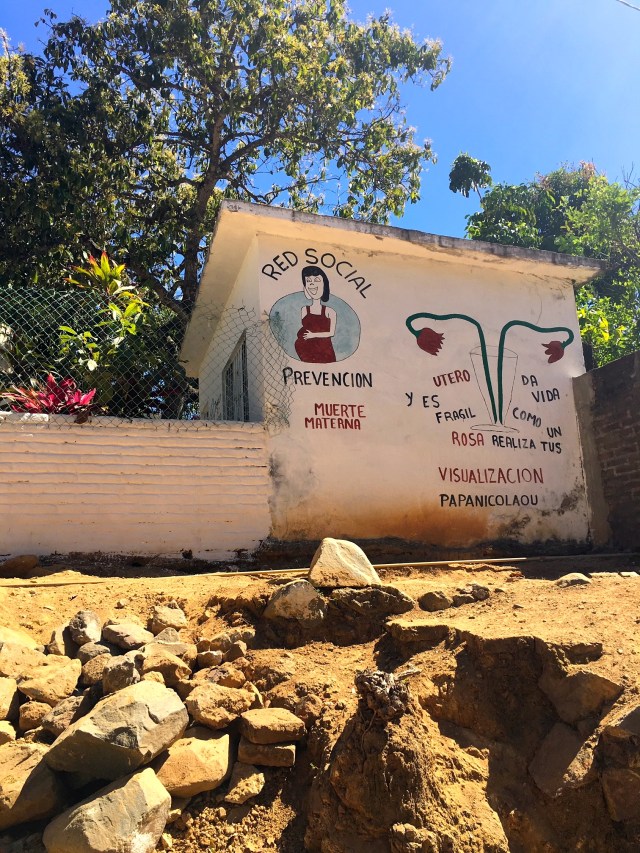
A public health announcement on the wall of a clinic in the village of Copala, Sinaloa, February 26,2019.
The messages: “Social network – Prevent maternal death.” “The uterus gives life and is fragile like a rose. Get your PAP smear!”
The red dirt trench and pile of rocks are characteristic of unpaved roads in villages and rural areas around Mexico, which seem to be in a perpetual state of repair or disrepair—it is often hard to know which.
Posted inMexico|Comments Off on Fotos ocasionales de México
“The sky throughout history has been variously filled by the promptings of the imagination, whether with gods and prophecies and the rhythms of the zodiac,
or with the first faint stirring of scientific thought.”
—Richard Hamblyn, The Invention of Clouds
In January this year we had several good rains in southern Sonora. Precipitation in the winter is much appreciated by all because it provides a buffer against the impending dry season, a parched, sweltering, and dusty period that persists until the onset of the rainy season in mid to late June. When we were talking about the good fortune of these winter rains with Alejandro Sauceda, a friend who grew up and still lives in the campo, he told us about a weather-forecasting system still widely used by country people around here. With our imperfect comprehension of Spanish as spoken in rural Sonora, we picked up on the idea but not the exact details—something about using the times when it rains in January to predict weather patterns, especially rainfall, in the ensuing months.
Not immediately catching the name he used for this practice, I asked, “¿Otra vez, cómo se llama este sistema?”
“Las Cabañuelas,” Alejandro replied, of course repeating the word several times until we thought we had captured all the syllables. Alejandro is very patient.
We asked another friend Ángel Esquir if he could elaborate on the subject. We figured, rightly, he would know all about it, because he was born and spent the majority of his 80-plus years in the campo, which here in Sonora is more commonly referred to as el monte. We videotaped his explanation of Las Cabañuelas so we could refer to it and translate the details and so we would have this memory of him explaining it. The elders who hold the knowledge of the Sonoran monte—its pastoral culture, norms, economy, and natural landscapes—are fading away.
I was skeptical when Ángel made the claim that Las Cabañuelas is a universal weather-forecasting system. Considering that Ángel’s universe is Hispanic, he is basically right. According to Wikepedia, today’s widespread click-away source of information, the tradition of Las Cabañuelas dates back at least several centuries in Spain, and its use spread around the world with Spanish conquests in the New World and parts of Africa. https://en.wikipedia.org/wiki/Caba%C3%B1uelas
Ángel grew up with Las Cabañuelas and can recite its rules like an anthem. Still I don’t know how doggedly he adheres to it as a forecasting tool. He, my husband, and I often discuss the science-driven weather forecasts we follow online and he follows on the blurry television in his home. I think Las Cabañuelas is simply woven into the fabric of his life. Just like Groundhog Day is woven into mine.
On the subject of weather, I just finished reading The Invention of Clouds by Richard Hamblyn. What a wonderful book! It is a biography of Luke Howard, a British chemist, Quaker, and amateur meteorologist who in the early 1800s devised and promoted among the scientific community a classification system for clouds.
I have been reading a lot about clouds and weather since 2016 when I purchased the CloudSpotter app ($2.99) and joined The Cloud Appreciation Society (member #41,844). I am accustomed to looking up. I have been watching birds for fifty years. Now I simply look up more often.
Adapting the Linnean system for ranking living organisms, Luke Howard used Latin names to classify clouds according to such factors as altitude, temperature, and solar radiation that drive their formation. For his continuing efforts to elucidate the clouds and share his knowledge with an enthusiastic public, Howard was greatly admired, indeed a celebrity, in Great Britain and Europe.
As Hamblyn writes, “By the end of the eighteenth century the grip of rational entertainment had firmly secured itself on the public mind, and had done so because it served the equal, if novel, demands of pleasure, instruction and imagination. Science had been on the rise for a century or more, and had now ascended to its height, where it drifted through the cultural atmosphere of the age.”
Across London, many lecturers expounded on biology, geology, meteorology, and new inventions, and their audiences widely embraced scientific discovery. Hamblyn writes, “…people cheered loudly at lectures.” I detect a bit of wistfulness in his tone as he describes this era—or I am projecting. My goodness, from my vantage in 2019, it is hard to imagine the public in the “grip of rational entertainment” or the appreciation of science drifting through the cultural atmosphere of my era.
With some modifications and additions over the years, Howard’s Latin-based nomenclature became the universally accepted system of cloud identification used by meteorologists around the world to help forecast and explain the weather and by cloud enthusiasts, such as myself, who wish to put names on the gorgeous specimens we gaze up at. A truly monumental effort, the International Cloud Atlas, first published in 1896 and still in print (and online), is the official authority and keeper of the cloud classification.
The Invention of Clouds is far more than a biography. Hamblyn uses clouds and the wonderful life of Luke Howard to tell a history of our human quest to understand, codify, explain, forecast, and frequently create dogmas about, the weather. In the chapter “A Brief History of Clouds” Hamblyn makes a sweeping survey of the subject drawing on ancient Egyptian and Babylonian texts, Chinese yin and yang philosophy, Taoist hierarchy of gods, Norse mythology, Greek and Roman treatises on mathematics, astronomy, and meteorology, Christian theology, the Cartesian scientific revolution and Age of Enlightenment (bringing the invention of the telescope, microscope, thermometer, and barometer)—all leading up to the cloud classifications proposed by the modest Quaker Luke Howard.
Although Hamblyn does not reference it, the Iberian spread of Las Cabañuelas around the world, news of which reached me in southern Sonora, Mexico, in 2019, is part of Homo sapiens’ long march to decipher the weather, which is so basic, changeable, critical for navigation and aviation, essential for forecasting and responding to weather-related emergencies—and so very personal. For eons people have been parsing the clouds and inventing interpretations that range from the quaint (Las Cabañuelas) to the sinister (Noah’s Ark). That there is now a rational explanation for clouds based on their chemistry and physics—what makes a cumulus a cumulus and a cirrus a cirrus—in no way distracts from marveling at their mutable beauty as they waft, roil, and shift across our sky canvas. I often stand outside looking up a cloud formation and hear myself saying, “Oh, my.”
The snow is blowing sideways on Boom Island in the Heartland. It looks like Marge Gunderson is going to announce her candidacy for president. No, no—it’s Senator Amy Klobuchar. There she is stepping out of the stratus clouds, coming barely into focus, dusted in snow. Yes, Klobuchar is going to run for president. She could not have picked a better place or better weather. On the Mississippi River in a blizzard! What a beautiful day, as we say in Minnesota.
If I were inclined to believe in a deity, it would be Tláloc, the Aztec god in charge of making it rain. To call him the Rain God, however, is to oversimplify the manifestations and metaphors of his godly responsibilities and of water itself. Tláloc has many names. In Náhuatl Tláloc means el néctar de la tierra. By virtue of his rainmaking role, Tláloc was, and perhaps in some quarters still is, venerated as dador de vida—giver of life. By virtue of the destructive potential of water or the lack thereof, Tláloc can bring on tempests, floods, hail, blizzards, hurricanes, and drought. He can give and take away.
Just to be clear, I am not a theist or a polytheist, but I am romanced by the imagery and poetry swirling around Tláloc, and I hold in high regard the power of water.
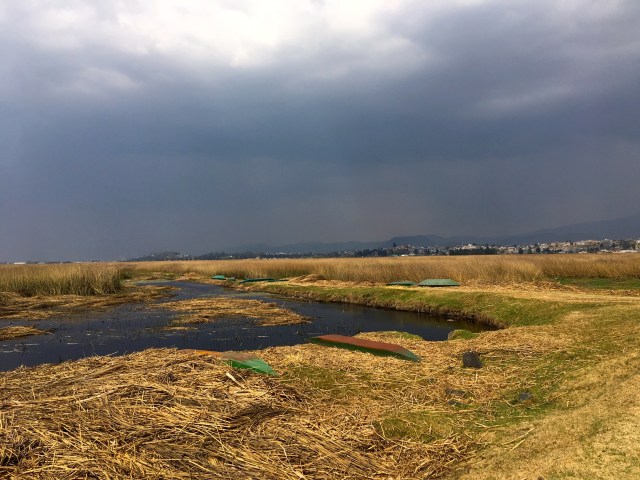
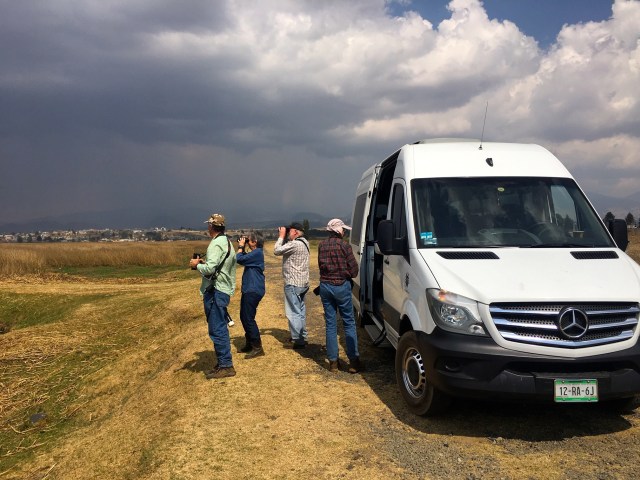
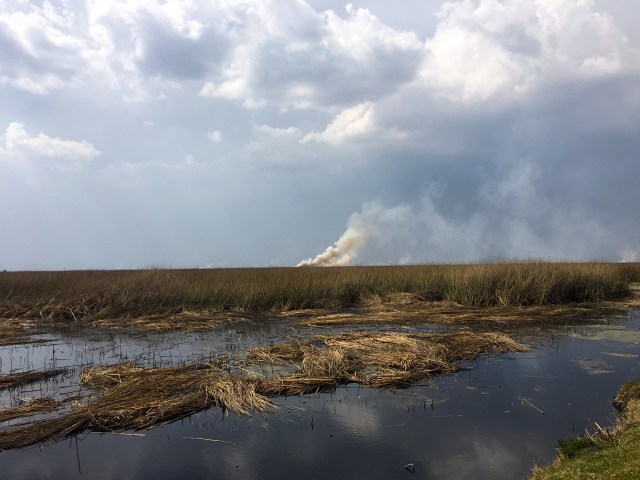
Last spring, Tláloc was at work, drumming thunder and throwing lightning bolts across the dark skies over the Lerma Marshes in the Valley of Toluca about 50 miles southwest of Mexico City. We were with several long-time birding friends on a standard birders’ pilgrimage—looking for a bird threatened with extinction in the last remnants of a largely destroyed landscape. It is a pastime fraught with despair.
Looking for the black-polled yellowthroat at Lerma Marsh while thunderstorm approaches.
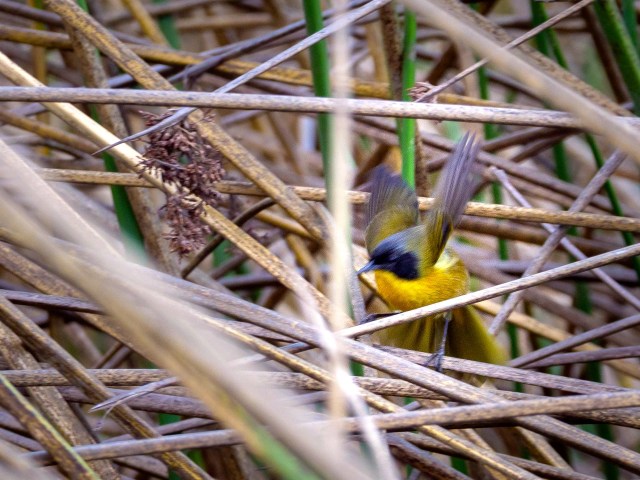
The black-polled yellowthroat is a small, secretive warbler now confined to five wetlands in central western Mexico. The Lerma River, the second longest in Mexico, originates at about 9,800 feet on the Mexican Plateau and flows 470 miles to Lake Chapala, Mexico’s largest lake, near Guadalajara. Its once vast marshes have been cleared for agriculture and drained for crop irrigation and urban water. In a recent article about the yellowthroat’s current distribution, population, and prognosis, the authors estimate the remaining habitat where it is found is 23,462 acres. By comparison, the metropolitan area of nearby Mexico City is 366,952 acres. The authors call for urgent action if the little bird is to survive—for instance, protecting and restoring some portion of what remains of the marshes, stopping illegal burning and harvesting of aquatic plants—none of which in my humble and pessimistic opinion is likely to happen.
A black-polled yellowthroat seen briefly in its thicket of reeds in Lerma Marsh. Photo by David F. Smith.
It is a beautiful sprite of a bird with a jet-black mask and lemon-yellow breast, and we had no trouble seeing a few. We tricked them by playing a recording of the male’s song. Thinking their territory was being invaded, they popped into view here and there in the marsh to defend their turf. The God of Technology—probably not a term that translates easily into Náhuatl—is in the birder’s pocket. I cannot speak for my companions, but seeing the yellowthroat so easily and so well produced a certain euphoria in me that dampened if only briefly the true state of its peril.
On the horizon, a fire burns in the marsh.
Eight months later, we were in Mexico City. We joined five friends, all birders and lovers of nature, two of whom had been with us at the Lerma Marshes. This was a trip about museums, markets, eating, walking, watching people, talking to merchants and waiters and taxi drivers, and marveling that the largest metropolis in the Western Hemisphere—with 21.2 million inhabitants—can function with such friendliness, politeness, good humor, sophistication, and the veneer of efficiency. We make no claims that this urban swirl is sustainable and we are not stupid. There is great socioeconomic disparity in Mexico City, as in all countries and vast metropolises. Unequal Scenes is a project that documents inequity around the world using drones, https://unequalscenes.com/mexico-city-df.
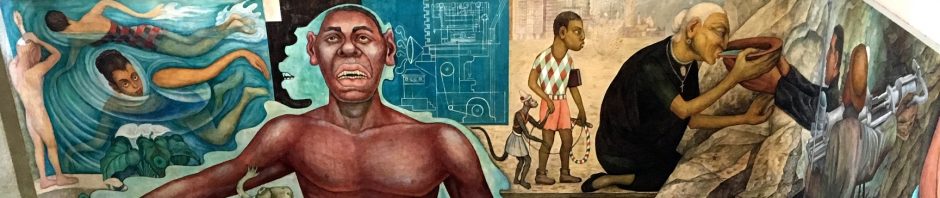
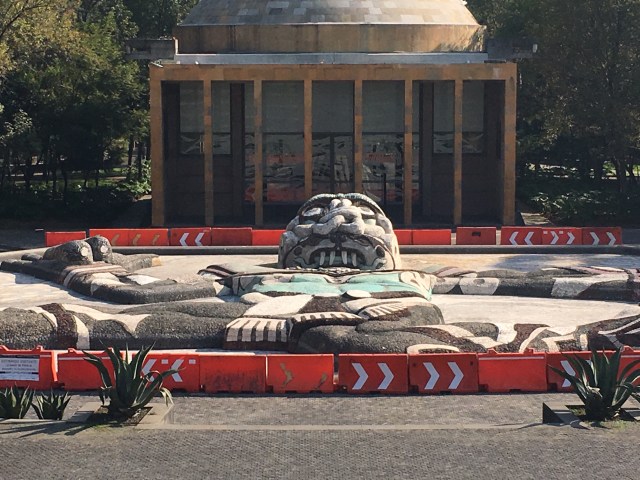
On our last day in Mexico City, on the recommendation of Jeffrey Banister, a social scientist at the University of Arizona, we visited the Cárcamo de Dolores, a municipal pumping station in Chapultepec Park that has transported water from the Lerma River to Mexico City since the 1950s. Here we encountered Tláloc lying on his back, arms and legs outstretched, eyes to the sky, two ears of corn in his right hand. I wondered, is Tláloc just taking a nap or is Tláloc dead? Is this his bed or his sepulcher?
Tláloc in repose at Cárcamo de Dolores in front of the temple structure housing the waterworks. The orange barricades and empty reflecting pool–the watery bed Diego Rivera designed for Tláloc–were the only disconcerting notes in an otherwise beautiful place.
In the 1940s, Mexico City’s exploding population was creating an urban water crisis (even though the capital built on a spongy marsh experiences regular flooding). Officials embarked on an engineering project to construct 40 miles of aqueducts and 26 tunnels to bring a regular supply of water from the Lerma River to the city.
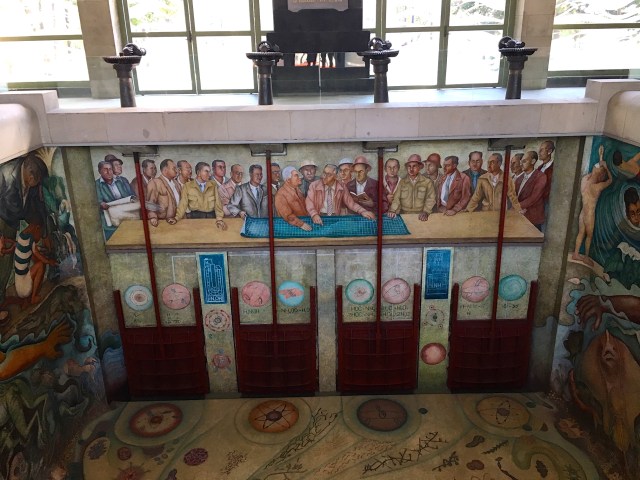
Mexico holds dear the profession of civil engineering. There are six engineers honored in the Rotunda of Illustrious People in the city’s Dolores Cemetery. Perhaps this veneration relates to the importance of large infrastructure projects in Mexico’s rapid transition from a third- to first-world country; perhaps it is because Mexico has long cherished the pyramids, temples, cities, and ceremonial centers built by its pre-Colombian civilizations. In this spirit, Ricardo Rivas—the architect of the Lerma pumping station, which resembles a Greco-Roman temple—set out to commemorate the engineering feat of his colleague Eduardo Molina, the civil engineer and Director of Water for the Federal District who designed the water transport system, as well as the 39 workers who died during the nine years it took to complete.
Rivera’s mural of the project engineers.
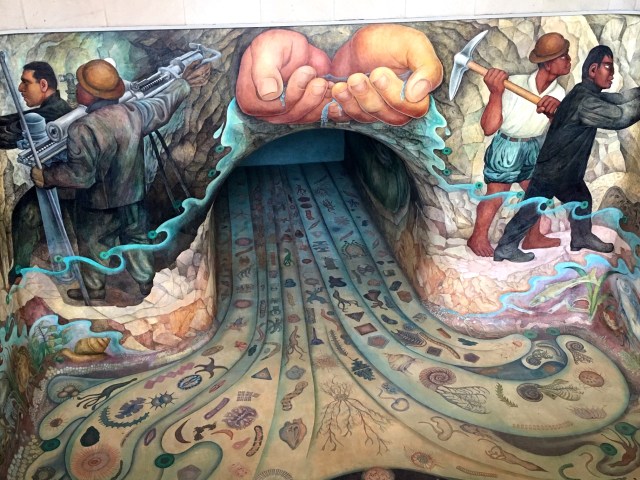
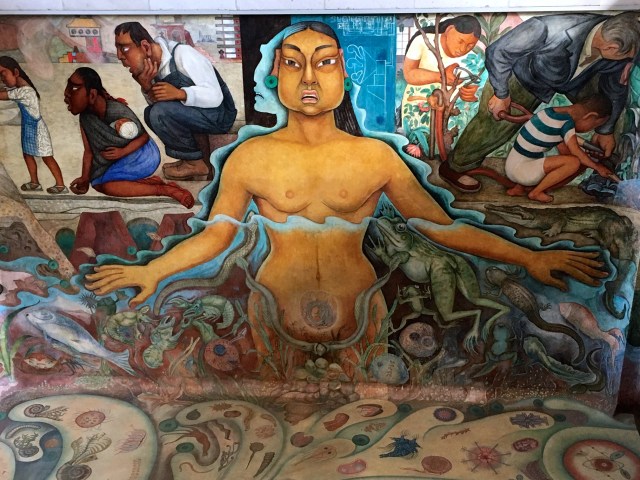
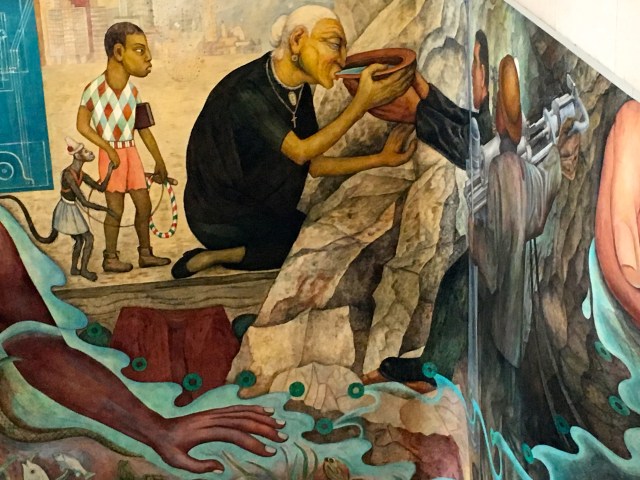
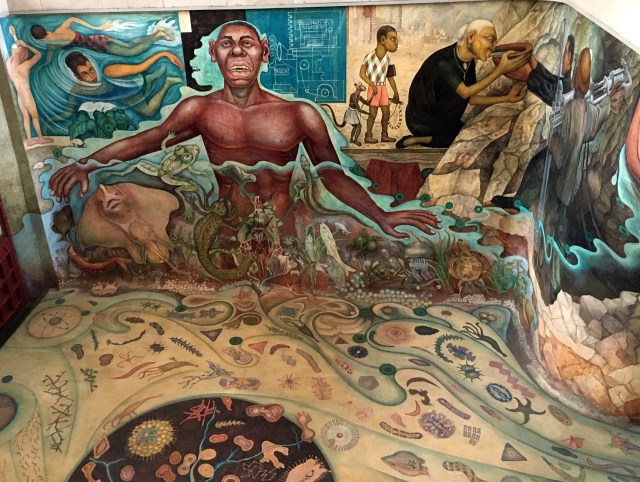
Rivas commissioned the famous artist and muralist Diego Rivera to create works of art in and around the pumping station to celebrate water. At the entrance, Rivera created the giant recumbent figure of Tláloc in a reflecting pool. Undergoing repairs to fix damage from the September 2017 earthquake, the pool was unfortunately empty on the day we visited, leaving Tláloc forlornly high and dry. Inside the pumping station on the walls of the gigantic tunnel that sluiced water into the city, Rivera painted vibrant murals that portray in gorgeous, fantastical images the role of water in the origin and evolutionary development of life, including the origin of Homo sapiens. Rivera based much of the imagery on the scientific theories of the Soviet scientist Alexander I. Oparin, a proponent of the primordial soup theory of evolution of life from carbon-based molecules. That Tláloc and Oparin inhabit the same art stage is proof of Rivera’s extraordinary gift for uniting myth and science as if the two were not at odds.
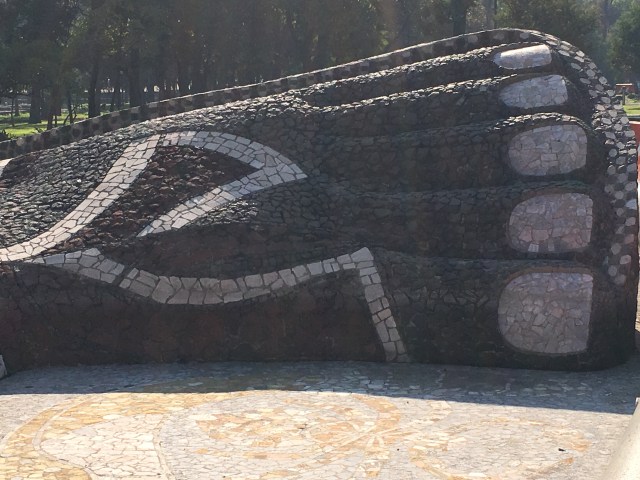
Tláloc’s foot.
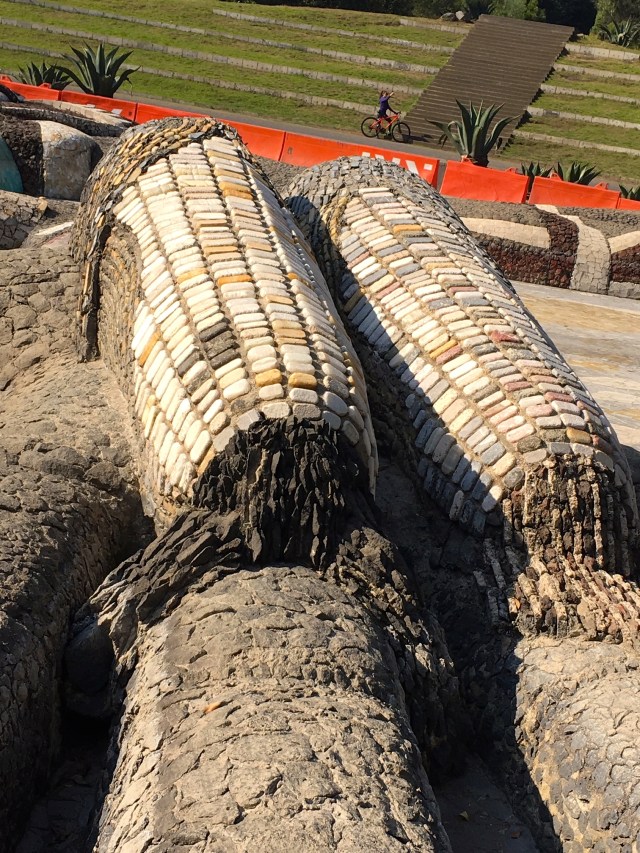
Corn in Tláloc’s right hand.
The incoming tunnel once submerged in water coming from the Rio Lerma.
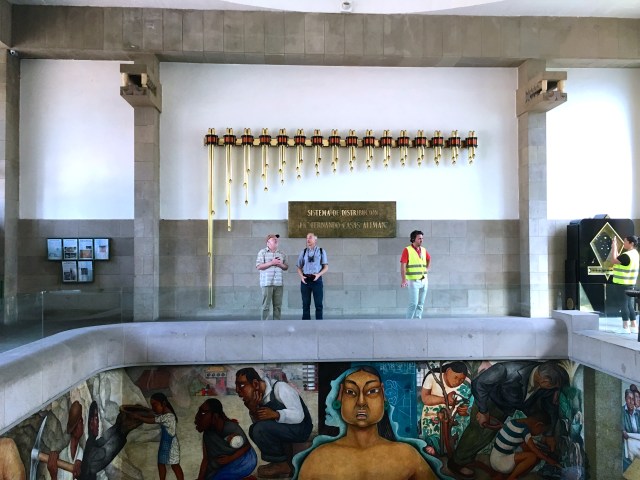
Two-thirds of Rivera’s murals would be submerged for 40 years. In 1990, the Instituto Nacional de Bellas Artes embarked on a decade-long project to restore the murals before they were totally erased by the rushing water and to open the pumping station as the public museum it so richly deserved to be. Underground tunnels were constructed to reroute the Rio Lerma water from the pumping station. Visitors can now stand and peer into the cavernous maw covered with Rivera’s amazing murals. In 2010, additional renovations began that included remedying what was lost in the renovation of the murals—the reverberations of water. Mexican artist Ariel Guzik designed a remarkable computerized mathematical system to replace the sound of water called the Cámara Lambdoma. Four outdoor sensors detect wind speed, seismic vibrations, angle of sun, and ambient temperature to activate a series of computer signals that in turn trigger organ pipes playing ever-changing murmurations.
The organ pipes of the Cámara Lambdoma.
Details of Rivera’s murals on walls of the waterworks.
Water as giver of life.
The origins and evolution of life.
The Cárcamo, with the ethereal music of the Cámara Lambdoma, is a jewel, one of the most beautiful and haunting spaces I’ve ever visited. Fifty miles to the southwest, black-polled yellowthroats, jewels of the Lerma Marshes, flitted in the cattails of their ever-shrinking waterscape. Here we were standing in an exquisite place that celebrates nature while at the same time destroying it. And I am left with a question. Can art take the place of nature?
Here’s the sound of water on an irrigation canal on the Rio Mayo, December 28, 2018. Jeffrey Banister has written about the capture of water in “Deluges of Grandeur: Water, Territory, and Power on Northwest Mexico’s Rio May, 1880-1910,” Southwest Center and School of Geography and Development, University of Arizona.
Posted inMexico|Comments Off on Tláloc at work, Tláloc in repose
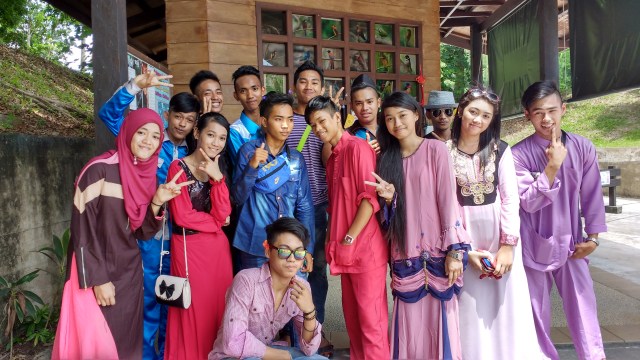
I took this photo of fourteen exuberant young people in eye-popping attire on July 7, 2016, two days after the end of Ramadan, at the entrance to Sepilok Rainforest Discovery Center near the town of Sandakan, which is in Sabah, one of two Malaysian states in Borneo, the third-largest island in the world. That is a lot of information for readers in the Western world, but it is important, in many ways, for me to establish the date and place. Malaysia is a multi-faith country with about 60 percent of its 32 million constituents practicing Islam. It is the first Muslim country I have visited.
We had come to Borneo to watch birds, many of them as exotic and eye-popping as this flock of kids, as well as primates and other mammals, and to be in forests with lizards, snakes, insects, orchids, fungi, the largest flower in the world, and some of the tallest trees on the planet. Borneo is a mega-diverse island, contains 20 percent of the world’s animal species. I will never forget the first Orang Utan I saw. We came back home dizzy with indelible experiences of the natural world and the rich and complex human culture.
A photo is a frozen moment in time, simple as that. But a photo also has context. Its moment stands in a continuum of present, past, future.
The photo’s present: While we were in Malaysia, details were emerging that then Prime Minister Najib Razak was busily looting and laundering money from a public investment fund he himself established to promote economic development. The sum was estimated to be $3.5 billion, millions of dollars of which he parked in the United States.
The photo’s most recent past: What is now called Malaysia became its own country in 1963 after centuries of domination by Portugal, the Dutch, and the British Empire. Global trade defines human history and human behavior. Malaysia is a federal constitutional monarchy with a government system based on Westminster parliamentary protocol. Malaysia has a robust economy—one of the best in Asia since its independence—and it strongly subsidizes free public education and free access to healthcare.
The photo’s recent future: Donald Trump was elected president in November 2016, four months after I took the picture. A week after his inauguration in January 2017, Trump announced his travel ban on seven predominantly Muslim counties. Malaysia was not among them. In September 2017, as the U.S. Justice Department was investigating Najib Razak, Trump welcomed the Prime Minister to the White House and thanked him for “all the investments you have made in the United States.” In May 2018, caught up in his scandal, Razak was roundly defeated in the general election by a 92-year-old former political leader Mahathir Mohamad. In September 2018, a year after Razak was Trump’s guest at the White House, he was arrested on corruption charges and is awaiting trial.
I keep the photo of the Malaysian kids on my desk. All their youthful beauty, energy, and goofiness make me smile. Yes, a moment in time. But the longer the photo sits on my desk, the more I dwell on what has happened in my country and on the global stage since that moment. I see my photo as a metaphor of the multiple intertwined universes we live in. There is my universe where my fellow travelers and I merely want to be good citizens with rewarding work, educational opportunities, access to decent health care, occasions to have fun and be silly, the comfort of kinship, family, and friends. Then there is another universe where power corrupts and where this corrupted power can take down democracies, rob public coffers, build walls, start wars, divide races, ignite genocide, turn up the heat on climate change, bring on global economic disruption. In short, blow my universe to hell and back.
When I saw the kids hanging out, waiting to get their tickets to enter the rainforest, I couldn’t take my eyes off them. I wanted to capture their radiance. I had just arrived in Borneo and did not know the customs for taking photos of people in a predominately Muslim culture. I took a chance, walked tentatively over, and asked if I could take a picture—English is the second language in Malaysia. It was as if they were just waiting for me to ask. They immediately choreographed themselves, striking poses, making hip hand gestures, laughing and smiling the whole time. Well, it was actually a short time, less than a minute. They went their way, and I went mine with my husband, off with our friends to watch more birds.
I will never see these kids again. I will never know where life takes them—or rather, where they take life. To a person, they are beautiful and lithe. The scourge of snacks and fast foods, so rampant in my country, has not taken hold among the people we encountered in Borneo. Their clothes and accessories are all over the global map—traditional Asia Islamic fashion, Westernized sunglasses, a shoulder bag, wristwatches, a fanny pack, headgear ranging from a hijab to a pork pie hat. The guy kneeling in the center has a flower tucked in his right ear. I have so many questions I wish I could have asked them. Maybe there is a future despot among them. But I am going to imagine, if only for my own peace of mind, that they will make their way in the universe of good citizenship, rewarding work, abundant learning, good health, fun and silliness, kinship, family, and friends.
 saaribampo
You must be logged in to post a comment.