Birding the Apocalypse: Coastal Plain of Sonora

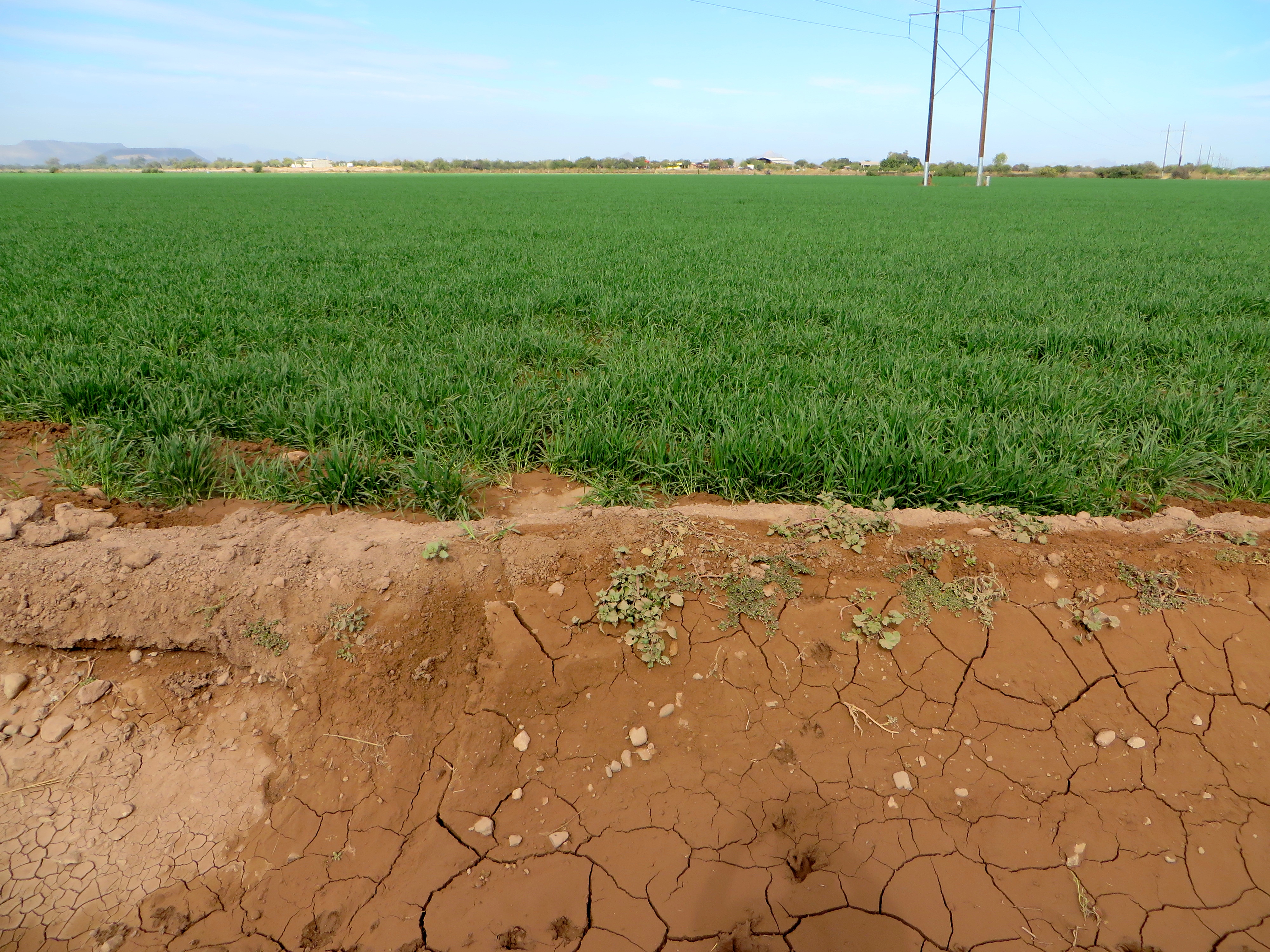
Winter wheat on the coastal plain of Sonora.

Winter wheat on the coastal plain of Sonora.

The smell of burning brush, skeins of smoke on the horizon, the sluicing sound of captive water.

We are birding the coastal plain of Sonora just west of the Agiabampo Estuary, a tidal body on the Sea of Cortez. It is December. We travel on grids of dirt roads amid plowed fields passing the occasional man on tractor or man on foot in white rubber boots who is manipulating the flow of water in the vast arterial system of concrete and earthen irrigation canals carrying water mined from the Rio Mayo. Most of the fields have not been planted. A few are starting to sprout their harlequin-green carpet of winter wheat. Almost all the winter wheat produced in Mexico is grown on the coastal plain of Sonora and Sinaloa under irrigation.

I call it the Iowazation of northwestern Mexico.

People have been reworking this landscape for millennia, but the relentless, leave no tree or cactus standing, dam and channel every river draining the Sierra Madre Occidental has been proceeding at ever massive scales since the plant geneticist Norman Borlaug, with the help of Mexican President Avila Camacho, the U.S. government, and the Rockefeller Foundation, brought the “Green Revolution” to Mexico in the 1940s. It’s green all right, weirdly green, one shade of green. Better to call it the Green Devolution.

Captive water.

Captive water.

Birders are accustomed to altered landscapes, often hellish, apocalyptic landscapes. Many of us suffer intermittently from a vague mental state my friends and I have labeled eco-despair. But wallowing in despair is a rat-hole, so we keep birding the Apocalypse. It is often beautiful in bizarre ways.

Crested Caracaras, dozens and dozens, perch on the furrows of the unplanted fields, on the banks of the canals, or in low shrubby trees. Others are flying about. They are regal-looking birds canonized on the Mexico coat of arms as an “eagle” grasping a snake. Caracaras are not quite so raptorial in real life. They are scavengers and opportunists, drawn to carrion along with vultures. In this case, the Caracaras are presumably eating grubs and other insects turned up by the tractors.

We are a group of five birders on one of the 2,300 or so Audubon Christmas Bird Counts held over a three-week period in the winter, mainly in the United States and Canada, with a scattering across Latin America. This tradition, sponsored by the National Audubon Society, has been going on since Christmas Day 1900.

The lodestar for the society – and the Christmas Bird Counts – is the 19th-century naturalist and artist John James Audubon. He was a man of prodigious talents and seemingly boundless energy who made his youthful passion for birds and nature a life-long pursuit and profession.

Here we are standing in Borlaug’s tamed landscape looking through our binoculars at birds, framing them in ways that mostly eliminate the Apocalypse. For me, it is something like being in my own fabricated museum looking at Audubon’s original watercolors for The Birds of America. Audubon and Borlaug, two titans in their realms: one captured wildness, the other obliterated it, two birds of vastly different feather.
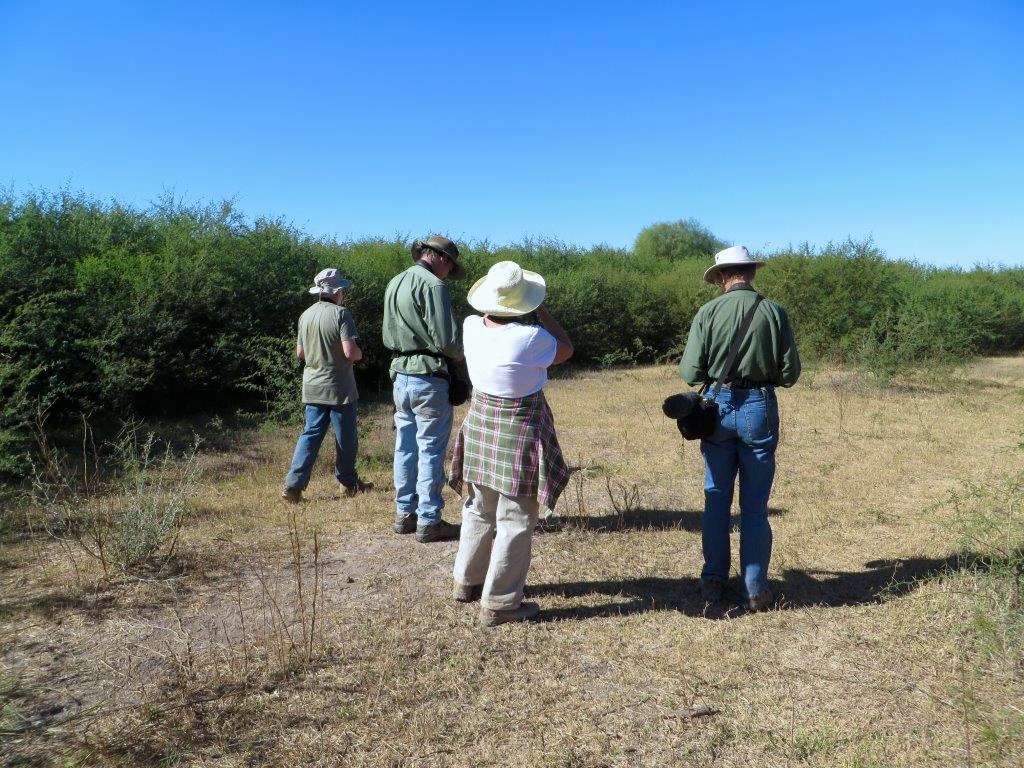
Birding a patch of brush that has escaped cultivation.

Birding a patch of brush that has escaped cultivation. (Photo by Lydia Lozano.)

We are on the Christmas Bird Count for the Navopatia Field Station, a small noble nonprofit working to save the last stands of pitaya cactus forest and the mangroves and mudflats in Agiabampo Estuary. I run with small, noble, and local.

The day unfolds. The five of us divide up. Christmas Counts often entail a little social engineering. I want my oldest best girl friend – one of the most skilled and knowledgeable birders walking the planet – to go with a younger birder to provide some mentorship. I sacrifice my friend to her, even though I would prefer to bird with my oldest best girl friend. I go with my spouse with whom I also love to bird. Our very dear friend and the partner of my oldest best girl friend – whose knowledge and athleticism as a birder ranks with hers – goes off on dirt roads in the vehicle to count birds alone.

The only area that would barely qualify as “natural” is an outcropping of low, rocky hills. But even around these little hills I see where the brush has been recently burned to clear a few more meters for winter wheat. And in the hills there are craters where dirt has been excavated to move somewhere else. The restless moving of aggregate is a defining characteristic of Homo sapiens. Later in the day, at the Agiabampo Estuary, we watch dredging boats pumping mud from the estuary floor through huge hoses that vomit the spoils on shore. It is a brutal scene. We have heard the government-sponsored project is supposed to “improve fishing.”

During the course of seven hours birding the hills, fields, weedy patches along roads, a couple of freshwater irrigation impoundments, a couple of villages, and the sandy shores of the Agiabampo Estuary we record 149 species. Not a bad list for the Apocalypse.

Most of these species are old friends of mine from years of random birding. I’m still surprised at what joy pertains to seeing a bird well no matter how many times I’ve seen it. Joy (of course) pertains to seeing new birds, and one species I am particularly thrilled to see is Bendire’s Thrasher. It is an uncommon and fairly reclusive bird of the deserts of the U.S. Southwest and adjacent Northwestern Mexico. I can remember seeing it only once and briefly a long, long time ago, I think on the outskirts of metro Phoenix.

I am partial to the thrasher family (of which the Mockingbird is a member). They have piercing eyes that give them a part-stern, part-quizzical look; they often pop out of nowhere, shifting quickly from shy to brash, if only momentarily (a behavioral trait I relate to); they are not gaudy, instead feathered in lovely muted colors of brown and gray (one species, the Blue Mockingbird, is a dark, glistening blue-black); and they are great songsters and mimics. Today’s Bendire’s Thrashers – we count five individuals – fill all my thrasher expectations and happiness. I am also relieved that they are easier to distinguish from Curve-billed Thrashers than the guidebooks warn.

And who, I need to remind myself, was Bendire? He was born Karl Emil Bender in Germany in 1836 (later changing his name to Charles Bendire). He immigrated to the United States as a young man where he enlisted in the U.S. Army. He fought in the Civil War and subsequently (like many Union soldiers) against the American Indians. During his wide travels across the continent as a military officer, he pursued a parallel passion for natural history, especially birds and birds’ eggs (his private collection became the core of the egg collection at the Smithsonian Institution). He discovered several new bird species, including the thrasher named for him. I try to picture a man fighting Indians and collecting fragile jewels of eggs from nests.
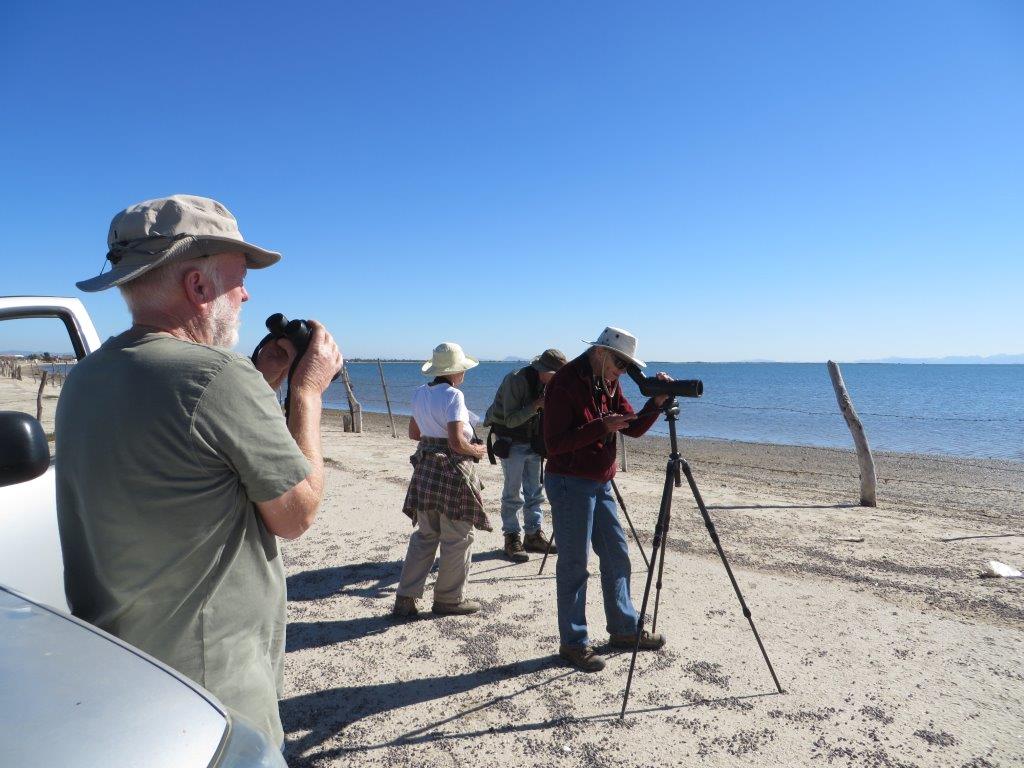
Birding the Agiabampo Estuary.

Birding the Agiabampo Estuary. (Photo by Lydia Lozano.)

The final species we record for our count day is an immature Bald Eagle. We had been watching a sudden, frenzied flight of ducks in the bay – usually a sign that a raptor is on the scene – when one of our most eagle-eyed observers (we are a team of various skill levels) sees the perpetrator circle and land on the beach. There is sudden, frenzied behavior on our part as we all try to get good looks at it. Bald Eagles typically eat fish, especially dead fish, but will hunt waterfowl, hence the alarm of the ducks. They are rare to uncommon in winter in Northwestern Mexico. Since the species’ population has recovered dramatically since DDT was banned in 1972, there are probably more Bald Eagles in Northwestern Mexico. However, there is a scarcity of birders in these parts to observe them. I cannot speak for what is in the heads of my cohorts. I am levitating from the Bald Eagle sighting while contemplating a cold beer and hot shower. We pack up the telescopes, wedge ourselves into our vehicle, and work our way homeward through the maze of winter wheat.

Postscript:
Small, local, noble: some great conservation groups working in Sonora:
Navopatia Field Station (www.navopatia.org), organizers of the coastal Audubon Christmas Count we were on.
Reserva Monte Mojino (www.montemojino.org), which owns and manages a large tract of Tropical Deciduous Forest near Alamos. It is part of a larger organization, Natural and Culture International (www.natureandculture.org), working in other parts of Latin America.
Northern Jaguar Project (www.northernjaguarproject.org), a leader in research and conservation efforts to better understand and protect northern populations of jaguar.
Cuenca Los Ojos (www.cuencalosojos), which is dedicated to protecting biodiversity along the U.S.-Mexico border.

Posted in Mexico | Comments Off on Birding the Apocalypse: Coastal Plain of Sonora

The World’s Oldest Cassowary

This piece originally appeared in Texas Parks & Wildlife Magazine in May 2008.
If Edgar B. Kincaid, Jr., were alive today, he would be 93 years old. 

Edgar B. Kincaid, Jr. was the quirky and beloved father of 20th-century birding in Texas. He and his colleagues – including a covey of young birders he took under his wing in the 1960s – elevated birdwatching from a pastime associated with pith-helmeted spinsters to an exacting exercise that revealed the exquisite beauty of nature and at the same time measured the status of Texas’ avian populations. For him, birdwatching was both science and high art, and the world around him a laboratory and museum.

Kincaid earned a bachelor’s degree in botany at the University of Texas but was a largely self-taught ornithologist and ecologist. He had an almost intuitive grasp of the dynamic between organisms and their environments and understood all too well how easy it is to tip that delicate balance.

He was a lonely prophet, forecasting the decline of many bird species well before academically trained ornithologists would amass the data to prove his point. Many of his predictions can be read in The Bird Life of Texas, published in 1974 by the University of Texas Press. The treatise, originally written by Henry Church Oberholser in the early 20th century, was edited over a 14-year period by Kincaid and various helpers, of whom I was one. Because he foresaw a world with ever more people and fewer birds, he was not what you would call a happy person. A tall, stooped man whose craggy features made him appear much older than his years, Kincaid seemed to bear the burden of the biologically compromised planet on his shoulders.

Gloom notwithstanding, Kincaid possessed a zany wit and a madcap sense of adventure, which explains why so many young disciple-birders swarmed to him. He was the antithesis of normal. While he became increasingly reluctant to travel in later years, in the 1950s, ’60s and ’70s, he roamed the byways of Texas and Mexico, chronicling birds in their habitats, and to be in his entourage on these outings was a gift beyond measure. It is no exaggeration to divulge that two trips I made with Edgar and associates – one to the Chiricahua Mountains in southeastern Arizona in July 1969; the other to Rancho del Cielo in Tamaulipas, Mexico, in July 1970 – put my callow and rather humdrum life on a different and far richer course.

Kincaid was born on December 30, 1921, in Physicians and Surgeons Hospital in San Antonio, his mother and father, Lucile and Edgar, Sr., having come in from the ranch near Sabinal in anticipation of his birth. He grew up on the ranch, but spent many weekends in San Antonio with his paternal grandparents, James Madison and Ethel Fenley Kincaid. He also regularly visited his maternal grandparents, Richard Alexander and Ray Park McKee, in Velasco on the Texas Gulf Coast. Edgar was an only child, and perhaps because he spent so much of his youth in the company of adults, many of whom were advanced in age, he always displayed a wonderful kindness and respect for elders.

It was a fertile environment for a bright, curious boy. Edgar had literally thousands of acres to roam on what was essentially his own private preserve, and he was surrounded by loving parents, grandparents, aunts, uncles and cousins. Besides love there was culture. The Kincaids and McKees put a high premium on the life of the mind – on education, discourse, literature, music and travel.

As a young woman fresh out of Southwestern University in Georgetown, Edgar’s mother-to-be, Lucile, came to teach school in Sabinal, where she would meet and marry Edgar Sr. All three McKee sisters graduated from Southwestern at a time (the early 1900s) when few people, especially women, contemplated a college degree. Lucile’s older sister, Bertha, in describing college many years later captured the family’s matter-of-fact attitude toward education: “[My parents] decided that I would graduate from Southwestern – I was the oldest, I would be the first in line to go. I would graduate with honors, and I grew up knowing I would.”

Not surprisingly, there was among Edgar’s extended family a great reverence for books. Bertha attributed a lack of feminine social skills as a freshman in college to her passion for reading. “I cared for nothing but books all my life,” she said. “I couldn’t talk anything but books and I learned that wasn’t what you did.”

Edgar, too, grew up with book lust. The next best thing to a bird was a bird book. He once wrote: “How does one distinguish a truly civilized nation from an aggregation of barbarians? That is easy. A civilized country produces much good bird literature.”

According to a story he told often, a book would seal Edgar’s bird-besotted fate. On one of those weekend visits to San Antonio, when he was about six years old, he was with his mother, shopping in Joske’s. On a display table in the book department, Edgar spied a book with a singing eastern meadowlark on the cover. Meadowlarks were already one of his favorite ranch birds, and the vivid yellow of its breast was and would remain his favorite color. “I threw such a tantrum there in Joske’s,” he was fond of recounting, “that in order to calm me down, Lucile bought me the book.” It was the Burgess Bird Book for Children, the first in a collection that grew to more than 1,000 volumes, now housed at Texas A&M University.

As idyllic as his life seems from afar, it was punctuated with tragedy. Young Edgar and his parents were in a harrowing accident in which their car was struck by a truck hauling pipe. He almost died. (In ghoulish moments, he would pull back his snow-white hair to show friends the tidy scar ringing his scalp where the top of his head had been opened like the lid of a tin can). A liability lawsuit ensued, during which Edgar had to take the stand and at which point he developed a lifelong antipathy toward lawyers. Then, when he was 14, out of the blue, his beloved mother died unexpectedly of heart failure at age 42.

It is possible that her loss explains two unswerving attributes of Edgar’s. He was a confirmed bachelor – no woman could ever live up to his mother – yet he adored women and held them in far higher esteem than men. He was a feminist long before the term came into parlance. He surrounded himself, albeit at a bachelor’s arm’s length, with women of all ages. He was kind, courteous (what genteel manners he had!), generous and supportive of countless women, and, in turn, they nurtured him as best they could, given his reclusive bachelor habits. Through his respect and friendship, he empowered a number of young women, including me, to make our ways in what was, even in the 1960s and ’70s, a man’s world.

Case in point: Kathleen Collins, now a teacher in Austin, was hanging wallpaper in the 1970s. In a card dated May 18, 1979, she wrote: “Casso [a name for Edgar that will be explained momentarily], I worked for a new builder this week, who, unlike yourself, was very skeptical of the capability of females. He was nervous as a cat, and hesitant about my doing the job. But I finished Friday and he told me I did a fine job and would I work for him next time! Yea for me and females everywhere!”

After Lucile’s death, the closest and dearest woman to Edgar was Aunt Bertha, his mother’s elder sister and the wife and amanuensis of the scholar, folklorist and raconteur J. Frank Dobie. Since they had no children of their own, Edgar became their de facto son. He lived with them in their comfortable, two-story, white-frame, book-stuffed bungalow at 702 East 26th Street on the edge of the University of Texas campus. J. Frank and Bertha would both die at home – he on September 9, 1964, at age 75; she on December 18, 1974, at age 84. Edgar lived barely another 10 years, dying at the untimely age of 63 on August 9, 1985.

Kincaid’s most tangible ornithological legacy lies in the two volumes of The Bird Life of Texas. Each range map for the book’s 545 species represents a massive behind-the-scenes effort on the part of Edgar and his birding minions who fanned across the state to, in his words, “bird the underbirded counties.” Since birdwatchers have always tended to concentrate their efforts looking for specialties and rarities (like the golden-cheeked warbler in the Hill Country or the whooping crane near Aransas) or for conspicuous beauties (like the majestic coastal wading birds), most of Texas’ 254 counties were underbirded, until Edgar et al. came along.

Always careful to give credit where credit was due, Kincaid explained the fact-finding mission in the introduction: “The senior editor [Kincaid] and his associates – chiefly Ruth Black, Bertha McKee Dobie, Carolyn Sue Coker, V. L. Emanuel, Frances Gillotti, Anne LeSassier, G.F. Oatman Jr., J.L. Rowlett, Rose Ann Rowlett and Dan Scurlock – drove, alone or in parties, some 400,000 miles in the 243 underbirded counties, gathering records to fill in the blank spaces on the maps.” Even today, these range maps are the best “snapshots” of the breeding, wintering and migratory patterns of Texas birds.

The other stroke of Kincaidian brilliance in the BLOT (as those of us who worked on the book so lovingly called it) was the inclusion of a “Changes” section for those species that, as he wrote, “have historically or recently undergone major changes in status or distribution – usually this means a decline.” The “Changes” sections display Kincaid’s flare for writing, the sum of his years of observation, and his passion for his subject, and taken together they represent a clarion call to conserve habitat in order to conserve birds.

Edgar’s other gifts are less tangible. His pebble in the pond continues to ripple outward. Those who were most touched by him have scattered across the country, variously involved in ecotourism, conservation, teaching, resource management, environmental policy and politics, landscape and bird photography, bird art, environmental writing and publishing, and (perhaps most importantly) relishing the pleasure birds bring to daily life. They, in turn, are touching others.

For many of us, his crowning gift was the bestowing of a bird name. It all began in December 1960 on a rollicking trip to Mexico – the party included the young Frank Oatman, John Rowlett and sister Rose Ann Rowlett, on their first trip to Mexico, with Edgar and two lovely, avid birding adult women, Elizabeth Henze and Maggie Schwartz, in the role of chaperones. On the trip, a rambling conversation ensued with regard to the particular “bird” traits that various friends and associates manifested – some, I am told, not always positive, since Homo sapiens can be a cruel species. By the trip’s end, bird names had been assigned to each member of the group and a tradition was born.

Edgar was self-christened the Cassowary, a large, flightless bird of Australia and New Guinea known for its bellicose behavior (yet another example of Edgar’s perpetual efforts to conceal his very gentle nature). His name later evolved to either the World’s Oldest Cassowary or simply Casso.

The tradition was well-established when I arrived on the scene in the early 1970s, so I cannot begin to plumb the nuances of its evolution. I am just glad to be part of it. There are no hard and fast rules to the process, although until his death, we always petitioned for Edgar’s approval of a bird assignation. I suspect there are a few hundred people with bird names still living across the planet. I know the tradition spread to California birders. I do not know if it remains a habit among birders in Texas. As for me, I am a greedy person with multiple personalities. For the historical record, I am the Brown Pelican, the Dipper and the Yellow-eyed Junco, and to prove I’m never satisfied, I always wanted to be the Yellow-breasted Chat.

Posted in West Saari Road | Comments Off on The World’s Oldest Cassowary

The Mexican Street Dog

IMG_0908 I am thinking about the Westminster Dog Show. It is coming up in February. In 2015, two new breeds will be on the roster – a little fru-fru dog from Madagascar called the coton de tulear and a lean, muscular Hungarian hunting dog, the wire-haired vizsla. Just as an aside, I have no particular problem with fru-fru breeds, but judging from the photos of the vizsla, it’s the one I could put my arms around.

For my own entertainment, I am going to imagine that some day the Westminster Dog Show will add the Mexican street dog to its canine line-up. OK, it is not a breed per se. The gene pool has not been manipulated to the extent that all Mexican street dogs look the same – indeed hardly one looks like another – but they have been selected over a long, long time to have certain characteristics that constitute a standard. And that is, by the Westminster Dog Show’s own criteria, what a breed is. To quote: “Each breed’s parent club creates a STANDARD, a written description of the ideal specimen of that breed…[g]enerally relating form to function…”

The form of the Mexican street dog, although wildly variable, always relates to function: survival in a precarious world. I guess that is what some people call a mongrel but what I call a super-breed. The Mexican street dog carries not a pool but an ocean of genes, swirling currents mixing morphological characteristics of terrier, labrador, spaniel, poodle, German shepherd, pit bull, boxer, cattle dog, doberman, dachshund, basenji, beagle, huskie, ridgeback, and, yes, vizsla. I have not yet seen signs of coton de tulear. To show you how broadly a standard can be defined, one of the spokespersons for the newly inducted coton de tulear said, “They’re just very adaptable, and they like everybody.” The same could be said about the Mexican street dog.

So here is my Standard: The Mexican Street Dog is a variably built, tiny to large dog possessing a sound conformation if given vaccinations, appropriate neutering, enough to eat, and periodic heartworm, tick, and flea medicine, allowing it to function as a dog who will be loyal, amusing, and a wonderful family companion. Physical features and mental characteristics should denote a dog bred to perform a variety of tasks, as trained by its owner, with perhaps an occasional lapse of stealing food off any surface left unattended. This is a survival mark of the super-breed. The distinguishing characteristics of the Mexican Street Dog are its desire to find a place or home with regular food and companionship, perhaps some work herding cattle, sheep, or children, and a place to nap in the sun. They are invariably intelligent, of good temperament, and know how to run in front of a truck or cross a street or busy highway without being killed. Above all, a Mexican Street Dog must be able to make its way in a precarious world. I guess, having written this description, I am now the founder of the Mexican Street Dog Club.

A street dog on the Alameda in Alamos.

A street dog on the Alameda in Alamos.

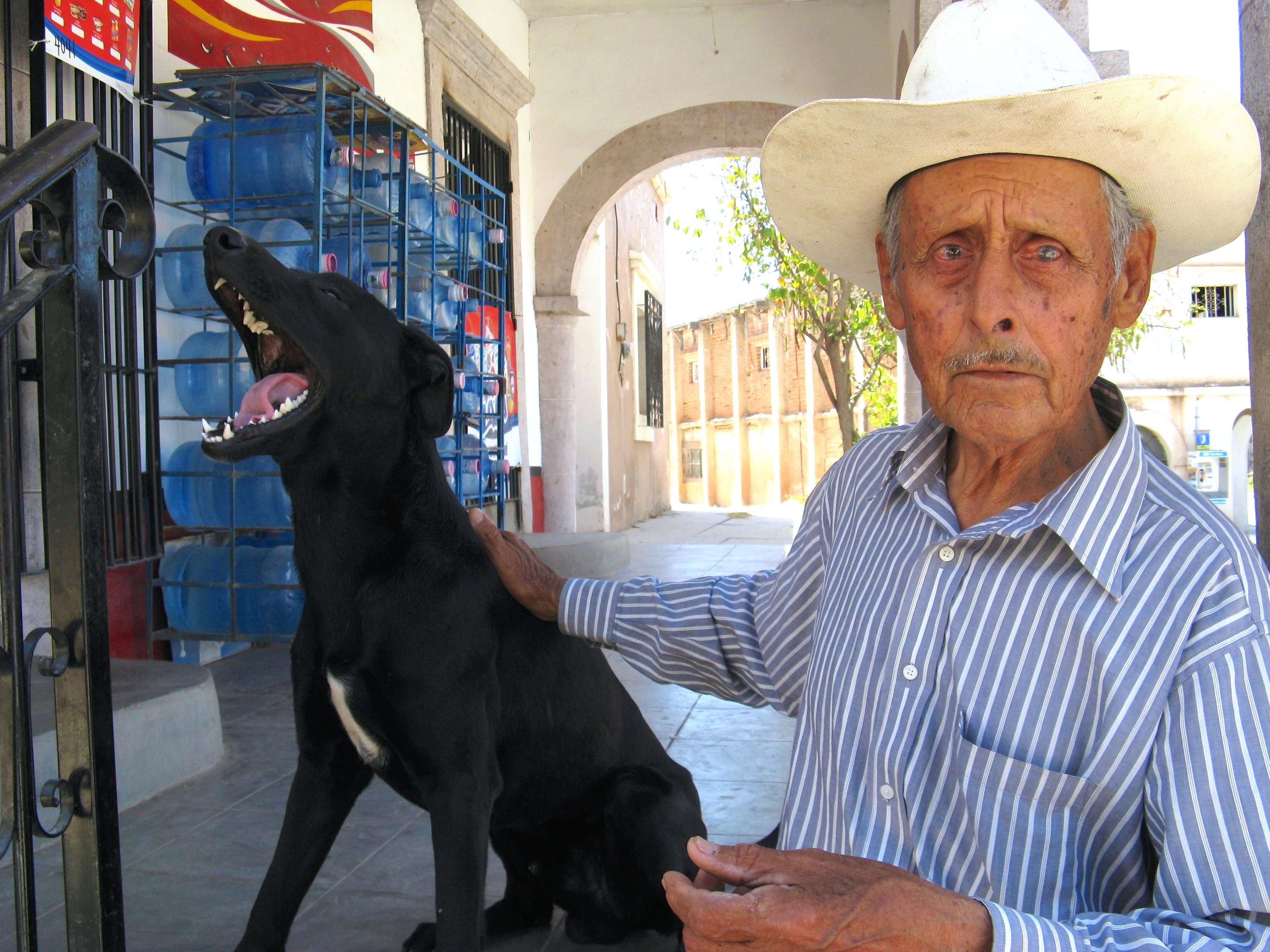
Diablo is the de factor seeing-eye dog for Rosario Morales, a virtually blind man who lives in Barrio Esmeralda.  We are old friends with both of them. Diablo and Rosario pass by our house almost everyday. By every measure -- his rotten teeth, wasting body, rheumy eyes -- Diablo is a dead dog. But he has some inner life force. So far, every year when we return to Alamos, Diablo and Rosario are here. Some day, one or both of them will be gone.

April 26, 2010. Diablo is the de factor seeing-eye dog for Rosario Morales, a virtually blind man who lives in Barrio Esmeralda.
We are old friends with both of them. Diablo and Rosario pass by our house almost everyday. By every measure — his rotten teeth, wasting body, rheumy eyes — Diablo is a dead dog. But he has some inner life force. So far, every year when we return to Alamos, Diablo and Rosario are here. Some day, one then both will be gone.

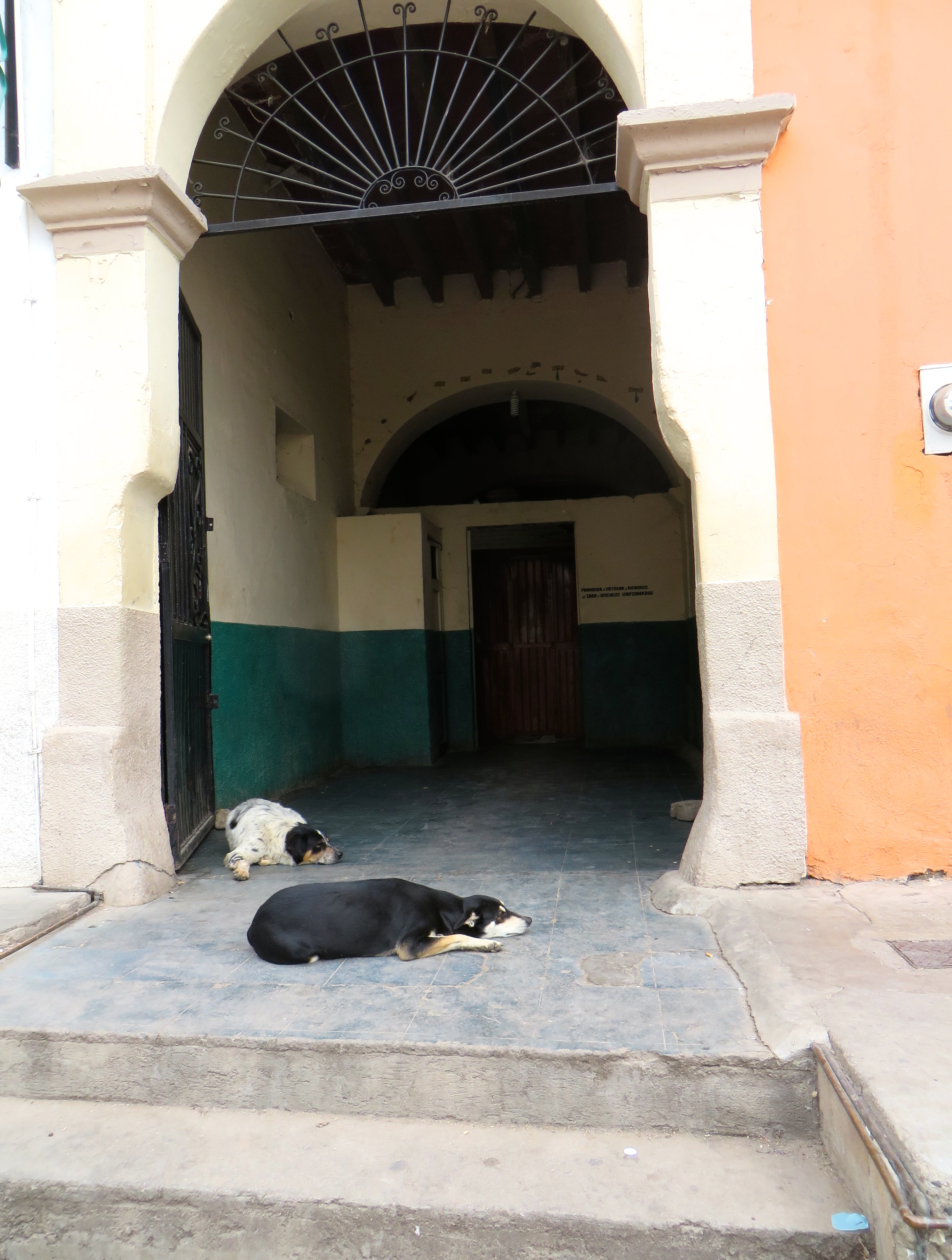
Two dogs sleeping at the entrance to Casino Señorial, the men's only cantina on the Alameda in Alamos

Two dogs sleeping at the entrance to Casino Señorial, the men’s only cantina on the Alameda in Alamos.

December 25, 2014. Sitting on our stoop, David, Diablo, Perra (Rosario's seeing-eye-dog-in training), and Rosario.

December 25, 2014. Sitting on our stoop, David, Diablo, Perra (the younger seeing-eye-dog-in-training), and Rosario.

Posted in Mexico | Comments Off on The Mexican Street Dog

There are times when I miss him

There are times when I miss him. Like now, as I write this, when I was doing
something else entirely different in a different country
and fifty years later I suddenly miss him.
I never know when I will miss him but I do.
I don’t need to tell you his name. He was tall and older and ruddy and red-haired and knew things I will never know, back from Vietnam. He came around in my life
when I was young. Then we drifted into other realms.
We kept in touch haphazardly.
This is not about romance. It is about the stellar time of friendship.
He pursued justice and married twice, two children.
He died at an age too early and I am now the elder.

Posted in The Occasional Poem | Comments Off on There are times when I miss him

Sweeping

The broom is the axis of Earth without which the planet would dissolve into dust. The women come out in the morning and prop their old bones on their brooms. They sweep away yesterday, make way for today, and tomorrow the planet will spin. May the women come out every morning and keep the world spinning.

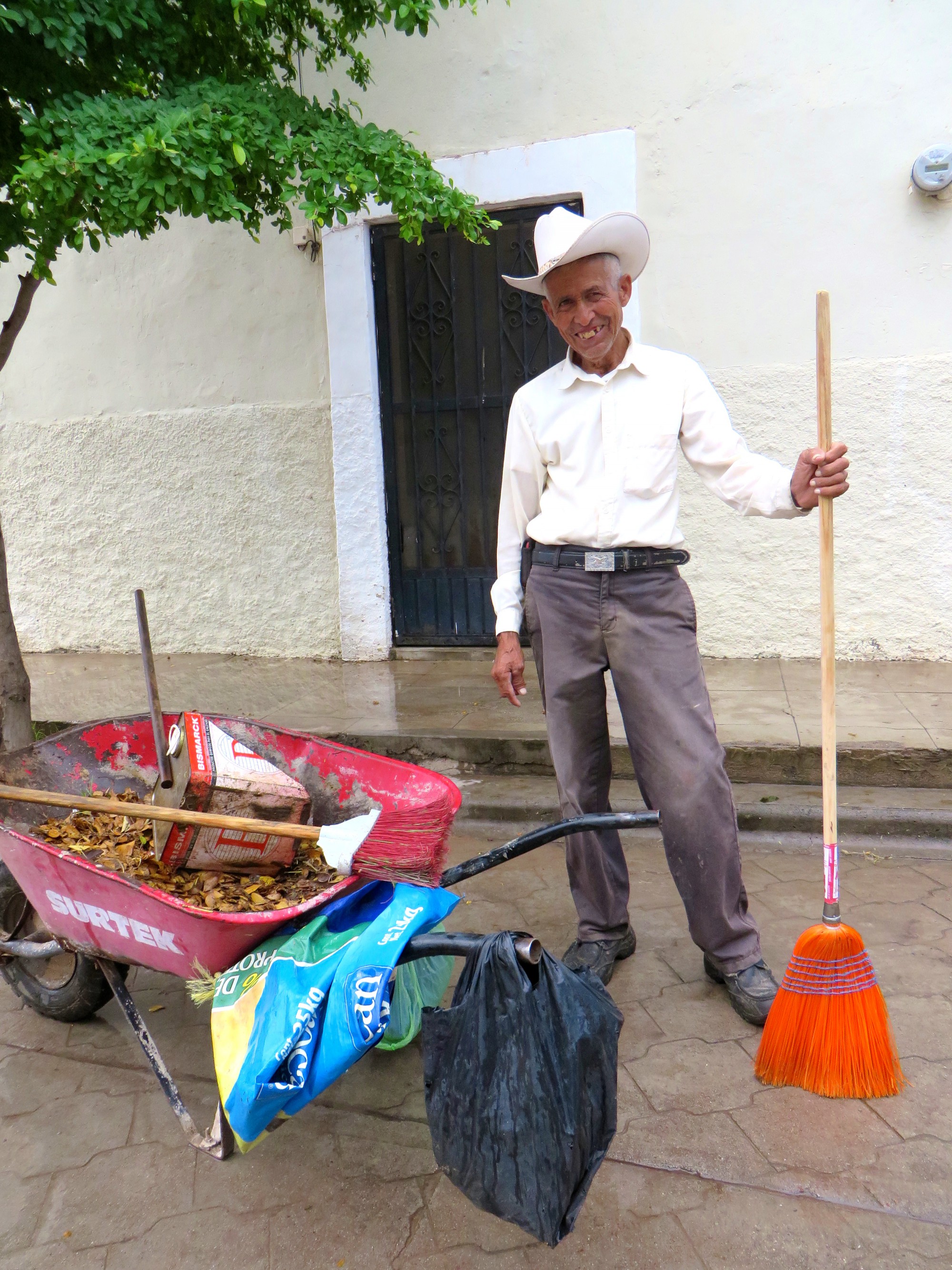
Everyday but Sunday, Francisco Valenzuela Zavala, a wisp of a man crooked with age, sweeps up and deposits in his wheelbarrow the dust and silt on several blocks of Calle Hidalgo, the street where we live in Alamos.

Francisco Valenzuela Zavala

Francisco Valenzuela Zavala

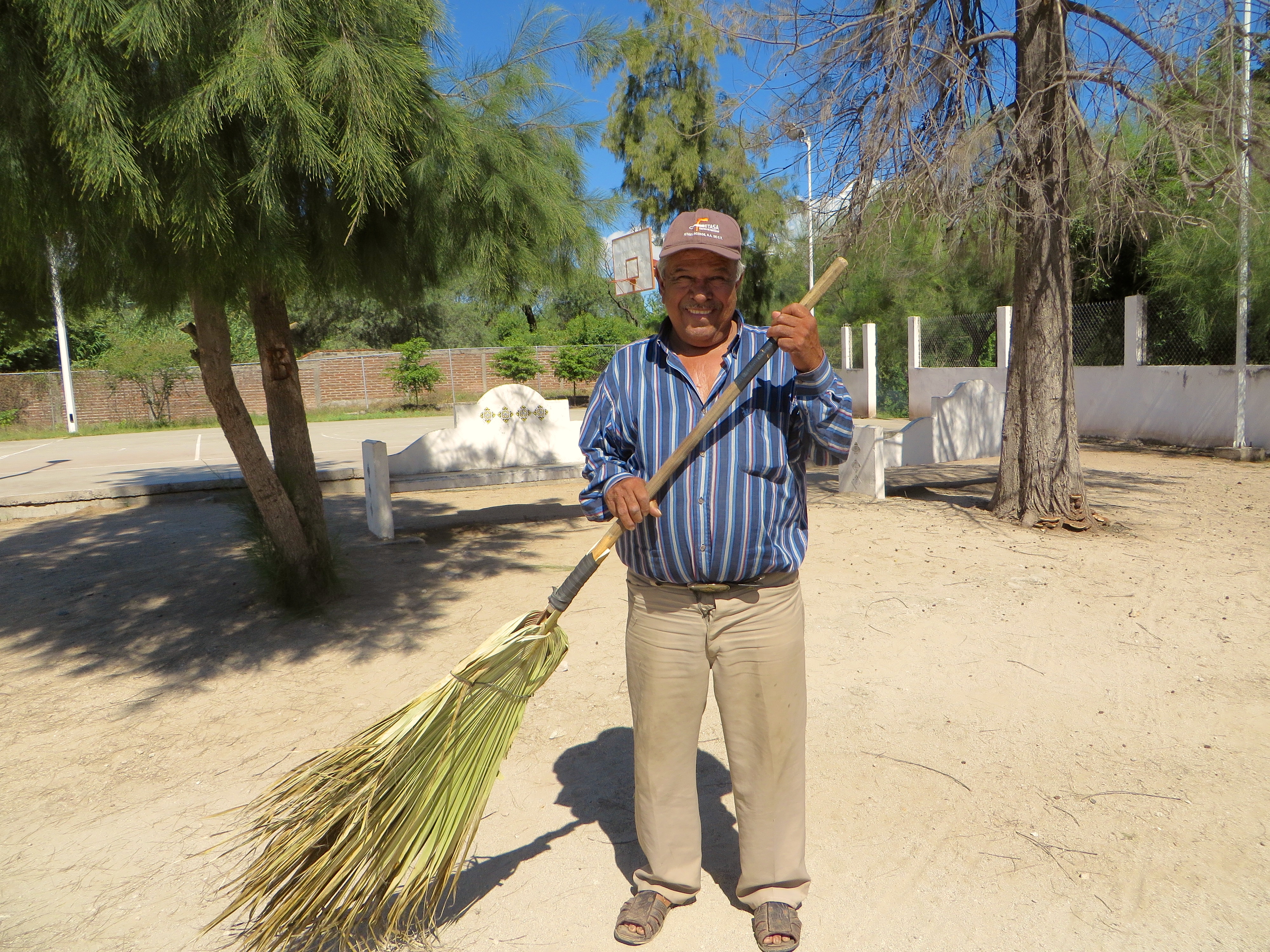
In the park up the street, Candelario Gastélum, a younger, rumpled, rounder gentleman, sweeps the basketball courts as well as the surrounding grounds. In Mexico people commonly sweep the dirt. In so doing they make lovely ephemeral patterns in the soil. For this task, Candelario uses a palm-frond broom of his own design. He makes a new one every few months.

Candelario Gastélum

Candelario Gastélum

Francisco and Candelario are public workers, hired by the city to sweep the streets and public spaces of Alamos. Householders and housekeepers — men and women — are just as religious about tidying their own domains. Hardly a morning goes by that I don’t see Doña Sara, our 90-year-old neighbor a few doors to the east, out sweeping her stoop and sidewalk. Don Chato, the caretaker of a house a few doors to the west, bikes to work and starts his day sweeping his stretch of sidewalk. These are just the people I know. There are many others in our neighborhood and all across Alamos who emerge every morning from their houses to sweep.

Doña Sara

Doña Sara

One thing in the lives of my neighbors is certain: the dust and silt — Sisyphus’ boulder decomposed — will creep in on the breezes and the tires of cars and trucks and be waiting for them and their brooms the next morning. But Sisyphus was being punished. My neighbors aren’t. Sweeping verges on daily devotion. It is certainly the daily norm.

I have never liked to sweep. It makes me nervous and irritable. When I am sweeping I am convinced I have a million – or at least one or two – other things I should be doing. Now, everyday, people around me are sweeping. And they are cheerful. I have daily brief encounters with my sweeping neighbors. If I’m walking, we exchange greetings (which involves shouting to Francisco Valenzuela and Doña Sara, who are deaf). Sometimes I am on my bike, so we wave. I wonder, in passing, how many tons of debris the people of Calle Hidalgo have swept up over the ages. My neighbors have made me think about the broom and if I could at this late date change my attitude about using one. The broom is such a simple tool. It has hardly changed in design in two centuries (as explained on the Web site “How Things Are Made,” http://www.madehow.com/Volume-6/Broom.html#ixzz3H0SqGE3y).

Simple things can be complicated. Any item that can be mass-produced to meet demand in millions of households can become in a global economy the subject of heated debate. In 1994, the broom — that is, the classic broom made of broomcom, a species of sorghum cultivated specifically for use in broom making — became the subject of a fierce dispute between Mexico and the United States when the North American Free Trade Agreement lifted import tariffs on cheaper brooms manufactured in Mexico. American makers of brooms argued for keeping stricter tariffs but lost the argument. This ruling pretty much obliterated the broom-making industry in the United States (http://www.sice.oas.org/dispute/nafta/english/us97801a.asp#).

I recently bought a new broom at Ferre-Carpintero, the hardware store down the street from us. It was manufactured in Guadalajara. It cost 48 pesos ($3.54 in U.S. dollars).

Brooms and mops in the window at Ferre-Carpintero, my neighborhood hardware store

Brooms and mops in the window at Ferre-Carpintero, my neighborhood hardware store

On the morning of October 24, 2014, I began my rehabilitation with regard to sweeping. I emerged from my house at about 7 a.m. with my broom to sweep my stoop. What could I like about this, I asked myself? The light is golden at this time of day. That’s the first good thing. Children in their uniforms, some accompanied by parents, were walking to the elementary school a block from us. Mexican parrotlets, in their tight formations were flying around making their gossipy chatter. Great-tailed grackles were on the utility poles posturing and crackling (grackles are capable of an amazing array of sounds). I could keep a list of birds heard and seen while sweeping, I thought.

The particulate matter of Mexico, at least in Alamos, is unbelievably fine and gossamery. Sweeping requires a strategic approach and style. Even in the subtlest breeze, you must sweep from upwind. Otherwise the dirt and silt blow back on you. I have a tendency to sweep furiously, with fast and broad swipes, part of my defiant outlook about the task. Not good. This approach, I noted, creates countless tornadic dust devils that fly up and then float down ever so elegantly precisely where I just swept. I modified my strokes. I made them shorter with more of a pushing as opposed to swinging motion — more like putting on the green versus driving off the tee. I was calming down and enjoying being a part of the waking-up day in Alamos.

When I had been sweeping for about 20 minutes, Ángel Esquer Chávez walked by and stopped to visit. He is the distinguished 80-year-old gardener who comes twice a week to tend the trees and plants for our next-door neighbors. As we were talking, he reached out and took the broom from me. Very matter-of-factly. He proceeded to finish my job. Was this chivalry, a lesson in technique, or both, or some other intention altogether, or should I try not to fix a meaning on it? I watched him at work. He was calm, his broom strokes were short and concise, he was not perturbed that some dust and silt were left inevitably behind. He is a master sweeper. I am his grateful student.

Ángel Esquer Chávez

Ángel Esquer Chávez

More brooms.

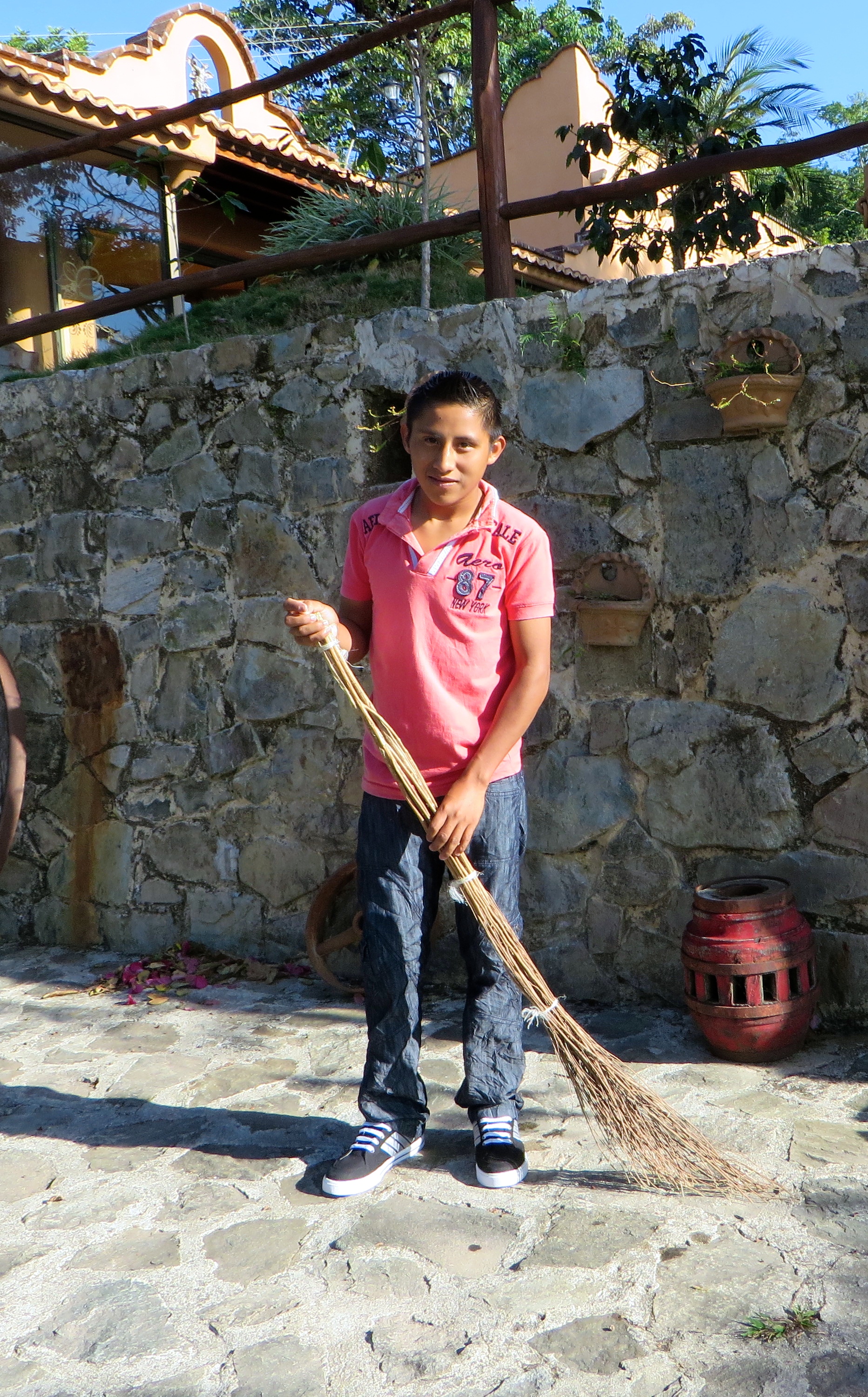
Ezekiel, sweeping with homemade broom at Finca Don Gabriel, Pluma Hidalgo, Oaxaca.

Ezekiel, sweeping with homemade broom at Finca Don Gabriel, Pluma Hidalgo, Oaxaca.

Two homemade brooms on a bench, Rancho Acosta, Alamos, Sonora.

Two homemade brooms on a bench, Rancho Acosta, Alamos, Sonora.

Posted in Mexico | Comments Off on Sweeping